

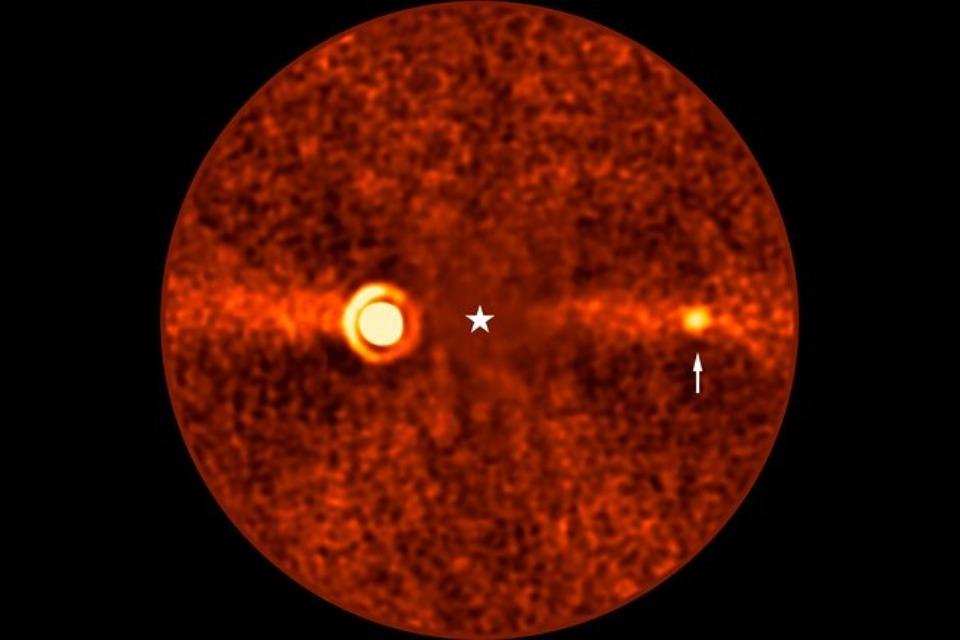
This image, taken with ESO’s Very Large Telescope (VLT) shows Beta Pictoris d, a new planet found orbiting the star Beta Pictoris. The star is at the centre of the frame, and was subtracted when processing the data, revealing the environment around it. The new planet, indicated with an arrow, is the third one found around this star. The other two are Beta Pictoris b –– the bright source to the left, and Beta Pictoris c, orbiting much closer to the star and not seen here.
The image was taken with the ERIS instrument at the VLT. Based on its infrared brightness and colour, the new planet appears to be a gas giant, about 2.4 times more massive than Jupiter.
The diffuse horizontal band in this image is a debris disc around the star, seen here edge-on, the leftover material of planetary formation.
Researchers from the Department of Physics at the University of Oxford took part in the discovery of a third planet orbiting the star Beta Pictoris, a planet that had been hiding in astronomical archive data for more than ten years. The new planet, Beta Pictoris d, is 100 times fainter than Beta Pictoris b, the first planet found in the same system, and is among the lightest exoplanets ever imaged from earth. After spotting the planet, the team found it had been hiding in archive observations spanning more than a decade. The discovery is published today in The Astrophysical Journal Letters.
Beta Pictoris d is a gas giant, like the two other planets already known in the system, but is roughly 2.4 times the mass of Jupiter, making it far lighter than its two known neighbours, which are each around ten times Jupiter's mass. It also orbits much further out. Because it is so cold, and therefore faint, taking a direct image of it represents a significant technical achievement.
The observations that led to the find were taken using the European Southern Observatory's (ESO) Very Large Telescope (VLT) in Chile. Professor Jayne Birkby from the Department of Physics was the science lead on the observing programme in which the new planet was discovered. Dr Ben Sutlieff, an astronomer at the University of Edinburgh and Professor Birkby's former PhD student, and Luke Parker, a final-year Oxford DPhil student, travelled to Chile in December to carry out the observations.
The team had originally set out to study the already-known planet in the system, Beta Pictoris b, to look for storms moving across its surface. Leyla Iskandarli, a pre-doctoral student working with the Breakthrough Listen project at Oxford, was using the data to bring her machine learning skills to bear on the observations. Building on Parker's initial analysis, Iskandarli added together all of the images taken during the run and noticed an extra, fuzzy blob some distance from Beta Pictoris b. Nobody was sure at first whether it was something real in the system, a background galaxy, or an artefact of the instrument itself.
Markus Bonse, an ESO fellow who was studying the same dataset as part of his own work using machine learning to improve the science return of the ERIS instrument, spotted the same signal independently. Professor Birkby recalls how he asked the team: 'Hey, there's something else in there, did you see it?' That question set off a rapid search through the ESO archives to see whether the object had been hiding in old observations all along. It had. The team found the planet, now named Beta Pictoris d, in images going back as far as 11 years, including one taken in 2014 in which it had been almost entirely lost in the glare of the much brighter Beta Pictoris b, just a few pixels away.
An independent team in the United States discovered the same planet using the James Webb Space Telescope (JWST), a facility of the US, European and Canadian space agencies. Their results are also published today in The Astrophysical Journal Letters.
‘Planet d, it seems, has been playing a game of hide-and-seek with us for over a decade and only now can we say “found you!”’ said Professor Birkby.
Leyla Iskandarli, who worked on the early data reductions that first gave the team confidence the signal was real, said: ‘For more than a decade, Beta Pic d kept slipping behind its star or hiding in the light of its much brighter neighbour, and we discovered it completely by chance. The ERIS data were originally taken for a pilot study, to test whether we could measure the variability of Beta Pic b, and we were surprised to find a persistent blob in our early reductions that, for weeks, we mistook for a background object. It's been thrilling to help add a new member to one of the most iconic planetary systems we know, and being part of that, this early in my career, has been incredible.’
The discovery also helps solve a long-standing puzzle about the shape of the disc of dusty debris that surrounds the star. Tim Pearce, of the University of Warwick, who worked on the implications of the find for the wider planetary system, had previously shown that the two known planets in the system could not account for the shape of the disc's inner edge on their own. Professor Birkby explained: ‘Tim worked out what mass and orbital distance planet d would need to have to shape the disc, and planet d sits right in the middle of that parameter space. It really ties together the whole system.’
Luke Parker commented, ‘It has been incredibly exciting to observe the data used to discover a new planet in this iconic planetary system. This work has highlighted the power of serendipitous discovery in astronomy, and demonstrates how new instruments can reveal unexpected discoveries, even in incredibly well studied systems.’
Read the paper in The Astrophysical Journal Letters | ESO press release