

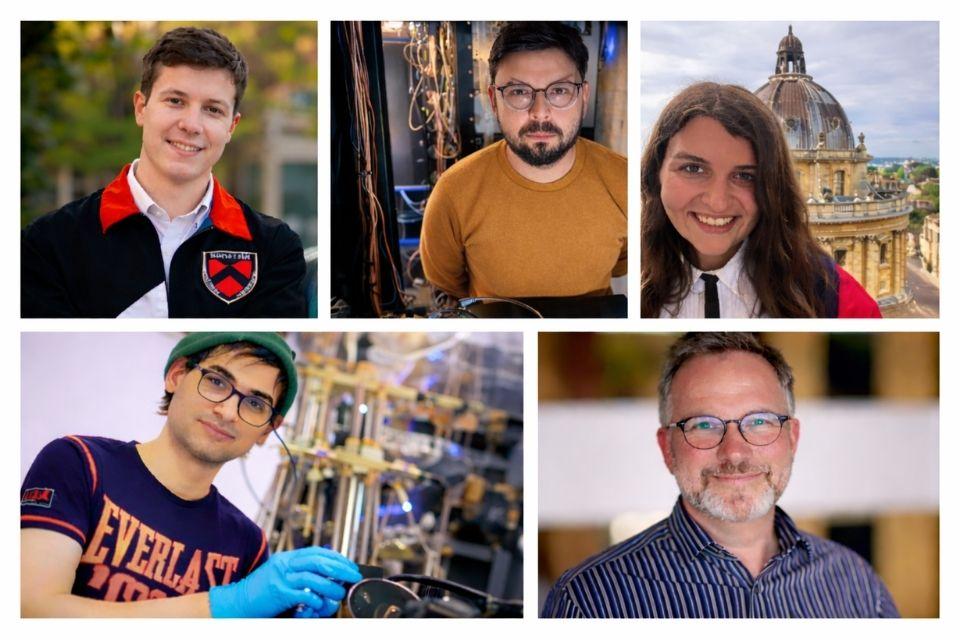
Clockwise from top left: Cosmin Andrei, Dr Gabriel Araneda Machuca, Oana Bazavan, Dr Keith Norman and Dr Mustafa Bakr
Quantum research is often presented through results: a new device, a record number of qubits, a promising application, a high-fidelity logic operation. But behind each of these milestones are people, with different backgrounds, motivations, and ways of working. Having celebrated the International Year of Quantum last year, here we speak to people across the Department of Physics to find out how they found their way into quantum, what their days look like now, and how they see the field changing. The result is not a single story, but a shared landscape of curiosity, uncertainty, and collaboration.
Why quantum?
There is no single way to arrive in quantum. For Dr Gabriel Araneda, Senior Postdoctoral Researcher, the pull came unexpectedly. Walking home one evening, he stopped beneath a flickering streetlamp: ‘The pattern was not random. It reminded me of the photon arrivals I had once seen plotted on a detector,’ he recalls. What caught his attention was not just the light itself, but the act of recognising structure in something ordinary. In that moment, quantum felt present everywhere – ‘woven into every flicker, every ripple.’
For Cosmin Andrei, DPhil student in Atomic and Laser Physics, the entry point was unease rather than wonder. As an undergraduate, he was struck by ‘the stark contrast between the evolution dictated by the Schrödinger equation and the collapse of the wavefunction postulate’ – the difference between how a quantum system evolves according to its equations and what happens when a measurement is performed, when we ‘open the box’. ‘I was determined to understand what was going on,’ he recalls, and why the problem has remained active ‘100 years from the inception of quantum mechanics.’
Some paths curve back later. Dr Keith Norman, Co-Director for Engagement at the QCi3 Hub, trained in high-energy physics before spending 25 years in industry. Returning to academia, he found it ‘quite a surprise to discover… a whole world of quantum information science’ that had emerged since his PhD. Concepts learned decades earlier had ‘come back to life in a completely different application.’
Others are drawn to quantum by a desire to work at its foundations. Dr Mustafa Bakr, Quantum Technology Fellow in Physics, describes being ‘deeply curious about understanding things from first principles,’ particularly in regimes where ‘the boundaries between classical and quantum are more subtle than textbooks suggest.’ Working with superconducting circuits allows him to explore those questions where theory and experiment meet.
Not every story involves a moment of certainty. Dr Oana Bazavan, Visiting Researcher in Atomic and Laser Physics, describes a quieter path: wanting to do research and experiments in a field ‘where the maths is well established, but so hard to imagine.’ Rather than being deterred by that gap between formalism and intuition, she found it motivating. Quantum became ‘an amazing way to go about understanding more,’ with experiments serving not just as tests of theory, but as a way of thinking – by building, measuring, and learning what the system reveals.
A day in the life
With very different roles, daily life in quantum is rarely uniform however weeks are largely shaped by teaching, supervision, desk-based analysis and time in the lab. For Dr Araneda, a typical week is ‘full of variety and a constant flow of ideas,’ moving between students, seminars, reading new papers to keep up with a rapidly changing field, and hands-on experimental work.
Across career stages, ideas often emerge through conversation rather than isolation. ‘New ideas often arise in discussions with colleagues,’ he continues, whether around a whiteboard or over coffee. Cosmin Andrei similarly describes balancing research with tutorials, college responsibilities, and external projects, a constant negotiation between different roles.
Experiments themselves demand patience. Systems ‘rarely behave the way we expect,’ reflects Dr Araneda , and progress can mean weeks of puzzling signals and careful checks. That unpredictability is part of the work. ‘I once spent hours chasing what I thought was a subtle quantum effect,’ he recalls, ‘only to discover it was caused by a loose cable.’ In the lab, they joke that the most mysterious quantum phenomenon of all is human error.
Then, now and what’s next
With the International Year of Quantum marking a century since the foundations of the field were laid, it is timely to reflect on how long quantum mechanics has been evolving and how some of its deepest questions persist.
Dr Araneda imagines doing his role 100 years ago, when quantum mechanics was just being born. Experiments would have relied on rudimentary electrical and optical tools, while international discussions took place through handwritten letters sent by post, often arriving weeks or months later. Even ten years ago, he notes, many ideas now actively pursued were still considered speculative.
It is not only the science that has changed, but the ecosystem around it. Keith Norman reflects that roles focused on engagement between academia, industry, government and the public didn’t really exist until a few years ago, emerging alongside the growing societal relevance of quantum technologies.
On the technical side, the acceleration is striking. Dr Bakr notes that ‘ten years ago, a 100-qubit processor was a laboratory concept.’ Today, such systems exist through large, coordinated efforts spanning institutions and countries. As experiments grow in scale and complexity, progress increasingly depends on collaboration. Reflecting on major milestones, Dr Bakr emphasises that ‘breakthroughs come from collaboration, not isolation,’ with the best ideas emerging from ‘late-night conversations with people whose expertise complemented rather than duplicated my own.’
Looking back over the past century of quantum mechanics, Cosmin Andrei notes that some of the field’s deepest questions have persisted alongside enormous technical progress. Early quantum research, he points out, was often accompanied by open philosophical debate about what the theory meant, long before experiments could test those ideas directly.
In the decades that followed, the focus shifted toward calculation and application, creating a divide between ‘useful’ quantum physics and its conceptual implications. Only recently, Cosmin observes, have foundational questions regained momentum, supported by new interpretations and experimental tools capable of probing them quantitatively.
Looking further ahead, he hopes that advances in quantum technologies will enable a genuinely quantitative understanding of the quantum-to-classical transition, reconnecting modern experiments with questions that once belonged largely to philosophy.