

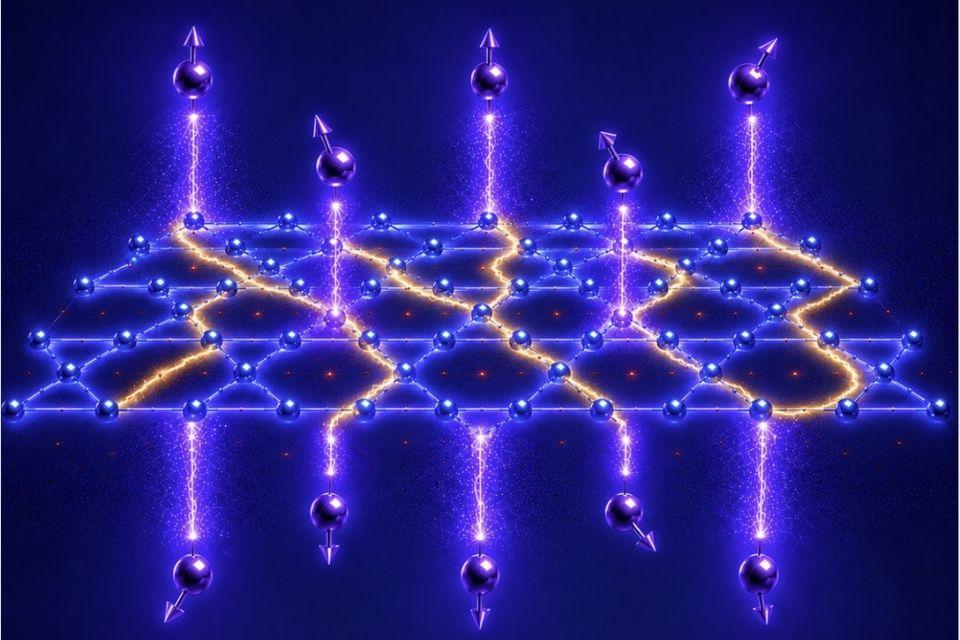
Witness spins above and below the quantum spin liquid interact by propagation of spinons within it.
Physicists at Oxford have developed a new approach in the search for a 'quantum spin liquid', a long-sought state of quantum matter resembling a magnetic liquid whose quantum properties mean it never freezes. The breakthrough is a key step in the search for 'quantum silicon': a mineral that could be used to create quantum computers, just as silicon is used in traditional computers.
Lead author Professor Séamus Davis explains: ‘By introducing the quantum witness technique, we provide a completely new perspective on the physics of quantum spin liquids and access their internal quantum excitations or “spinons” directly for the first time".
As liquids cool they freeze into solids as their atoms cease to move. But some liquids, such as helium, never freeze: predominant quantum effects mean they flow as superfluids even at absolute zero (the coldest possible temperature). The magnetism of each individual atom is called its 'spin'. In a quantum spin liquid the overall magnetic field of these spins maintains liquid-like properties, never freezing into a fixed configuration. It achieves this extraordinary state by using universal quantum entanglement.
Dr Felix Flicker from the University of Bristol, who led the theoretical work on the paper, continues: ‘Usually when we think of quantum entanglement we are picturing a carefully prepared experiment on two or three particles. But in a quantum spin liquid every spin becomes entangled with every other. This happens naturally: you can find these crystals laying on the ground!’
The team was investigating a mineral called Herbertsmithite, named after British mineralogist George Frederick Herbert Smith. First synthesised in 2004, Herbertsmithite is the leading candidate to host a quantum spin liquid. However, earlier attempts to prove that Herbertsmithite forms a quantum spin liquid were hampered by the presence of magnetic impurity atoms in the mineral. Previous studies attempted to subtract off the impurity spin effects but at low temperatures the impurity spins completely dominate the signal.
The breakthrough in the current work was to reconceptualise the impurity spins as qubits (quantum bits, the basis of quantum computers) and then to measure their dynamics, treating them as 'witnesses' to the quantum spin liquid.
Dr Flicker offered the following analogy: ‘Imagine your friend calls to you underwater in a swimming pool. You can hear them because vibrations pass through the water. Now stand the same distance apart under the sea. You will hear your friend's call earlier, since seawater is denser and so sound travels faster within it. Hence you can deduce properties of the water by “witnessing” your friend. The witnesses in Herbertsmithite call to one another through the quantum spin liquid.’
The analogy to sound goes further. To measure the witness spins, the experimental team deployed a new experimental technique called 'spin witness spectroscopy'. It uses a 'superconducting quantum interference device', or SQUID, to make some of the most sensitive detections of magnetic flux ever performed. The SQUID is sensitive to the same range of frequencies of magnetic fluctuations as the human ear is to sound.
The experimentalists, Hiroto Takahashi from the University of Oxford and now of Princeton University, and Jack Murphy from University College Cork, used their device to measure fluctuations in the ultra-small magnetic field generated spontaneously by crystals of Herbertsmithite. The field they detected is around a billion times smaller than the magnetic field at the Earth's surface. The magnetic signal resembled random noise. But there are many types of noise. White noise is the most familiar. But 'pink noise', which is deeper, resembles the mix of sounds in music and many natural processes. A detailed statistical analysis of the magnetic noise showed it to be a precise form of pink noise. This allowed the theory team including Professor Stephen Blundell from the University of Oxford to identify the interactions between witnesses. They found that these interactions were mediated by new emergent particles called 'spinons'. Spinons only exist within certain states of quantum matter, most importantly in quantum spin liquids.
Spinons are of major current interest to physicists. The quantum entanglement that stops quantum spin liquids from freezing might be utilised to make practical quantum computers. The entanglement can be understood in terms of the spinons. Along with another particle called a 'vison', they have the property that passing one around the other changes the nature of both. This is the basis of 'topological quantum computation', one of the leading proposals for scalable error-corrected quantum computers.
While the particles in Herbertsmithite are not quite of the form required for quantum computation (they are 'abelian anyons', rather than 'non-abelian anyons'), the current study gives some of the best evidence yet for their existence in natural minerals. Just as the natural growth of silicon was harnessed for the microchip, the natural growth of quantum matter could one day lead to practical quantum computers. More importantly, spin witness spectroscopy offers a route to controlling the spinons. On the basis of the current work, other groups are now building new devices to control the witnesses, exchanging quantum information with the Herbertsmithite crystals.
Spinon mediation of witness spin dynamics in herbertsmithite, H Takahashi et al, Nature Physics, 10 June 2026