

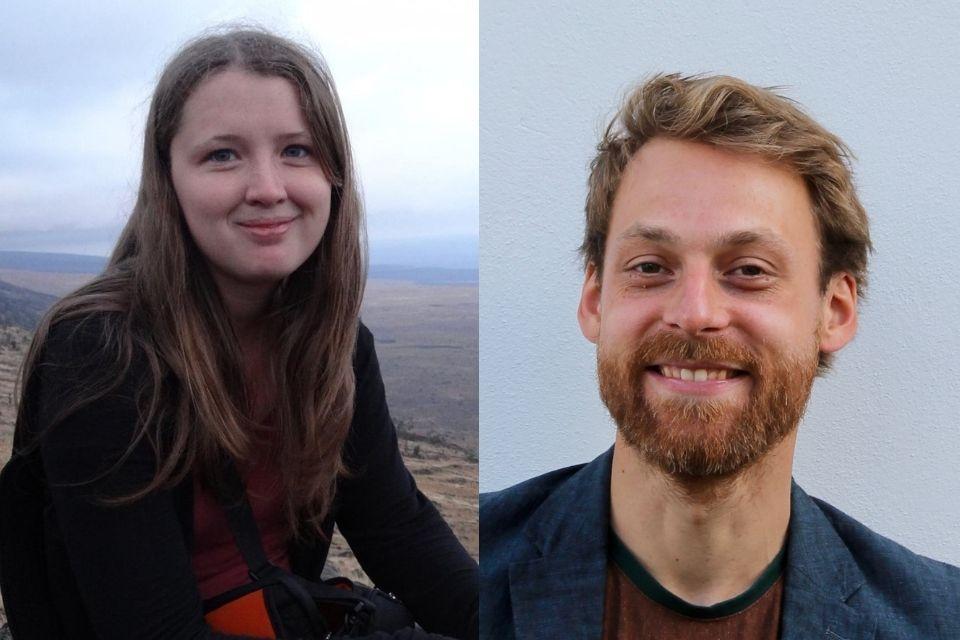
Dr Isabelle Taylor, left, and Dr Milan Klöwer, right, have both been recognised with a Divisional award for 'outstanding research supervision'
Two research supervisors from the Department of Physics have been recognised in this year’s MPLS Awards for Outstanding Research Supervision. Dr Milan Klöwer and Dr Isabelle Taylor, both from the Atmospheric and Oceanic and Planetary Physics sub-department, have received the divisional award that celebrates leadership and best practice in nurturing and supporting research colleagues. Recipients demonstrate exceptional commitment to mentoring and have shown outstanding dedication to inspiring others and creating an environment where people can thrive and advance in their careers. In total, ten supervisors from across MPLS division were recognised with an award.
Dr Klöwer is a Natural Environment Research Council (NERC) Independent Research Fellow working on integrating machine learning into climate modelling. He creates a supervisory environment in which students are encouraged to stretch beyond their perceived limits while feeling fully supported in doing so. Nominators emphasise how he actively builds both technical expertise and intellectual confidence. One student recalls arriving “nervous about [their] coding ability,” yet being encouraged to pursue an ambitious machine learning project; Dr Klöwer not only provided expert guidance but “excelled at building [their] research intuition,” even dedicating hours to in-depth discussion and creating tailored teaching materials. As a result, the student now feels “confident that [they] will be able to learn anything.”
His approach fosters a collaborative and psychologically safe research culture. Group meetings are described as spaces where students are “encouraged to share [their] work in progress and missteps rather than only ‘perfect’ results,” with Dr Klöwer modelling openness by sharing his own challenges. This ethos is reinforced through a co-created group handbook and proactive inclusion work. One nominator described how during the pre-admissions season, Milan “took over 20 calls with prospective students to improve equality of access,” after explicitly stating on his website that candidates – particularly women who may feel less “entitled” to contact senior academics – should feel encouraged to reach out. He then dedicated 20-30 minutes to each conversation, personally encouraging applicants who met the requirements to apply, demonstrating, what the nominator describes as, “a great example of the positive role that academics can play in making academia more accessible.”
Dr Klöwer consistently goes beyond the expectations of supervision, investing time, networking, and personal effort in his students’ development. He encourages early conference participation, secures funding opportunities, and facilitates high-level introductions, sometimes “taking a personal reputational risk” to advance his students’ confidence and visibility. His attentiveness is equally notable: he is described, by one nominator, as “great at ‘reading the room’ and offering the right encouragement at the right time,” whether that means helping to ease pressure during stressful moments or pushing students to “think bigger and push further” when they are ready.
Dr Taylor is a postdoctoral researcher in the Earth Observation Data Group and her research involves the development of tools for studying volcanic clouds of ash and gas with satellite data, and using these to learn about volcanic clouds, their hazards and the potential impacts on the environment and climate.
Dr Taylor is recognised for outstanding research supervision through her exceptional commitment to developing students’ skills, fostering an inclusive culture, and going well beyond the expectations of her role. Central to her impact is a “unified training programme for MPhys students,” in which she delivers “a series of introductory lectures… including introductions to AOPP computing systems, LaTeX, Unix systems.” This structured yet inclusive approach ensures that opportunities are extended “to all students in the group, not just her students,” demonstrating a deep commitment to equitable development. Her supervision is characterised by sustained, thoughtful support. Nominators highlight how she “devotes a significant amount of time to helping MPhys students applying for PhD programmes with practice interviews” and provides “insightful feedback” on presentations and applications. Importantly, she creates opportunities for peer learning, “encouraging other postdocs, students, and researchers to attend these practice presentations,” building confidence and collaboration across the group.
Dr Taylor also cultivates a highly positive and welcoming research environment. She is described as “approachable, encouraging, and supportive,” and “often present in the office,” making time to speak with students informally several times a week. Her efforts to include everyone – from daily coffees to group activities – ensure that “everyone is invited… not just the students she is directly supervising.” What distinguishes Dr Taylor most is her dedication beyond formal supervision. From interview Q&A sessions to intensive one-to-one preparation, such as a three-hour practice session that helped a student succeed, she consistently invests in her students’ futures. Her supervision “combines support with challenge,” enabling students to become independent, confident researchers.
‘I am absolutely delighted to see colleagues from our sub-department recognised in these awards,’ comments Professor Myles Allen, Head of Atmospheric, Oceanic and Planetary Physics. ‘We actively work to cultivate a positive and enriching culture where everybody can reach their potential and Isabelle and Milan exemplify this brilliantly – congratulations to them both. I would also like to add a shout-out to our Director of Graduate Studies, Don Grainger, as well as Graduate Studies Assistant Andrea Simpson, for putting the culture and systems in place to allow individual supervisors to shine. Well done everyone!’