


Quantum Measurements at High-Energy Colliders
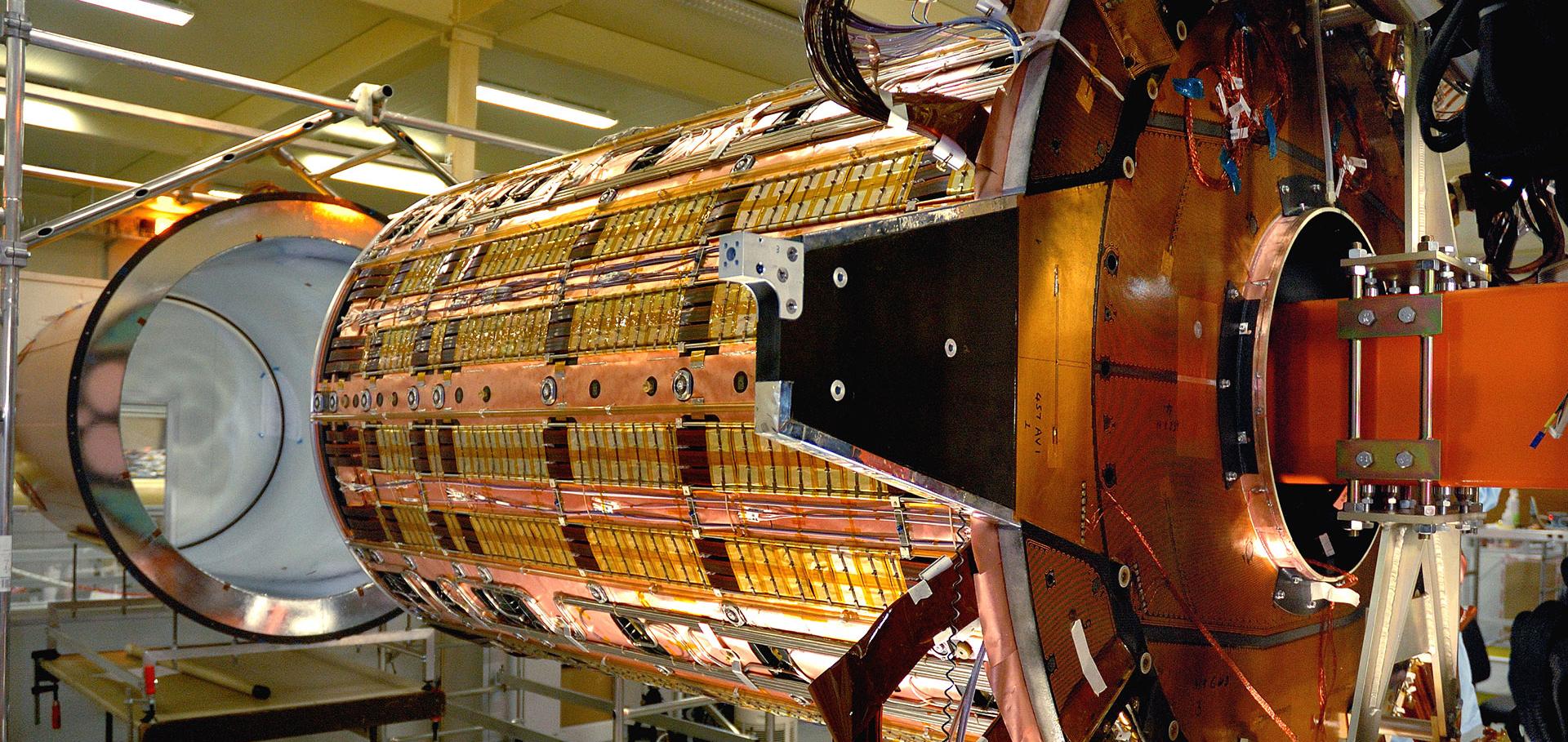
Colliders are capable of addressing quantum phenomena under extreme conditions of very high energies and at smallest possible scales. Particle collisions and decays are considered as a quantum system and the interest lies in tracing how information flows by analysing these processes.
Studying the spatial distributions using the ATLAS particle detector as an instrument to reconstruct the spin density matrix of parent particles, which entails correlations between particle spins in spatial coordinates (x, y, z).
This research lies at a newly emergent intersection of particle physics and quantum information theory, offering insights into subtle questions about entanglement and has the potential to deliver a deeper understanding of the quantum-to-classical transition when treating particle decay as a process equivalent to making a measurement.
Prior to joining the graduate programme in Oxford, Malek worked as a research scholar at Max Planck Institute for Nuclear Physics. Earlier, he graduated from Heidelberg University with a master's degree and from Leibniz University Hannover with a bachelor's degree and spent a semester abroad at Sapienza University of Rome. Malek is keen to make physics more accessible by an engagement with the Quantum Academy, a summer school that is designed to inspire the next generation of school students to pursue scientific paths.
------------------------
Observation of quantum entanglement has been firstly made in top–antitop quark events by the ATLAS team in 2023: