Home
Department Of Physics text logo
  • Research
    • Our research
    • Our research groups
    • Our research in action
    • Research funding support
    • Summer internships for undergraduates
  • Study
    • Undergraduates
    • Postgraduates
  • Engage
    • For young people
    • For teachers
    • For the public
    • For alumni
    • For business
  • Support
Menu
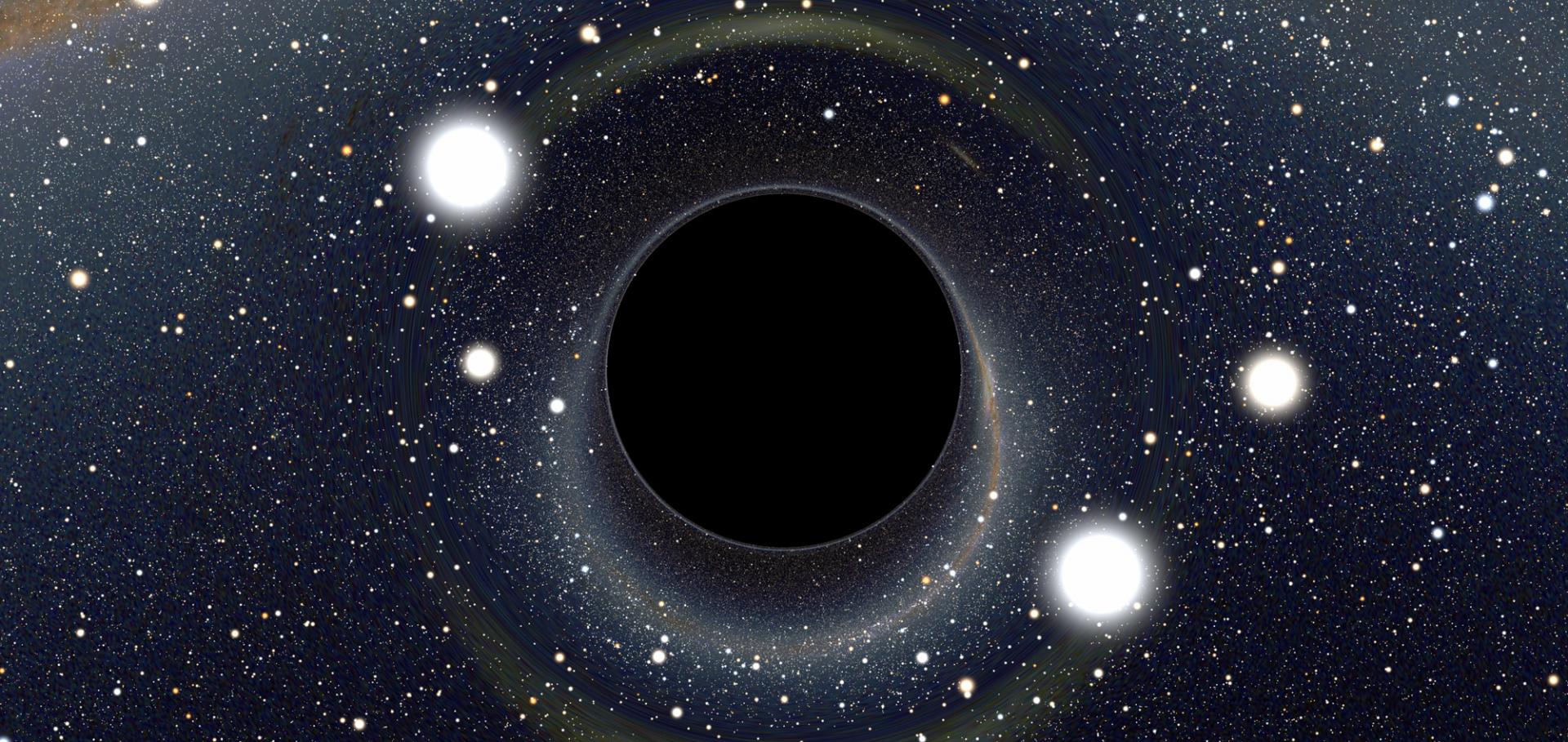
Black Hole

Lensing of space time around a black hole. At Oxford we study black holes observationally and theoretically on all size and time scales - it is some of our core work.

Credit: ALAIN RIAZUELO, IAP/UPMC/CNRS. CLICK HERE TO VIEW MORE IMAGES.

Prof Steven Balbus FRS, FInstP

Emeritus Savilian Professor

Research theme

  • Astronomy and astrophysics

Sub department

  • Astrophysics

Research groups

  • Pulsars, transients and relativistic astrophysics
  • Theoretical astrophysics and plasma physics at RPC
steven.balbus@physics.ox.ac.uk
  • About
  • Publications

Dynamical, biological and anthropic consequences of equal lunar and solar angular radii

Proceedings of the Royal Society A The Royal Society 470:2168 (2014) 20140263
More details from the publisher
Details from ArXiV

An accretion disc instability induced by a temperature sensitive alpha parameter (vol 441, pg 681, 2014)

MONTHLY NOTICES OF THE ROYAL ASTRONOMICAL SOCIETY 464:4 (2014) 4544-4544

Authors:

William J Potter, Steven A Balbus
More details from the publisher
More details

An accretion disc instability induced by a temperature sensitive α parameter

Monthly Notices of the Royal Astronomical Society 441:1 (2014) 681-689

Authors:

WJ Potter, SA Balbus

Abstract:

In the standard thin-disc formalism, the dimensionless α parameter is usually assumed to be constant. However, there are good theoretical reasons for believing, as well as evidence from simulations, that α is dependent on intrinsic disc properties. In this paper, we analyse the conditions for the stability of a thin accretion disc in which α is a function of the magnetic Prandtl number, the ratio of collisional viscosity to resistivity. In the inner disc, where the free electron opacity and radiation viscosity dominate, the disc is unstable if α is proportional to the magnetic Prandtl number with an exponent >0.5. This is within the range of values for the power-law index found in magnetohydrodynamic simulations with simple energetics. We calculate the evolution of the unstable disc within the α-formalism and show that the physically accessible solutions form a limit cycle, analogous to the behaviour seen in recurrent dwarf novae. It is noteworthy that the time-dependent global behaviour of the instability results in cyclic heating of the inner section of the disc, when parameters appropriate for an X-ray binary system are used. We calculate a model spectrum of the disc in the flaring and quiescent states and show that the behaviour is compatible with X-ray observations of the thermal accretion disc in flaring X-ray binary systems. © 2014 The Authors Published by Oxford University Press on behalf of the Royal Astronomical Society.
More details from the publisher
More details

Axisymmetric and non-axisymmetric magnetostrophic MRI modes

Physics of The Earth and Planetary Interiors Elsevier 223 (2013) 21-31

Authors:

Ludovic Petitdemange, Emmanuel Dormy, Steven Balbus
More details from the publisher

Angular momentum transport in astrophysics and in the lab

Physics Today AIP Publishing 66:8 (2013) 27-33

Authors:

Hantao Ji, Steven Balbus
More details from the publisher

Pagination

  • First page First
  • Previous page Prev
  • …
  • Page 4
  • Page 5
  • Page 6
  • Page 7
  • Current page 8
  • Page 9
  • Page 10
  • Page 11
  • Page 12
  • …
  • Next page Next
  • Last page Last

Footer Menu

  • Contact us
  • Giving to the Dept of Physics
  • Work with us
  • Media

User account menu

  • Log in

Follow us

FIND US

Clarendon Laboratory,

Parks Road,

Oxford,

OX1 3PU

CONTACT US

Tel: +44(0)1865272200

University of Oxfrod logo Department Of Physics text logo
IOP Juno Champion logo Athena Swan Silver Award logo

© University of Oxford - Department of Physics

Cookies | Privacy policy | Accessibility statement

Built by: Versantus

  • Home
  • Research
  • Study
  • Engage
  • Our people
  • News & Comment
  • Events
  • Our facilities & services
  • About us
  • Giving to Physics
  • Current students
  • Staff intranet