Home
Department Of Physics text logo
  • Research
    • Our research
    • Our research groups
    • Our research in action
    • Research funding support
    • Summer internships for undergraduates
  • Study
    • Undergraduates
    • Postgraduates
  • Engage
    • For young people
    • For teachers
    • For the public
    • For alumni
    • For business
  • Support
Menu
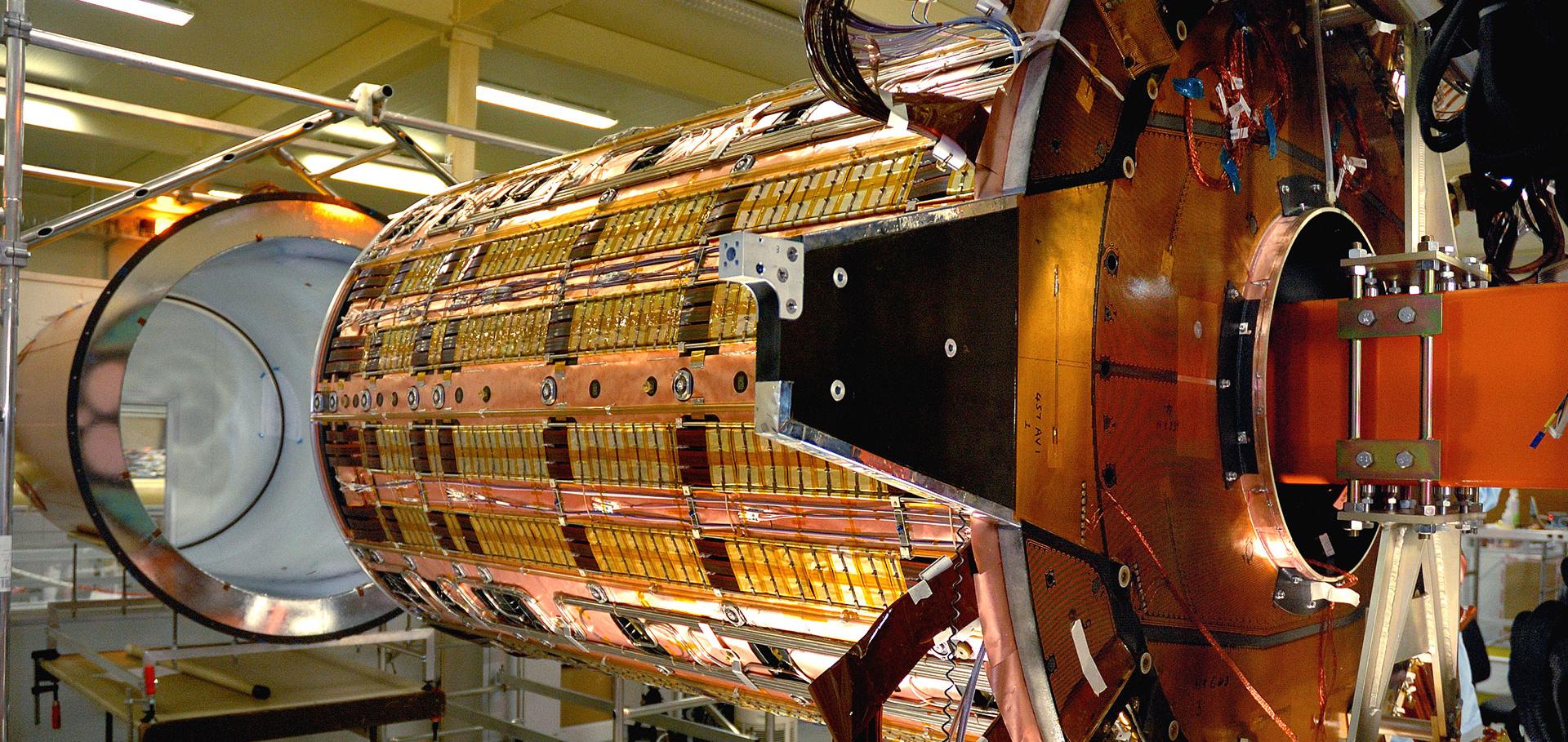
Insertion of STC into TRT at the Department of Physics, Oxford
Credit: CERN

Giles Barr

Professor of Physics

Sub department

  • Particle Physics

Research groups

  • Accelerator Neutrinos
Giles.Barr@physics.ox.ac.uk
Telephone: 01865 (2)73446
Denys Wilkinson Building, room 664a
  • About
  • Publications

A measurement of the KS lifetime

Physics Letters, Section B: Nuclear, Elementary Particle and High-Energy Physics 537:1-2 (2002) 28-40

Authors:

A Lai, D Marras, JR Batley, A Bevan, RS Dosanjh, TJ Gershon, B Hay, GE Kalmus, C Lazzeroni, DJ Munday, MD Needham, E Olaiya, MA Parker, TO White, SA Wotton, G Barr, G Bocquet, A Ceccucci, T Cuhadar-Dönszelmann, D Cundy, G D'Agostini, N Doble, V Falaleev, W Funk, L Gatignon, A Gonidec, B Gorini, G Govi, P Grafström, W Kubischta, A Lacourt, M Lenti, S Luitz, JP Matheys, I Mikulec, A Norton, S Palestini, B Panzer-Steindel, D Schinzel, G Tatishvili, H Taureg, M Velasco, O Vossnack, H Wahl, C Cheshkov, A Gaponenko, P Hristov, V Kekelidze, D Madigojine, N Molokanova, Y Potrebenikov, A Tkatchev, A Zinchenko, I Knowles, V Martin, H Parsons, R Sacco, A Walker, M Contalbrigo, P Dalpiaz, J Duclos, PL Frabetti, A Gianoli, M Martini, F Petrucci, M Savrié, M Scarpa, A Bizzeti, M Calvetti, G Collazuol, G Graziani, E Iacopini, F Martelli, M Veltri, HG Becker, H Blümer, D Coward, M Eppard, H Fox, A Hirstius, K Holtz, A Kalter, K Kleinknecht, U Koch, L Köpke, P Lopesda Silva

Abstract:

A measurement of the KS lifetime is presented using data recorded by the NA48 experiment at the CERN-SPS during 1998 and 1999. The KS lifetime is derived from the ratio of decay time distributions in simultaneous, collinear KS and KL beams, giving a result which is approximately independent of the detector acceptance and with reduced systematic errors. The result obtained is τS = (0.89598 ± 0.00048 ± 0.00051) × 10-10 s, where the first error is statistical and the second systematic. © 2002 Published by Elsevier Science B.V.
More details from the publisher

Precise measurement of the decay KL → π0γγ

Physics Letters Section B Nuclear Elementary Particle and High Energy Physics 536:3-4 (2002) 229-240

Authors:

A Lai, D Marras, A Bevan, RS Dosanjh, TJ Gershon, B Hay, GE Kalmus, C Lazzeroni, DJ Munday, MD Needham, E Olaiya, MA Parker, TO White, SA Wotton, G Barr, G Bocquet, A Ceccucci, T Cuhadar-Dönszelmann, D Cundy, G D'Agostini, N Doble, V Falaleev, L Gatignon, A Gonidec, B Gorini, G Govi, P Grafström, W Kubischta, A Lacourt, M Lenti, S Luitz, I Mikulec, A Norton, S Palestini, B Panzer-Steindel, G Tatishvili, H Taureg, M Velasco, H Wahl, C Cheshkov, P Hristov, V Kekelidze, D Madigojine, N Molokanova, Y Potrebenikov, A Zinchenko, I Knowles, V Martin, R Sacco, A Walker, M Contalbrigo, P Dalpiaz, J Duclos, PL Frabetti, A Gianoli, M Martini

Abstract:

The decay rate of KL → π0 γγ has been measured with the NA48 detector at the CERN SPS. A total of 2558 KL π0γγ candidates have been observed with a residual background of 3.2%. The branching ratio is determined to be (1.36 ± 0.03(stat) ± 0.03(syst) ± 0.03(norm)) × 10-6 and the vector coupling constant av = -0.46 ± 0.03(stat) ± 0.04(syst). This result suggests that the CP-violation effects are dominating in the KL → π0e+e- decay. An upper limit for the KL → π0γγ decay rate in the two photon mass region mγγ < mπ0 is also given. © 2002 Published by Elsevier Science B.V.
More details from the publisher

New measurements of the η and K0 masses

Physics Letters Section B Nuclear Elementary Particle and High Energy Physics 533:3-4 (2002) 196-206

Authors:

A Lai, D Marras, JR Batley, AJ Bevan, RS Dosanjh, TJ Gershon, GE Kalmus, C Lazzeroni, DJ Munday, E Olaiya, MA Parker, TO White, SA Wotton, G Barr, G Bocquet, A Ceccucci, T Cuhadar-Dönszelmann, D Cundy, G D'Agostini, N Doble, V Falaleev, W Funk, L Gatignon, A Gonidec, B Gorini, G Govi, P Grafström, W Kubischta, A Lacourt, M Lenti, I Mikulec, A Norton, S Palestini, B Panzer-Steindel, D Schinzel, G Tatishvili, H Taureg, M Velasco, H Wahl, C Cheskov, P Hristov, V Kekelidze, D Madigojine, N Molokanova, Y Potrebenikov, A Zinchenko, VJ Martin, P Rubin, R Sacco, A Walker, D Bettoni, R Calabrese, M Contalbrigo, P Dalpiaz, J Duclos, PL Frabetti, A Gianoli, E Luppi, M Martini, L Masetti, F Petrucci, M Savrié, M Scarpa, A Bizzeti, M Calvetti, G Collazuol, G Graziani, E Iacopini, F Martelli, M Veltri, HG Becker, M Eppard, H Fox, A Hirstius, K Holtz, A Kalter, K Kleinknecht, U Koch, L Köpke, P Lopes da Silva, P Marouelli, I Mestvirishvili, I Pellmann, A Peters, SA Schmidt, V Schönharting, Y Schué, R Wanke, A Winhart, M Wittgen, JC Chollet, L Fayard, L Iconomidou-Fayard, J Ocariz, G Unal, I Wingerter-Seez, G Anzivino, P Cenci

Abstract:

New measurements of the η and K0 masses have been performed using decays to 3π0 with the NA48 detector at the CERN SPS. Using symmetric decays to reduce systematic effects, the results M(η) = 547.843 ± 0.051 MeV/c2 and M(K0) = 497.625 ± 0.031 MeV/c2 were obtained. © 2002 Elsevier Science B.V. All rights reserved.
More details from the publisher
More details

Precise measurement of the decay KL to pi0 gamma gamma

Physics Letters B 536 (2002) 229-240

Authors:

GD Barr, D. Schinzel, K. Kleinknecht, U. Koch
More details from the publisher
More details

Search for CP violation in τ → Kπντ Decays

Physical Review Letters 88:11 (2002) 1118031-1118035

Authors:

G Bonvicini, D Cinabro, M Dubrovin, S McGee, A Bornheim, E Lipeles, SP Pappas, A Shapiro, WM Sun, AJ Weinstein, G Masek, HP Paar, R Mahapatra, RJ Morrison, RA Briere, GP Chen, T Ferguson, G Tatishvili, H Vogel, NE Adam, JP Alexander, C Bebek, K Berkelman, F Blanc, V Boisvert, DG Cassel, PS Drell, JE Duboscq, KM Ecklund, R Ehrlich, L Gibbons, B Gittelman, SW Gray, DL Hartill, BK Heltsley, L Hsu, CD Jones, J Kandaswamy, DL Kreinick, A Magerkurth, H Mahlke-Krüger, TO Meyer, NB Mistry, E Nordberg, M Palmer, JR Patterson, D Peterson, J Pivarski, D Riley, AJ Sadoff, H Schwarthoff, MR Shepherd, JG Thayer, D Urner, B Valant-Spaight, G Viehhauser, A Warburton, M Weinberger, SB Athar, P Avery, C Prescott, H Stoeck, J Yelton, G Brandenburg, A Ershov, DYJJ Kim, R Wilson, K Benslama, BI Eisenstein, J Ernst, GD Gollin, RM Hans, I Karliner, N Lowrey, MA Marsh, C Plager, C Sedlack, M Selen, JJ Thaler, J Williams, KW Edwards, R Ammar, D Besson, X Zhao, S Anderson, VV Frolov, Y Kubota, SJ Lee, SZ Li, R Poling, A Smith, CJ Stepaniak, J Urheim, S Ahmed, MS Alam, L Jian, M Saleem, F Wappler, E Eckhart, KK Gan

Abstract:

The origin and source of CP violation in fundamental fermion interactions was discussed. The CP violation in Lepton decay was analyzed in the context of a model where the CP symmetry was broken. No evidence of violation was found in lepton decays into the final state. Limits on the imaginary part of the coupling constant were provided describing a relative contribution of the CP violating processes with respect to the standard model. Systematic errors were estimated in order to estimate the limits on CP violating parameter.
More details from the publisher
Details from ArXiV

Pagination

  • First page First
  • Previous page Prev
  • …
  • Page 50
  • Page 51
  • Page 52
  • Page 53
  • Current page 54
  • Page 55
  • Page 56
  • Page 57
  • Page 58
  • …
  • Next page Next
  • Last page Last

Footer Menu

  • Contact us
  • Giving to the Dept of Physics
  • Work with us
  • Media

User account menu

  • Log in

Follow us

FIND US

Clarendon Laboratory,

Parks Road,

Oxford,

OX1 3PU

CONTACT US

Tel: +44(0)1865272200

University of Oxfrod logo Department Of Physics text logo
IOP Juno Champion logo Athena Swan Silver Award logo

© University of Oxford - Department of Physics

Cookies | Privacy policy | Accessibility statement

Built by: Versantus

  • Home
  • Research
  • Study
  • Engage
  • Our people
  • News & Comment
  • Events
  • Our facilities & services
  • About us
  • Giving to Physics
  • Current students
  • Staff intranet