Home
Department Of Physics text logo
  • Research
    • Our research
    • Our research groups
    • Our research in action
    • Research funding support
    • Summer internships for undergraduates
  • Study
    • Undergraduates
    • Postgraduates
  • Engage
    • For young people
    • For teachers
    • For the public
    • For alumni
    • For business
  • Support
Menu
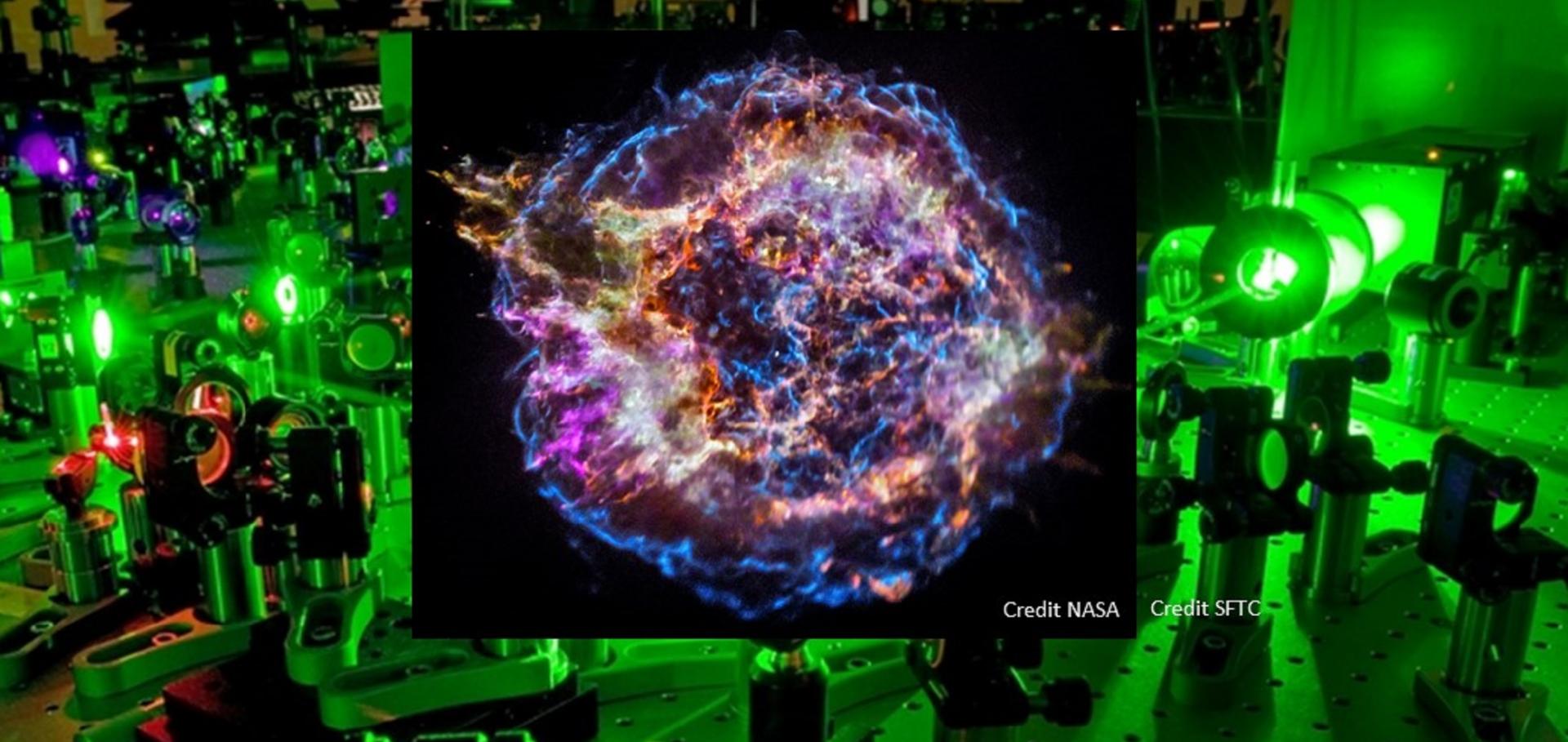
A CHANDRA image of the supernova remnant Cas A superimposed on the Gemini laser at the UK Central Laser Facility

The plasma physics of supernova remnants in astrophysics is similar to plasma physics of solids irradiated with powerful lasers in the laboratory.

Credit: 1) The Royal Society (personal photo) 2) NASA/CXC/MIT/UMass Amherst/M.D.Stage et al. (Cas A) 3) STFC (laser)

Tony Bell FRS

Academic Visitor

Research theme

  • Particle astrophysics & cosmology
  • Plasma physics

Sub department

  • Atomic and Laser Physics
Tony.Bell@physics.ox.ac.uk
Telephone: 01865 (2)72210
Clarendon Laboratory, room 316.4
  • About
  • Publications

Supernova shock breakout from a red supergiant.

Science 321:5886 (2008) 223-226

Authors:

Kevin Schawinski, Stephen Justham, Christian Wolf, Philipp Podsiadlowski, Mark Sullivan, Katrien C Steenbrugge, Tony Bell, Hermann-Josef Röser, Emma S Walker, Pierre Astier, Dave Balam, Christophe Balland, Ray Carlberg, Alex Conley, Dominique Fouchez, Julien Guy, Delphine Hardin, Isobel Hook, D Andrew Howell, Reynald Pain, Kathy Perrett, Chris Pritchet, Nicolas Regnault, Sukyoung K Yi

Abstract:

Massive stars undergo a violent death when the supply of nuclear fuel in their cores is exhausted, resulting in a catastrophic "core-collapse" supernova. Such events are usually only detected at least a few days after the star has exploded. Observations of the supernova SNLS-04D2dc with the Galaxy Evolution Explorer space telescope reveal a radiative precursor from the supernova shock before the shock reached the surface of the star and show the initial expansion of the star at the beginning of the explosion. Theoretical models of the ultraviolet light curve confirm that the progenitor was a red supergiant, as expected for this type of supernova. These observations provide a way to probe the physics of core-collapse supernovae and the internal structures of their progenitor stars.
More details from the publisher
More details
Details from ArXiV

Cosmic ray acceleration by a supernova shock in a dense circumstellar plasma

Monthly Notices of the Royal Astronomical Society 385:4 (2008) 1884-1892

Abstract:

Cosmic ray acceleration may occur at a supernova shock expanding into a circumstellar wind sustaining a Parker spiral magnetic field. Cosmic rays drift to the poles producing a large cosmic ray pressure which can generate polar density cavities through which cosmic rays escape upstream of the shock. This may be relevant to gamma-ray bursts accompanying shock breakout. © 2008 The Author. Journal compilation © 2008 RAS.
More details from the publisher
More details

Non-Spitzer return currents in intense laser-plasma interactions

PHYSICS OF PLASMAS 14:10 (2007) ARTN 102708

Authors:

M Sherlock, AR Bell, RJ Kingham, APL Robinson, R Bingham
More details from the publisher

Absorption of ultra-short laser pulses and particle transport in dense targets

LASER AND PARTICLE BEAMS 24:2 (2006) 231-234

Authors:

M Sherlock, AR Bell, W Rozmus
More details from the publisher

Effect of Target Composition on Proton Energy Spectra in Ultraintense Laser-Solid Interactions

Physical Review Letters 96 (2006) 035005 4pp

Authors:

AR Bell, A.P.L. Robinson, R.J. Kingham
More details from the publisher
More details
More details

Pagination

  • First page First
  • Previous page Prev
  • …
  • Page 11
  • Page 12
  • Page 13
  • Page 14
  • Current page 15
  • Page 16
  • Page 17
  • Page 18
  • Page 19
  • …
  • Next page Next
  • Last page Last

Footer Menu

  • Contact us
  • Giving to the Dept of Physics
  • Work with us
  • Media

User account menu

  • Log in

Follow us

FIND US

Clarendon Laboratory,

Parks Road,

Oxford,

OX1 3PU

CONTACT US

Tel: +44(0)1865272200

University of Oxfrod logo Department Of Physics text logo
IOP Juno Champion logo Athena Swan Silver Award logo

© University of Oxford - Department of Physics

Cookies | Privacy policy | Accessibility statement

Built by: Versantus

  • Home
  • Research
  • Study
  • Engage
  • Our people
  • News & Comment
  • Events
  • Our facilities & services
  • About us
  • Giving to Physics
  • Current students
  • Staff intranet