


A New Technique to Load 130Te in Liquid Scintillator for Neutrinoless Double Beta Decay Experiments
Journal of Physics Conference Series IOP Publishing 888:1 (2017) 012084
Current status and future prospects of the SNO+ experiment
Advances in High Energy Physics Hindawi Publishing Corporation 2016 (2016) 6194250-6194250
Abstract:
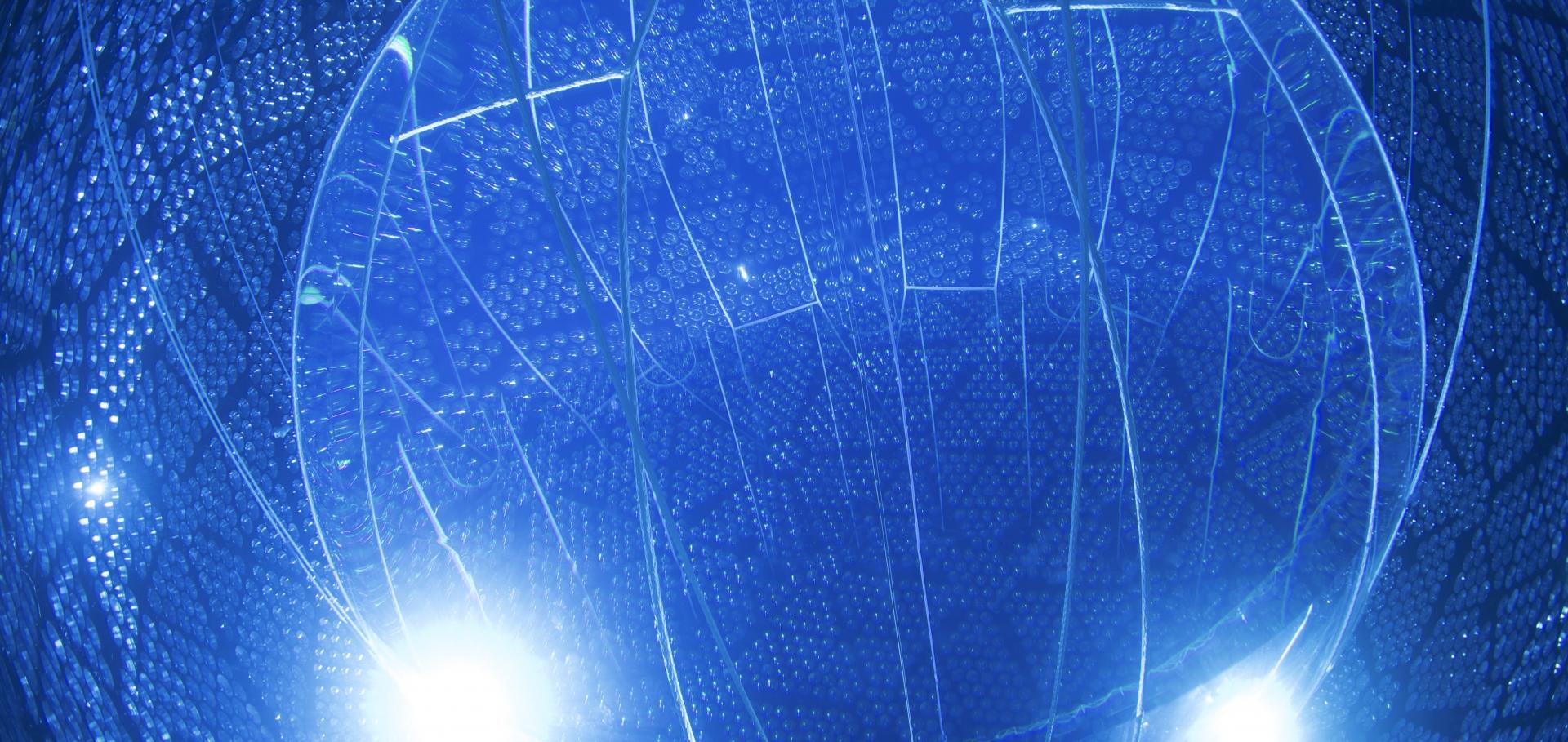
SNO+ is a large liquid scintillator-based experiment located 2km underground at SNOLAB, Sudbury, Canada. It reuses the Sudbury Neutrino Observatory detector, consisting of a 12m diameter acrylic vessel which will be filled with about 780 tonnes of ultra-pure liquid scintillator. Designed as a multipurpose neutrino experiment, the primary goal of SNO+ is a search for the neutrinoless double-beta decay (0$\nu\beta\beta$) of 130Te. In Phase I, the detector will be loaded with 0.3% natural tellurium, corresponding to nearly 800 kg of 130Te, with an expected effective Majorana neutrino mass sensitivity in the region of 55-133 meV, just above the inverted mass hierarchy. Recently, the possibility of deploying up to ten times more natural tellurium has been investigated, which would enable SNO+ to achieve sensitivity deep into the parameter space for the inverted neutrino mass hierarchy in the future. Additionally, SNO+ aims to measure reactor antineutrino oscillations, low-energy solar neutrinos, and geoneutrinos, to be sensitive to supernova neutrinos, and to search for exotic physics. A first phase with the detector filled with water will begin soon, with the scintillator phase expected to start after a few months of water data taking. The 0$\nu\beta\beta$ Phase I is foreseen for 2017.Purification of telluric acid for SNO+ neutrinoless double-beta decay search
Nuclear Instruments and Methods in Physics Research Section A Accelerators Spectrometers Detectors and Associated Equipment Elsevier 795 (2015) 132-139
Another look at confidence intervals: Proposal for a more relevant and transparent approach
Nuclear Instruments and Methods in Physics Research Section A Accelerators Spectrometers Detectors and Associated Equipment Elsevier 774 (2015) 103-119
SNO+ with Tellurium
Physics Procedia Elsevier 61 (2015) 205-210