
Home
Department Of Physics text logo
  • Research
    • Our research
    • Our research groups
    • Our research in action
    • Research funding support
    • Summer internships for undergraduates
  • Study
    • Undergraduates
    • Postgraduates
  • Engage
    • For young people
    • For teachers
    • For the public
    • For alumni
    • For business
  • Support
Menu
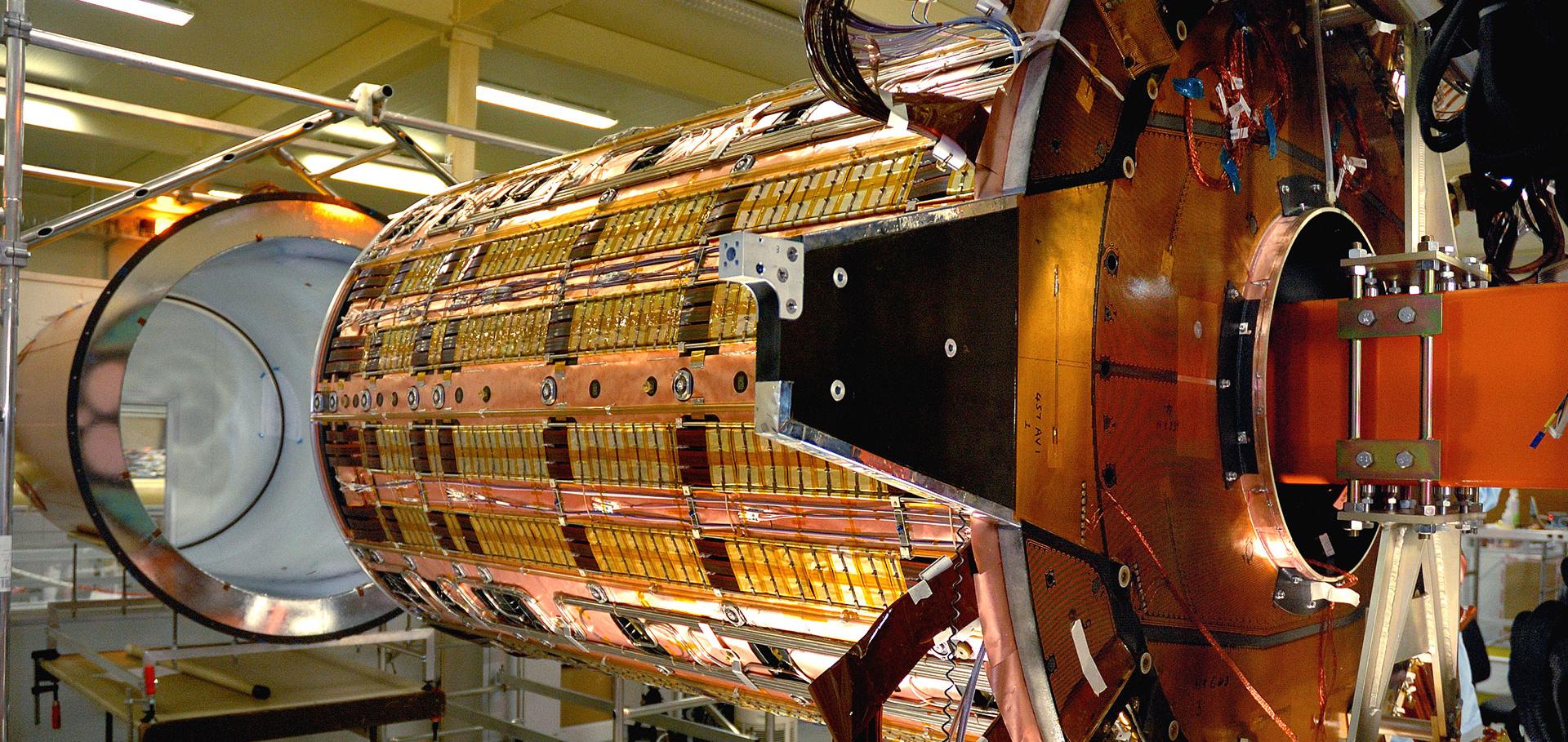
Insertion of STC into TRT at the Department of Physics, Oxford
Credit: CERN

Professor Daniela Bortoletto

Professor and Head of Particle Physics

Research theme

  • Instrumentation
  • Fundamental particles and interactions

Sub department

  • Particle Physics

Research groups

  • AION/Magis
  • ATLAS
  • Future Colliders
  • Mu3e
  • OPMD
daniela.bortoletto@physics.ox.ac.uk
Telephone: 01865 (2)73635
Denys Wilkinson Building, room 608c1
  • About
  • Students
  • Research
  • Teaching
  • Publications

Search for heavy Majorana neutrinos in vector boson scattering with $τ$-lepton final states with the ATLAS detector

ArXiv 2607.27307 (2026)
Details from ArXiV

Study of $t\bar{t}H$ and $tH$ production in the $H\toττ$ channel in $pp$ collisions at $\sqrt{s}=13$ TeV and 13.6 TeV with the ATLAS detector

ArXiv 2607.27276 (2026)
Details from ArXiV

Design optimization of MAPS-based detectors using a data-driven fast simulation approach

The European Physical Journal C SpringerOpen 86:7 (2026) 890

Authors:

Dumitru Vlad Berlea, Lucian Fasselt, Prafulla Behera, Daniela Bortoletto, Craig Buttar, Theertha Chembakan, Valerio Dao, Ganapati Dash, Sebastian Haberl, Tomohiro Inada, Fuat Kerem Isik, Cigdem Issever, Xuan Li, Long Li, Heinz Pernegger, Petra Riedler, Walter Snoeys, Carlos Solans Sánchez, Anna Swoboda, Ilkay Turk Cakir, Milou van Rijnbach, Anusree Vijay, Julian Weick, Steven Worm

Abstract:

Abstract A parametric simulation tool for pixel sensors is presented. A realistic pixel response is simulated purely based on measurement input, without requiring detailed knowledge of the underlying manufacturing process. As such, it provides an efficient alternative to the use of Technology Computer-Aided Design simulations, which typically depend on proprietary process information. Due to its parametric approach, the package is fast and thus particularly useful for larger detector systems and high hit rate environments. This work presents measurements, simulation and its validation for the MALTA2 sensor. It is a small collection electrode monolithic active pixel sensor produced in the Tower 180 nm complementary metal-oxide-semiconductor imaging process. Modifications to the sensor’s periphery, mainly in the hit merger, are studied in order to optimize the performance for tracking and calorimetry. This optimization is of special interest as part of the MALTA3 sensor redesign in the 65 nm Tower Partners Semiconductor Co. process.
More details from the publisher
Details from ORA

Observation of the electroweak production of $γγjj$ at $\sqrt{s}=13$ TeV in $140\ \text{fb}^{-1}$ of $pp$ collision data with the ATLAS detector

ArXiv 2607.25869 (2026)
Details from ArXiV

The calibration of large-radius jets using the Run 2 dataset with the ATLAS detector

ArXiv 2607.25893 (2026)
Details from ArXiV

Pagination

  • First page First
  • Previous page Prev
  • …
  • Page 8
  • Page 9
  • Page 10
  • Page 11
  • Current page 12
  • Page 13
  • Page 14
  • Page 15
  • Page 16
  • …
  • Next page Next
  • Last page Last

Footer Menu

  • Contact us
  • Giving to the Dept of Physics
  • Work with us
  • Media

User account menu

  • Log in

Follow us

FIND US

Clarendon Laboratory,

Parks Road,

Oxford,

OX1 3PU

CONTACT US

Tel: +44(0)1865272200

University of Oxfrod logo Department Of Physics text logo
IOP Juno Champion logo Athena Swan Silver Award logo

© University of Oxford - Department of Physics

Cookies | Privacy policy | Accessibility statement

Built by: Versantus

  • Home
  • Research
  • Study
  • Engage
  • Our people
  • News & Comment
  • Events
  • Our facilities & services
  • About us
  • Giving to Physics
  • Current students
  • Staff intranet