

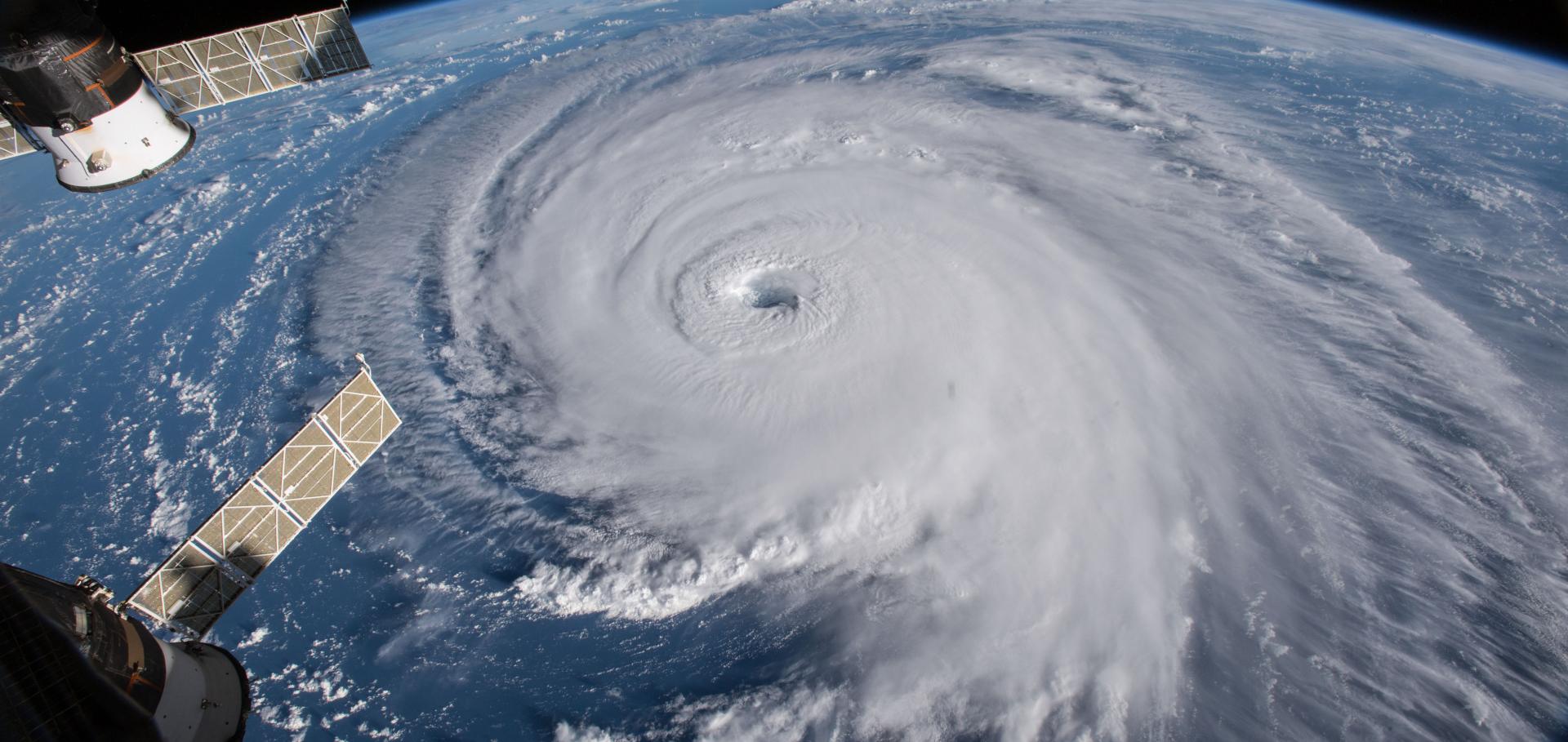

HuracanPy: A Python package for reading and analysing cyclone tracks
Journal of Open Source Software The Open Journal 10:111 (2025) 8174-8174
Improving analogues-based detection & attribution approaches for hurricanes
Environmental Research Letters IOP Publishing 20:2 (2025) 024042
Abstract:
This paper presents a proof of concept for a new analogue-based framework for the detection and attribution of hurricane-related hazards. This framework addresses two important limitations of existing analogue-based methodologies: the lack of observed similar events, and the unsuitability of the distance metrics for hurricanes. To do so, we use a track-based metric, and we make use of synthetic tracks catalogues. We show that our method allows for selecting a sufficient number of suitable analogues, and we apply it to nine hurricane cases. Our analysis does not reveal any robust changes in wind hazards, translation speed, seasonality, or frequency over recent decades, consistent with current literature. This framework provides a reliable alternative to traditional analogue-based methods in the case of hurricanes, complementing and potentially enhancing efforts in addressing extreme weather event attribution.Tropical cyclones in global high-resolution simulations using the IPSL model
Climate Dynamics Springer 62:5 (2024) 4343-4368
Abstract:
International audienceAbstract Despite many years of extensive research, the evolution of Tropical Cyclone (TC) activity in our changing climate remains uncertain. This is partly because the answer to that question relies primarily on climate simulations with horizontal resolutions of a few tens of kilometers. Such simulations have only recently become accessible for most modeling centers, including the Institut Pierre-Simon Laplace (IPSL). Using recent numerical developments in the IPSL model, we perform a series of historical atmospheric-only simulations that follow the HighResMIP protocol. We assess the impact of increasing the resolution from $${\sim }\, 200$$ ∼ 200 to 25 km on TC activity. In agreement with previous work, we find a systematic improvement of TC activity with increasing resolution with respect to the observations. However, a clear signature of TC frequencies convergence with resolution is still lacking. Cyclogenesis geographical distributions also improve at the scale of individual basins. This is particularly true of the North Atlantic, where the agreement with the observed distribution is impressive at 25 km. In agreement with the observations, TC activity correlates with the large-scale environment and ENSO in that basin. By contrast, TC frequencies remain too small in the Western North Pacific at 25 km, where significant biases of humidity and vorticity are found compared to the reanalysis. Despite the few minor weaknesses we identified, our results demonstrate that the IPSL model is a suitable tool for studying TCs on climate time scales. This work thus opens the way for further studies contributing to our understanding of TC climatologyAssessing the representation of tropical cyclones in ERA5 with the CNRM tracker
Climate Dynamics Springer Science and Business Media LLC 62:1 (2024) 223-238
Moisture amplification of the high-altitude deglacial warming
Quaternary Science Reviews Elsevier BV 318 (2023) 108303