Home
Department Of Physics text logo
  • Research
    • Our research
    • Our research groups
    • Our research in action
    • Research funding support
    • Summer internships for undergraduates
  • Study
    • Undergraduates
    • Postgraduates
  • Engage
    • For alumni
    • For business
    • For schools
    • For the public
Menu
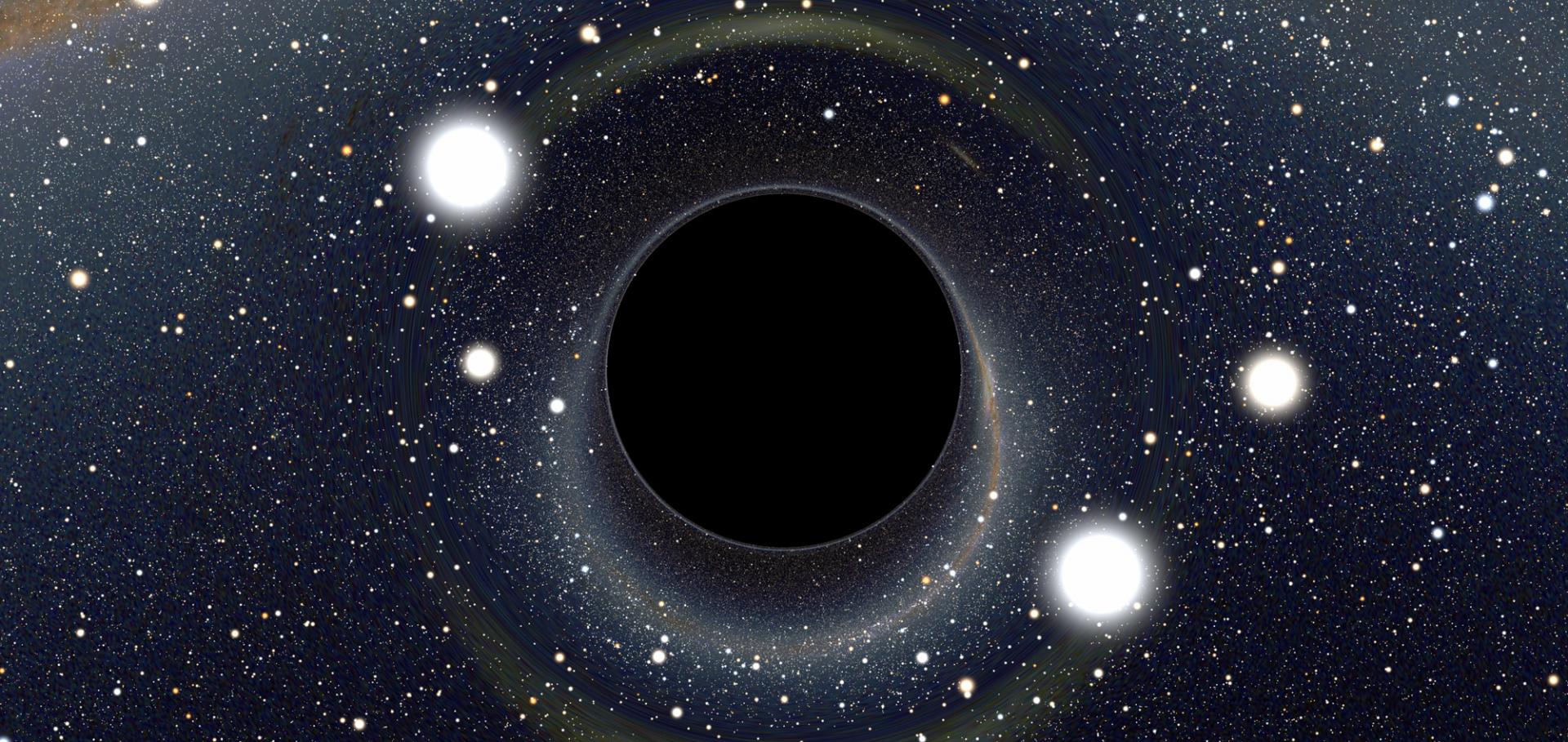
Black Hole

Lensing of space time around a black hole. At Oxford we study black holes observationally and theoretically on all size and time scales - it is some of our core work.

Credit: ALAIN RIAZUELO, IAP/UPMC/CNRS. CLICK HERE TO VIEW MORE IMAGES.

Michele Cappellari

Professor of Astrophysics

Research theme

  • Astronomy and astrophysics

Sub department

  • Astrophysics

Research groups

  • Galaxy formation and evolution
  • Extremely Large Telescope
michele.cappellari@physics.ox.ac.uk
Telephone: 01865 (2)73647
Denys Wilkinson Building, room 755
  • About
  • Publications

Nuclear Mass Concentrations in Galaxies

Publications of the Astronomical Society of the Pacific IOP Publishing 113:784 (2001) 769-769
More details from the publisher

The cuspy liner nucleus of the S0/A galaxy NGC 2681

Astrophysical Journal 551:1 PART 1 (2001) 197-205

Authors:

M Cappellari, F Bertola, D Burstein, LM Buson, L Greggio, A Renzini

Abstract:

The nucleus of the bulge-dominated, multiply barred S0/a galaxy NGC 2681 is studied in detail using the high-resolution Hubble Space Telescope Faint Object Camera (FOC), Near-Infrared Camera and Multiobject Spectrometer (NICMOS) imaging, and the Faint Object Spectrograph (FOS). The ionized gas central velocity dispersion is found to increase by a factor ≈2 when narrowing the aperture from R ≈ 1″.5 (ground) to R ≈ 0″.1 (FOS). Dynamical modeling of these velocity dispersions suggests that NGC 2681 does host a supermassive black hole (BH) for which one can estimate a firm mass upper limit MBH ≲ 6 × 10⁷ M⊙. This upper limit is consistent with the relation between the central BH mass and velocity dispersion MBH - σ known for other galaxies. The emission-line ratios place the nucleus of NGC 2681 among LINERs. It is likely that the emission-line region comes from a rather mild, but steady, feeding of gas to the central BH in this galaxy. The inner stellar population lacks any measurable color gradient (to a radius of 0.6 kpc) from the infrared to the ultraviolet, consistently with FOC, FOS, and IUE data, all indicating that this system underwent a starburst ≈1 Gyr ago that encompassed its whole interior, down to its very center. The most likely source of such a widely distributed starburst is the dumping of tidally extruded gas from a galaxy neighbor. If so, then NGC 2681 can be considered as the older brother of M82, seen face-on as opposed to the edge-on view we have for M82.
More details from the publisher

An orthogonal stellar disk in the nucleus of NGC 4698

ASTR SOC P 230 (2001) 163-164

Authors:

MC Scarlata, F Bertola, M Cappellari, M Sarzi, EM Corsini, A Pizzella
More details

Dynamical modeling of the counterrotating stellar core in IC 1459

ASTR SOC P 230 (2001) 439-440

Authors:

M Cappellari, EK Verolme, GAV Kleijn, M Franx, PT de Zeeuw, RP van der Marel, CM Carollo
More details

Position-velocity diagrams in the inner regions of disk galaxies

ASTR SOC P 230 (2001) 277-278

Authors:

JG Funes, A Pizzella, EM Corsini, M Cappellari, MC Scarlata, F Bertola, JCV Beltran
More details

Pagination

  • First page First
  • Previous page Prev
  • …
  • Page 125
  • Page 126
  • Page 127
  • Page 128
  • Current page 129
  • Page 130
  • Page 131
  • Page 132
  • Page 133
  • …
  • Next page Next
  • Last page Last

Footer Menu

  • Contact us
  • Giving to the Dept of Physics
  • Work with us
  • Media

User account menu

  • Log in

Follow us

FIND US

Clarendon Laboratory,

Parks Road,

Oxford,

OX1 3PU

CONTACT US

Tel: +44(0)1865272200

University of Oxfrod logo Department Of Physics text logo
IOP Juno Champion logo Athena Swan Silver Award logo

© University of Oxford - Department of Physics

Cookies | Privacy policy | Accessibility statement

Built by: Versantus

  • Home
  • Research
  • Study
  • Engage
  • Our people
  • News & Comment
  • Events
  • Our facilities & services
  • About us
  • Giving to Physics
  • Current students
  • Staff intranet