Home
Department Of Physics text logo
  • Research
    • Our research
    • Our research groups
    • Our research in action
    • Research funding support
    • Summer internships for undergraduates
  • Study
    • Undergraduates
    • Postgraduates
  • Engage
    • For young people
    • For teachers
    • For the public
    • For alumni
    • For business
  • Support
Menu
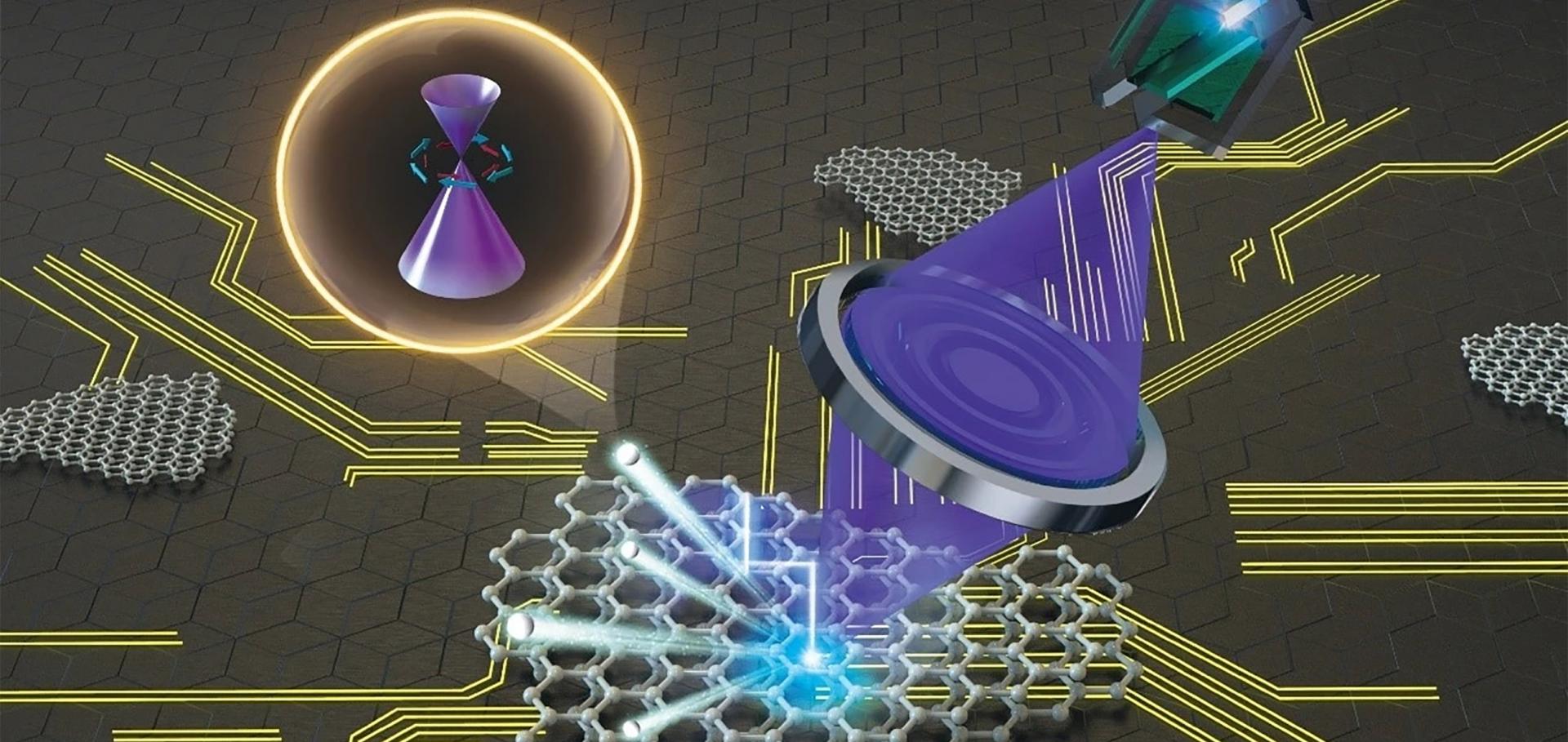
A VUV sub-micron hotspot for photoemission spectroscopy

Vacuum ultraviolet (VUV) lasers have exhibited great potential as the light source for various spectroscopies, which, if they can be focused into a smaller beam spot, will not only allow investigation of mesoscopic materials but also find applications in manufacture of nano-objects with excellent precision. Towards this goal, scientists in China invented a 177 nm VUV laser system that can achieve a record-small (<1 μm) focal spot at a long focal length (~45 mm). This system can be re-equipped for usage in low-cost ARPES and might benefit quantum materials, condensed matter physics and nanophotonics.

Prof Yulin Chen

Professor of Physics

Research theme

  • Quantum materials

Sub department

  • Condensed Matter Physics

Research groups

  • Electronic structures and photoemission spectroscopy
yulin.chen@physics.ox.ac.uk
Clarendon Laboratory, room 041,263 (office)
Recent publications
  • About
  • Publications

Robust topological surface state against direct surface contamination

Physica E: Low-dimensional Systems and Nanostructures

Authors:

ZK Liu, YL Chen, JG Analytis, SK Mo, DH Lu, RG Moore, IR Fisher, Z Hussain, ZX Shen
More details from the publisher
More details

The topological surface state of $α$-Sn on InSb(001) as studied by photoemission

arxiv Museu de Ciències Naturals de Barcelona

Authors:

MR Scholz, VA Rogalev, L Dudy, F Reis, F Adler, J Aulbach, LJ Collins-McIntyre, LB Duffy, HF Yang, YL Chen, T Hesjedal, ZK Liu, M Hoesch, S Muff, JH Dil, J Schäfer, R Claessen

Abstract:

We report on the electronic structure of the elemental topological semimetal $\alpha$-Sn on InSb(001). High-resolution angle-resolved photoemission data allow to observe the topological surface state (TSS) that is degenerate with the bulk band structure and show that the former is unaffected by different surface reconstructions. An unintentional $p$-type doping of the as-grown films was compensated by deposition of potassium or tellurium after the growth, thereby shifting the Dirac point of the surface state below the Fermi level. We show that, while having the potential to break time-reversal symmetry, iron impurities with a coverage of up to 0.25 monolayers do not have any further impact on the surface state beyond that of K or Te. Furthermore, we have measured the spin-momentum locking of electrons from the TSS by means of spin-resolved photoemission. Our results show that the spin vector lies fully in-plane, but it also has a finite radial component. Finally, we analyze the decay of photoholes introduced in the photoemission process, and by this gain insight into the many-body interactions in the system. Surprisingly, we extract quasiparticle lifetimes comparable to other topological materials where the TSS is located within a bulk band gap. We argue that the main decay of photoholes is caused by intraband scattering, while scattering into bulk states is suppressed due to different orbital symmetries of bulk and surface states.
More details
Details from ORA
More details from the publisher
More details
Details from ArXiV

Pagination

  • First page First
  • Previous page Prev
  • …
  • Page 51
  • Page 52
  • Page 53
  • Page 54
  • Page 55
  • Page 56
  • Page 57
  • Page 58
  • Current page 59

Footer Menu

  • Contact us
  • Giving to the Dept of Physics
  • Work with us
  • Media

User account menu

  • Log in

Follow us

FIND US

Clarendon Laboratory,

Parks Road,

Oxford,

OX1 3PU

CONTACT US

Tel: +44(0)1865272200

University of Oxfrod logo Department Of Physics text logo
IOP Juno Champion logo Athena Swan Silver Award logo

© University of Oxford - Department of Physics

Cookies | Privacy policy | Accessibility statement

Built by: Versantus

  • Home
  • Research
  • Study
  • Engage
  • Our people
  • News & Comment
  • Events
  • Our facilities & services
  • About us
  • Giving to Physics
  • Current students
  • Staff intranet