Home
Department Of Physics text logo
  • Research
    • Our research
    • Our research groups
    • Our research in action
    • Research funding support
    • Summer internships for undergraduates
  • Study
    • Undergraduates
    • Postgraduates
  • Engage
    • For alumni
    • For business
    • For schools
    • For the public
  • Support
Menu
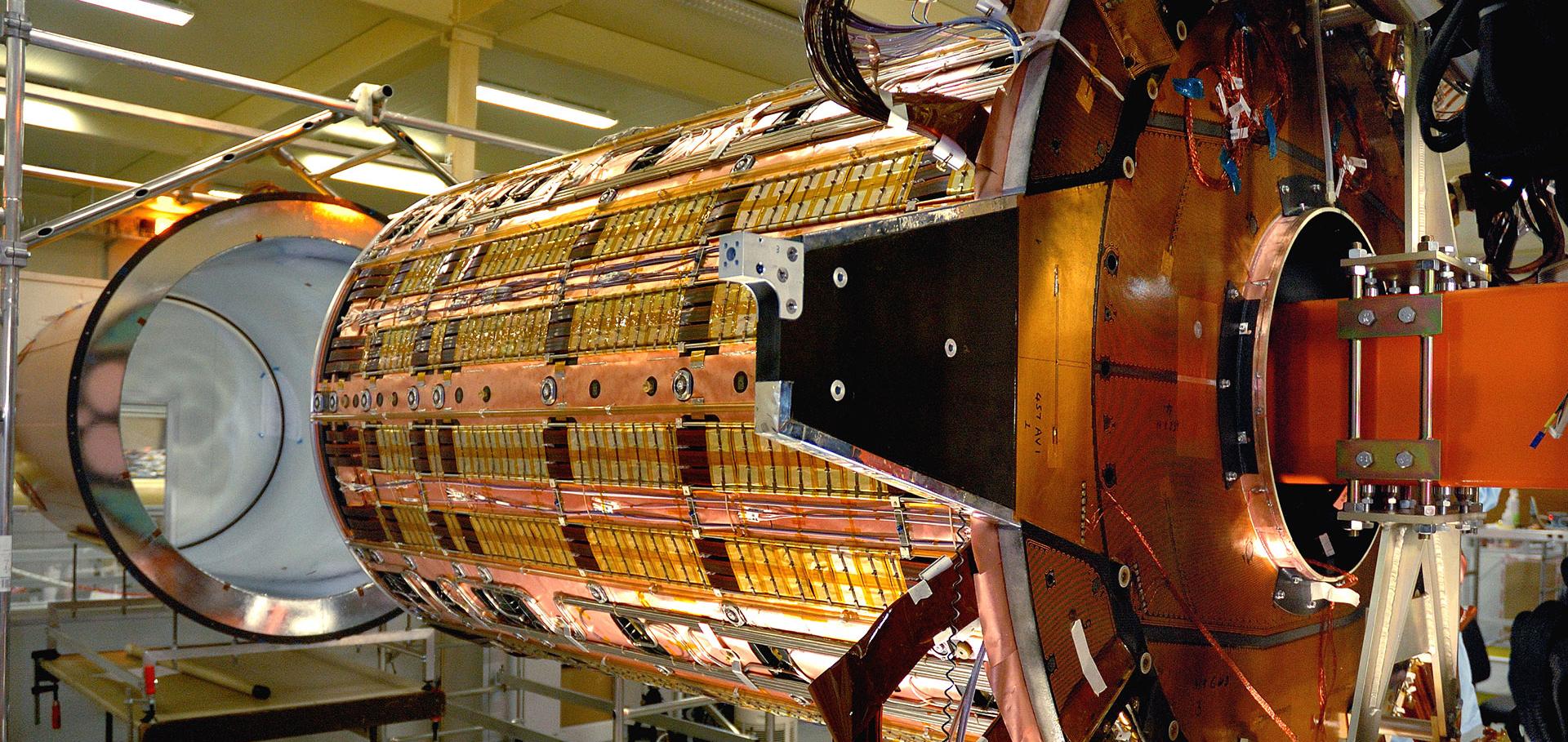
Insertion of STC into TRT at the Department of Physics, Oxford
Credit: CERN

Professor Amanda Cooper-Sarkar

Emeritus Professor

Research theme

  • Fundamental particles and interactions

Sub department

  • Particle Physics

Research groups

  • ATLAS
Amanda.Cooper-Sarkar@physics.ox.ac.uk
Telephone: 01865 (2)73406
Denys Wilkinson Building, room 659
  • About
  • Publications

Search for single production of a vector-like $T$ quark decaying into a Higgs boson and top quark with fully hadronic final states using the ATLAS detector

ArXiv 2201.07045 (2022)
Details from ArXiV

Search for exotic decays of the Higgs boson into b$$ \overline{b} $$ and missing transverse momentum in pp collisions at $$ \sqrt{s} $$ = 13 TeV with the ATLAS detector

Journal of High Energy Physics Springer 2022:1 (2022) 63

Authors:

G Aad, B Abbott, DC Abbott, A Abed Abud, K Abeling, DK Abhayasinghe, SH Abidi, H Abramowicz, H Abreu, Y Abulaiti, AC Abusleme Hoffman, BS Acharya, B Achkar, L Adam, C Adam Bourdarios, L Adamczyk, L Adamek, SV Addepalli, J Adelman, A Adiguzel, S Adorni, T Adye, AA Affolder, Y Afik, C Agapopoulou

Abstract:

A summary of results in heavy flavour physics from Run 1 of the LHC is presented. Topics discussed include spectroscopy, mixing, CP violation and rare decays of charmed and beauty hadrons.Comment: 25 pages, 9 figures (total 17 subfigures). Invited review for Comptes Rendus de Physique de l'Academie des Science
More details from the publisher
Details from ORA
More details

Operation and performance of the ATLAS semiconductor tracker in LHC Run 2

Journal of Instrumentation IOP Publishing 17:01 (2022) P01013

Authors:

Georges Aad, Brad Abbott, Dale Charles Abbott, L Ambroz, G Artoni, WK Balunas, AJ Barr, D Bortoletto, F Celli, EI Conroy, Amanda Cooper-Sarkar, JA Frost, MG Foti, GE Gallardo, EJ Gallas, JC Grundy, C Gwenlan, YT Harris, CP Hays, TB Huffman, K Karava, Z Li, C Merlassino, M Mironova, Koichi Nagai, RB Nickerson, AP O’Neill, SR Paredes Saenz, CS Pollard, E Schopf, IPJ Shipsey, Y Wei, HA Smith, M Stankaityte, I Veliscek, GHA Viehhauser, AR Weidberg, PJ Windischhofer, R Wölker, KW Woźniak, S Yan, K Potamianos

Abstract:

The semiconductor tracker (SCT) is one of the tracking systems for charged particles in the ATLAS detector. It consists of 4088 silicon strip sensor modules. During Run 2 (2015–2018) the Large Hadron Collider delivered an integrated luminosity of 156 fb-1 to the ATLAS experiment at a centre-of-mass proton-proton collision energy of 13 TeV. The instantaneous luminosity and pile-up conditions were far in excess of those assumed in the original design of the SCT detector. Due to improvements to the data acquisition system, the SCT operated stably throughout Run 2. It was available for 99.9% of the integrated luminosity and achieved a data-quality efficiency of 99.85%. Detailed studies have been made of the leakage current in SCT modules and the evolution of the full depletion voltage, which are used to study the impact of radiation damage to the modules.
More details from the publisher
Details from ORA
More details

Search for long-lived charginos based on a disappearing-track signature using 136 fb$^{-1}$ of $pp$ collisions at $\sqrt{s}$ = 13 TeV with the ATLAS detector

ArXiv 2201.02472 (2022)
Details from ArXiV

Performance of the ATLAS Level-1 topological trigger in Run 2

The European Physical Journal C SpringerOpen 82:1 (2022) 7

Authors:

G Aad, B Abbott, DC Abbott, A Abed Abud, K Abeling, DK Abhayasinghe, SH Abidi, OS AbouZeid, NL Abraham, H Abramowicz, H Abreu, Y Abulaiti, AC Abusleme Hoffman, BS Acharya, B Achkar, L Adam, C Adam Bourdarios, L Adamczyk, L Adamek, J Adelman, A Adiguzel, S Adorni, T Adye, AA Affolder, Y Afik

Abstract:

During LHC Run 2 (2015–2018) the ATLAS Level-1 topological trigger allowed efficient data-taking by the ATLAS experiment at luminosities up to 2.1×1034 cm−2s−1, which exceeds the design value by a factor of two. The system was installed in 2016 and operated in 2017 and 2018. It uses Field Programmable Gate Array processors to select interesting events by placing kinematic and angular requirements on electromagnetic clusters, jets, τ-leptons, muons and the missing transverse energy. It allowed to significantly improve the background event rejection and signal event acceptance, in particular for Higgs and B-physics processes
More details from the publisher
Details from ORA
More details
More details

Pagination

  • First page First
  • Previous page Prev
  • …
  • Page 153
  • Page 154
  • Page 155
  • Page 156
  • Current page 157
  • Page 158
  • Page 159
  • Page 160
  • Page 161
  • …
  • Next page Next
  • Last page Last

Footer Menu

  • Contact us
  • Giving to the Dept of Physics
  • Work with us
  • Media

User account menu

  • Log in

Follow us

FIND US

Clarendon Laboratory,

Parks Road,

Oxford,

OX1 3PU

CONTACT US

Tel: +44(0)1865272200

University of Oxfrod logo Department Of Physics text logo
IOP Juno Champion logo Athena Swan Silver Award logo

© University of Oxford - Department of Physics

Cookies | Privacy policy | Accessibility statement

Built by: Versantus

  • Home
  • Research
  • Study
  • Engage
  • Our people
  • News & Comment
  • Events
  • Our facilities & services
  • About us
  • Giving to Physics
  • Current students
  • Staff intranet