Home
Department Of Physics text logo
  • Research
    • Our research
    • Our research groups
    • Our research in action
    • Research funding support
    • Summer internships for undergraduates
  • Study
    • Undergraduates
    • Postgraduates
  • Engage
    • For young people
    • For teachers
    • For the public
    • For alumni
    • For business
  • Support
Menu
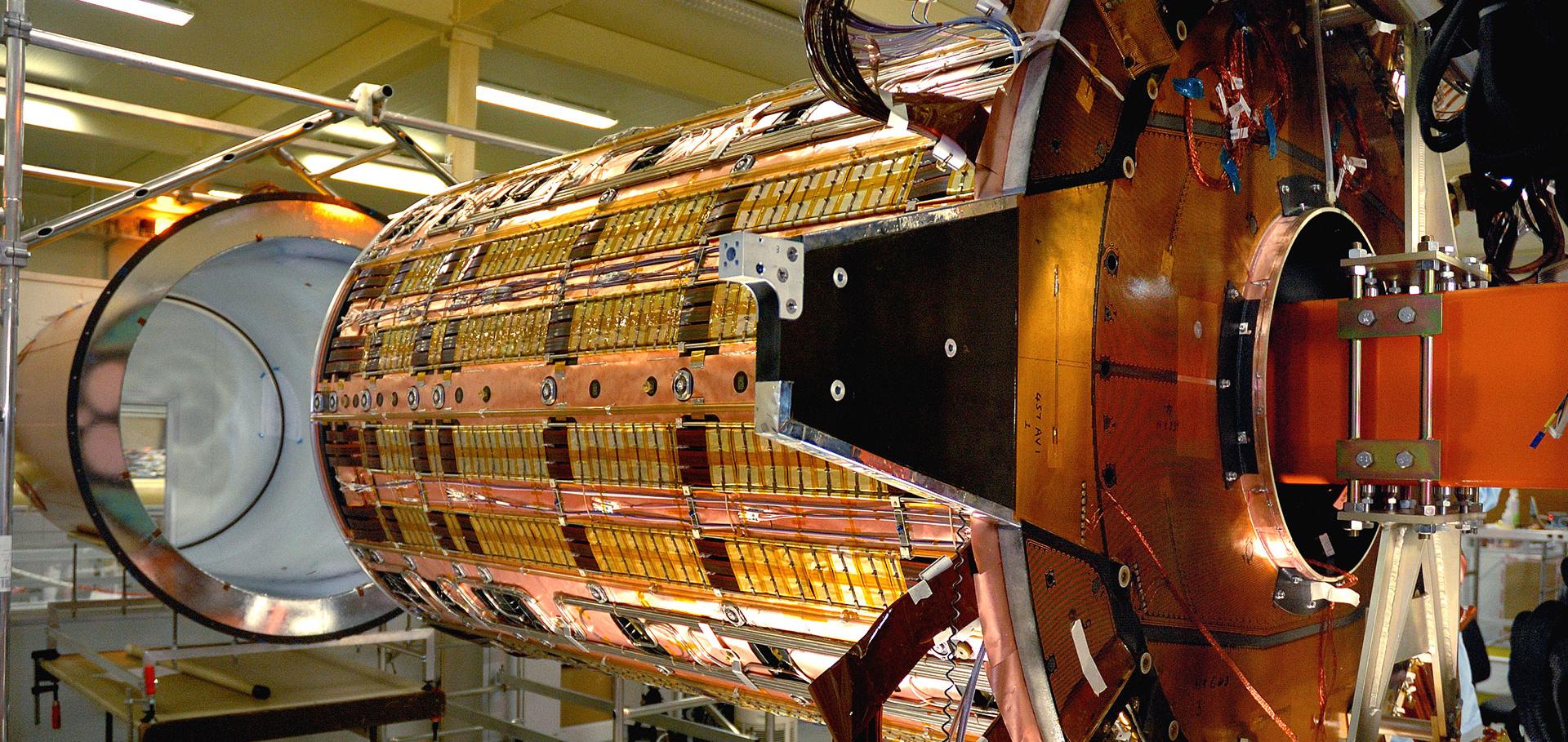
Insertion of STC into TRT at the Department of Physics, Oxford
Credit: CERN

Professor Amanda Cooper-Sarkar

Emeritus Professor

Research theme

  • Fundamental particles and interactions

Sub department

  • Particle Physics

Research groups

  • ATLAS
Amanda.Cooper-Sarkar@physics.ox.ac.uk
Telephone: 01865 (2)73406
Denys Wilkinson Building, room 659
  • About
  • Publications

Search for Higgs bosons decaying into new spin-0 or spin-1 particles in four-lepton final states with the ATLAS detector with 139 fb−1 of pp collision data at $$ \sqrt{s} $$ = 13 TeV

Journal of High Energy Physics Springer 2022:3 (2022) 41

Authors:

G Aad, B Abbott, DC Abbott, A Abed Abud, K Abeling, DK Abhayasinghe, SH Abidi, A Aboulhorma, H Abramowicz, H Abreu, Y Abulaiti, AC Abusleme Hoffman, BS Acharya, B Achkar, L Adam, C Adam Bourdarios, L Adamczyk, L Adamek, SV Addepalli, J Adelman, A Adiguzel, S Adorni, T Adye, AA Affolder, Y Afik

Abstract:

We consider a model where the electroweak symmetry breaking is driven by strong dynamics, resulting in an electroweak doublet scalar condensate, and transmitted to the standard model matter fields via another electroweak doublet scalar. At low energies the effective theory therefore shares features with a type-I two Higgs doublet model. However, important differences arise due to the rich composite spectrum expected to contain new vector resonances accessible at the LHC. We carry out a systematic analysis of the vector resonance signals at LHC and find that the model remains viable, but will be tightly constrained by direct searches as the projected integrated luminosity, around 200 fb(-1), of the current run becomes available.Peer reviewe
More details from the publisher
Details from ORA
More details

Study of $B_c^+\to J/ψD_s^+$ and $B_c^+\to J/ψD_s^{*+}$ decays in $pp$ collisions at $\sqrt{s} = 13$ TeV with the ATLAS detector

ArXiv 2203.01808 (2022)
Details from ArXiV

Search for neutral long-lived particles in $pp$ collisions at $\sqrt{s}=13$ TeV that decay into displaced hadronic jets in the ATLAS calorimeter

ArXiv 2203.01009 (2022)
Details from ArXiV

Search for events with a pair of displaced vertices from long-lived neutral particles decaying into hadronic jets in the ATLAS muon spectrometer in pp collisions at $\sqrt{s}=13$ TeV

ArXiv 2203.00587 (2022)
Details from ArXiV

Measurements of jet observables sensitive to $b$-quark fragmentation in $t\bar{t}$ events at the LHC with the ATLAS detector

ArXiv 2202.13901 (2022)
Details from ArXiV

Pagination

  • First page First
  • Previous page Prev
  • …
  • Page 182
  • Page 183
  • Page 184
  • Page 185
  • Current page 186
  • Page 187
  • Page 188
  • Page 189
  • Page 190
  • …
  • Next page Next
  • Last page Last

Footer Menu

  • Contact us
  • Giving to the Dept of Physics
  • Work with us
  • Media

User account menu

  • Log in

Follow us

FIND US

Clarendon Laboratory,

Parks Road,

Oxford,

OX1 3PU

CONTACT US

Tel: +44(0)1865272200

University of Oxfrod logo Department Of Physics text logo
IOP Juno Champion logo Athena Swan Silver Award logo

© University of Oxford - Department of Physics

Cookies | Privacy policy | Accessibility statement

Built by: Versantus

  • Home
  • Research
  • Study
  • Engage
  • Our people
  • News & Comment
  • Events
  • Our facilities & services
  • About us
  • Giving to Physics
  • Current students
  • Staff intranet