Home
Department Of Physics text logo
  • Research
    • Our research
    • Our research groups
    • Our research in action
    • Research funding support
    • Summer internships for undergraduates
  • Study
    • Undergraduates
    • Postgraduates
  • Engage
    • For young people
    • For teachers
    • For the public
    • For alumni
    • For business
  • Support
Menu
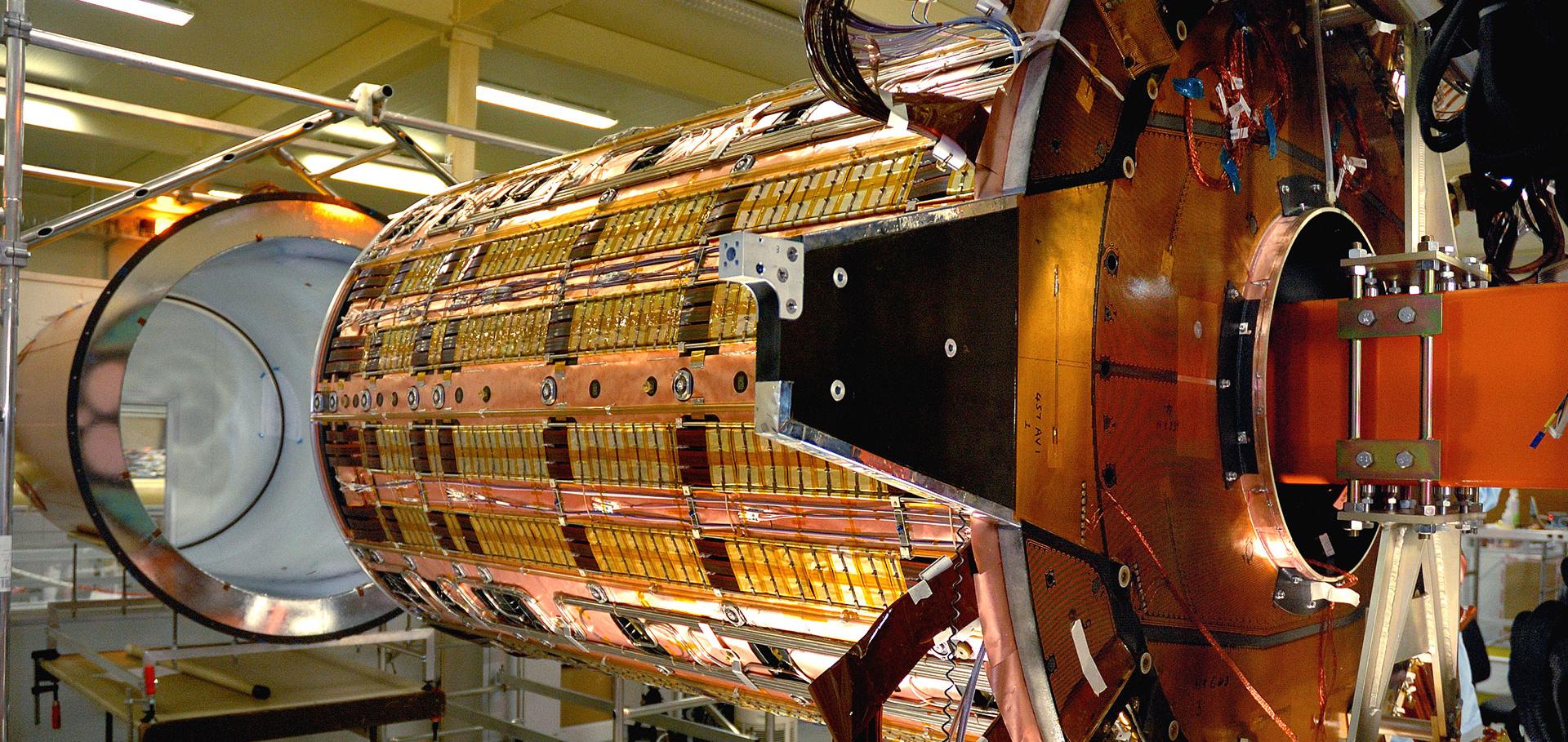
Insertion of STC into TRT at the Department of Physics, Oxford
Credit: CERN

Professor Amanda Cooper-Sarkar

Emeritus Professor

Research theme

  • Fundamental particles and interactions

Sub department

  • Particle Physics

Research groups

  • ATLAS
Amanda.Cooper-Sarkar@physics.ox.ac.uk
Telephone: 01865 (2)73406
Denys Wilkinson Building, room 659
  • About
  • Publications

Search for direct slepton and gaugino production in final states with two leptons and missing transverse momentum with the ATLAS detector in pp collisions at s=7 TeV

Physics Letters, Section B: Nuclear, Elementary Particle and High-Energy Physics 718:3 (2013) 879-901

Authors:

G Aad, T Abajyan, B Abbott, J Abdallah, S Abdel Khalek, AA Abdelalim, O Abdinov, R Aben, B Abi, M Abolins, OS AbouZeid, H Abramowicz, H Abreu, BS Acharya, BS Acharya, L Adamczyk, DL Adams, TN Addy, J Adelman, S Adomeit, P Adragna, T Adye, S Aefsky, JA Aguilar-Saavedra, M Agustoni, M Aharrouche, SP Ahlen, F Ahles, A Ahmad, M Ahsan, G Aielli, G Aielli, T Akdogan, TPA Åkesson, G Akimoto, AV Akimov, MS Alam, MA Alam, J Albert, S Albrand, M Aleksa, IN Aleksandrov, F Alessandria, C Alexa, G Alexander, G Alexandre, T Alexopoulos, M Alhroob, M Alhroob, M Aliev, G Alimonti, J Alison, BMM Allbrooke, PP Allport, SE Allwood-Spiers, J Almond, A Aloisio, A Aloisio, R Alon, A Alonso, F Alonso, A Altheimer, B Alvarez Gonzalez, MG Alviggi, MG Alviggi, K Amako, C Amelung, VV Ammosov, SP Amor Dos Santos, A Amorim, N Amram, C Anastopoulos, LS Ancu, N Andari, T Andeen, CF Anders, G Anders, KJ Anderson, A Andreazza, A Andreazza, V Andrei, ML Andrieux, XS Anduaga, P Anger, A Angerami, F Anghinolfi, A Anisenkov, N Anjos, A Annovi, A Antonaki, M Antonelli, A Antonov, J Antos, F Anulli, M Aoki, S Aoun, L Aperio Bella, R Apolle, G Arabidze, I Aracena

Abstract:

A search for the electroweak pair production of charged sleptons and weak gauginos decaying into final states with two leptons is performed using 4.7 fb-1 of proton-proton collision data at s=7 TeV recorded with the ATLAS experiment at the Large Hadron Collider. No significant excesses are observed with respect to the prediction from Standard Model processes. In the scenario of direct slepton production, if the sleptons decay directly into the lightest neutralino, left-handed slepton masses between 85 and 195 GeV are excluded at 95% confidence level for a 20 GeV neutralino. Chargino masses between 110 and 340 GeV are excluded in the scenario of direct production of wino-like chargino pairs decaying into the lightest neutralino via an intermediate on-shell charged slepton for a 10 GeV neutralino. The results are also interpreted in the framework of the phenomenological minimal supersymmetric Standard Model. © 2012 CERN.
More details from the publisher

Search for new phenomena in the WW→lνl'ν' final state in pp collisions at s=7TeV with the ATLAS detector

Physics Letters, Section B: Nuclear, Elementary Particle and High-Energy Physics 718:3 (2013) 860-878

Authors:

G Aad, T Abajyan, B Abbott, J Abdallah, S Abdel Khalek, AA Abdelalim, O Abdinov, R Aben, B Abi, M Abolins, OS AbouZeid, H Abramowicz, H Abreu, E Acerbi, E Acerbi, BS Acharya, BS Acharya, L Adamczyk, DL Adams, TN Addy, J Adelman, S Adomeit, P Adragna, T Adye, S Aefsky, JA Aguilar-Saavedra, M Agustoni, M Aharrouche, SP Ahlen, F Ahles, A Ahmad, M Ahsan, G Aielli, G Aielli, T Akdogan, TPA Åkesson, G Akimoto, AV Akimov, MS Alam, MA Alam, J Albert, S Albrand, M Aleksa, IN Aleksandrov, F Alessandria, C Alexa, G Alexander, G Alexandre, T Alexopoulos, M Alhroob, M Alhroob, M Aliev, G Alimonti, J Alison, BMM Allbrooke, PP Allport, SE Allwood-Spiers, J Almond, A Aloisio, A Aloisio, R Alon, A Alonso, F Alonso, B Alvarez Gonzalez, MG Alviggi, MG Alviggi, K Amako, C Amelung, VV Ammosov, A Amorim, N Amram, C Anastopoulos, LS Ancu, N Andari, T Andeen, CF Anders, G Anders, KJ Anderson, A Andreazza, A Andreazza, V Andrei, XS Anduaga, P Anger, A Angerami, F Anghinolfi, A Anisenkov, N Anjos, A Annovi, A Antonaki, M Antonelli, A Antonov, J Antos, F Anulli, M Aoki, S Aoun, L Aperio Bella, R Apolle, G Arabidze, I Aracena, Y Arai

Abstract:

This Letter reports a search for a heavy particle that decays to WW using events produced in pp collisions at s=7TeV. The data were recorded in 2011 by the ATLAS detector and correspond to an integrated luminosity of 4.7 fb-1. WW→ℓνℓ'ν' (ℓ, ℓ'=e or μ) final states are considered and the distribution of the transverse mass of the WW candidates is found to be consistent with Standard Model expectations. Upper limits on the production cross section times branching ratio into W boson pairs are set for Randall-Sundrum and bulk Randall-Sundrum gravitons, which result in observed 95% CL lower limits on the masses of the two particles of 1.23 TeV and 0.84 TeV, respectively. © 2012 CERN.
More details from the publisher

Search for single b*-quark production with the ATLAS detector at sqrt(s)=7 TeV

ArXiv 1301.1583 (2013)
Details from ArXiV

Search for contact interactions and large extra dimensions in dilepton events from pp collisions at √s=7 TeV with the ATLAS detector

Physical Review D - Particles, Fields, Gravitation and Cosmology 87:1 (2013)

Authors:

G Aad, T Abajyan, B Abbott, J Abdallah, S Abdel Khalek, AA Abdelalim, O Abdinov, R Aben, B Abi, M Abolins, OS Abouzeid, H Abramowicz, H Abreu, BS Acharya, L Adamczyk, DL Adams, TN Addy, J Adelman, S Adomeit, P Adragna, T Adye, S Aefsky, JA Aguilar-Saavedra, M Agustoni, M Aharrouche, SP Ahlen, F Ahles, A Ahmad, M Ahsan, G Aielli, TPA Åkesson, G Akimoto, AV Akimov, MS Alam, MA Alam, J Albert, S Albrand, M Aleksa, IN Aleksandrov, F Alessandria, C Alexa, G Alexander, G Alexandre, T Alexopoulos, M Alhroob, M Aliev, G Alimonti, J Alison, BMM Allbrooke, PP Allport, SE Allwood-Spiers, J Almond, A Aloisio, R Alon, A Alonso, F Alonso, A Altheimer, B Alvarez Gonzalez, MG Alviggi, K Amako, C Amelung, VV Ammosov, SP Amor Dos Santos, A Amorim, N Amram, C Anastopoulos, LS Ancu, N Andari, T Andeen, CF Anders, G Anders, KJ Anderson, A Andreazza, V Andrei, ML Andrieux, XS Anduaga, S Angelidakis, P Anger, A Angerami, F Anghinolfi, A Anisenkov, N Anjos, A Annovi, A Antonaki, M Antonelli, A Antonov, J Antos, F Anulli, M Aoki, S Aoun, L Aperio Bella, R Apolle, G Arabidze, I Aracena, Y Arai, ATH Arce, S Arfaoui, JF Arguin, S Argyropoulos, E Arik

Abstract:

A search for nonresonant new phenomena, originating from either contact interactions or large extra spatial dimensions, has been carried out using events with two isolated electrons or muons. These events, produced at the LHC in proton-proton collisions at √s=7 TeV, were recorded by the ATLAS detector. The data sample, collected throughout 2011, corresponds to an integrated luminosity of 4.9 and 5.0 fb-1 in the e+e - and μ+μ- channels, respectively. No significant deviations from the Standard Model expectation are observed. Using a Bayesian approach, 95% confidence level lower limits ranging from 9.0 to 13.9 TeV are placed on the energy scale of ℓℓqq contact interactions in the left-left isoscalar model. Lower limits ranging from 2.4 to 3.9 TeV are also set on the string scale in large extra dimension models. After combining these limits with results from a similar search in the diphoton channel, slightly more stringent limits are obtained.
More details from the publisher
More details

Measurement of D*± production in deep inelastic scattering at HERA

Journal of High Energy Physics 2013:5 (2013)

Authors:

H Abramowicz, I Abt, L Adamczyk, M Adamus, R Aggarwal, S Antonelli, P Antonioli, A Antonov, M Arneodo, O Arslan, V Aushev, Y Aushev, O Bachynska, A Bamberger, AN Barakbaev, G Barbagli, G Bari, F Barreiro, N Bartosik, D Bartsch, M Basile, O Behnke, J Behr, U Behrens, L Bellagamba, A Bertolin, S Bhadra, M Bindi, C Blohm, V Bokhonov, T Bold, EG Boos, K Borras, D Boscherini, D Bot, I Brock, E Brownson, R Brugnera, N Brümmer, A Bruni, G Bruni, B Brzozowska, PJ Bussey, B Bylsma, A Caldwell, M Capua, R Carlin, CD Catterall, S Chekanov, J Chwastowski, J Ciborowski, R Ciesielski, L Cifarelli, F Cindolo, A Contin, AM Cooper-Sarkar, N Coppola, M Corradi, F Corriveau, M Costa, G D'agostini, F Dal Corso, J Del Peso, RK Dementiev, S De Pasquale, M Derrick, RCE Devenish, D Dobur, BA Dolgoshein, G Dolinska, AT Doyle, V Drugakov, LS Durkin, S Dusini, Y Eisenberg, PF Ermolov, A Eskreys, S Fang, S Fazio, J Ferrando, MI Ferrero, J Figiel, B Foster, G Gach, A Galas, E Gallo, A Garfagnini, A Geiser, I Gialas, A Gizhko, LK Gladilin, D Gladkov, C Glasman, O Gogota, YA Golubkov, P Göttlicher, I Grabowska-Bold, J Grebenyuk, I Gregor, G Grigorescu

Abstract:

The production of D *± mesons in deep inelastic ep scattering has been measured for exchanged photon virtualities 5 < Q 2 < 1000 GeV2, using an integrated luminosity of 363 pb-1 with the ZEUS detector at HERA. Differential cross sections have been measured and compared to next-to-leading-order QCD calculations. The cross-sections are used to extract the charm contribution to the proton structure functions, expressed in terms of the reduced charm cross section, σredc̄c. Theoretical calculations based on fits to inclusive HERA data are compared to the results. © 2013 SISSA.
More details from the publisher

Pagination

  • First page First
  • Previous page Prev
  • …
  • Page 424
  • Page 425
  • Page 426
  • Page 427
  • Current page 428
  • Page 429
  • Page 430
  • Page 431
  • Page 432
  • …
  • Next page Next
  • Last page Last

Footer Menu

  • Contact us
  • Giving to the Dept of Physics
  • Work with us
  • Media

User account menu

  • Log in

Follow us

FIND US

Clarendon Laboratory,

Parks Road,

Oxford,

OX1 3PU

CONTACT US

Tel: +44(0)1865272200

University of Oxfrod logo Department Of Physics text logo
IOP Juno Champion logo Athena Swan Silver Award logo

© University of Oxford - Department of Physics

Cookies | Privacy policy | Accessibility statement

Built by: Versantus

  • Home
  • Research
  • Study
  • Engage
  • Our people
  • News & Comment
  • Events
  • Our facilities & services
  • About us
  • Giving to Physics
  • Current students
  • Staff intranet