Home
Department Of Physics text logo
  • Research
    • Our research
    • Our research groups
    • Our research in action
    • Research funding support
    • Summer internships for undergraduates
  • Study
    • Undergraduates
    • Postgraduates
  • Engage
    • For young people
    • For teachers
    • For the public
    • For alumni
    • For business
  • Support
Menu
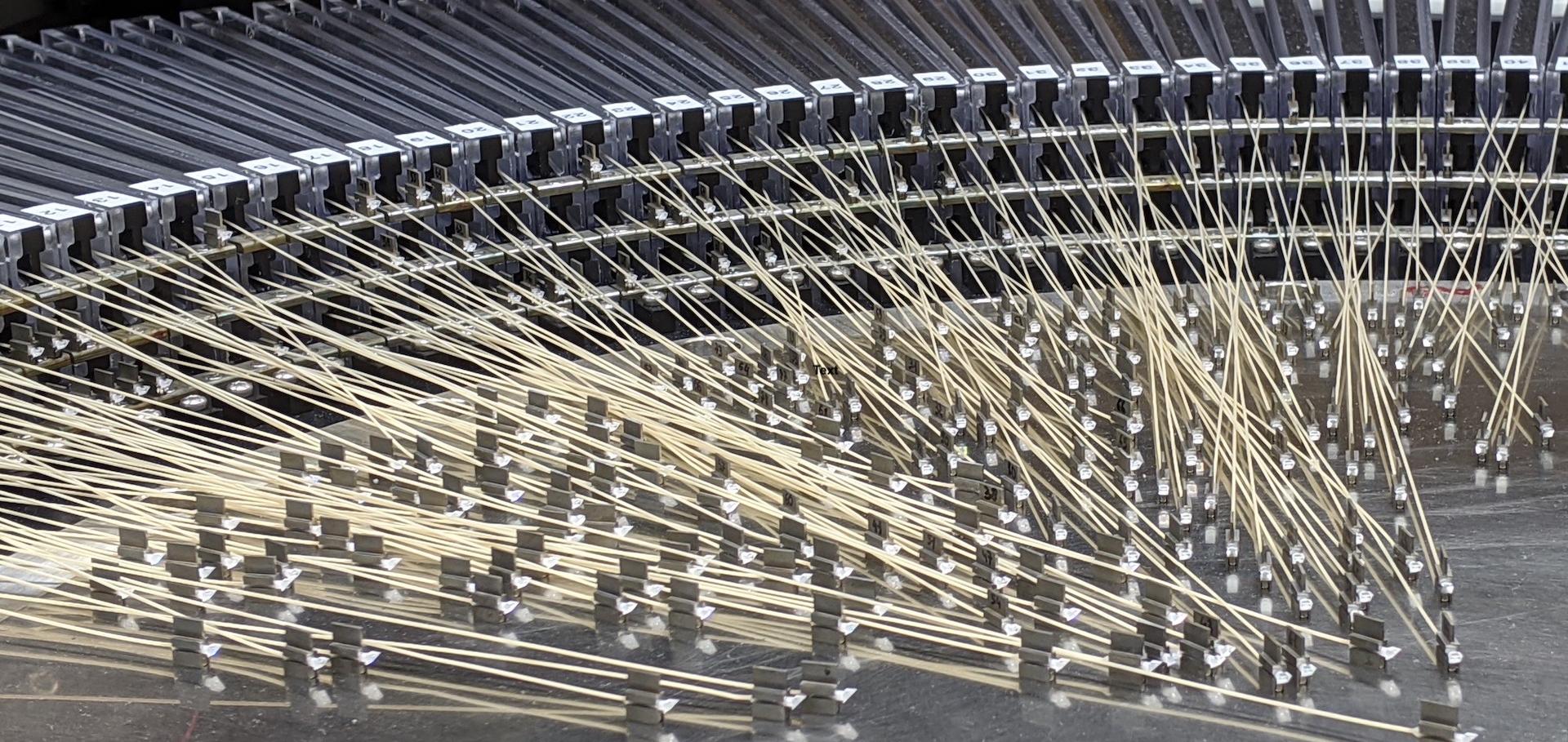
Part of a WEAVE fibre configuration

Part of the WEAVE focal plane showing optical fibres positioned on a set of targets in the telescope focal plane.

Prof Gavin Dalton

Professor of Astrophysics

Research theme

  • Astronomy and astrophysics

Sub department

  • Astrophysics

Research groups

  • Astronomical instrumentation
  • Extremely Large Telescope
Gavin.Dalton@physics.ox.ac.uk
  • About
  • Research
  • Publications

The hardware control system for WEAVE at the William Herschel telescope

Ground-based and Airborne Telescopes VII Society of Photo-optical Instrumentation Engineers (2018)

Authors:

JM Delgado, SM Mendoza, JA Burgal, JM Herreros, S Picó, DC Abrams, C Martin, D Cano, FJ Gribbin, J Skvarc, K Dee, E Lhome, Gavin Dalton, K Middleton, S Trager, JAL Aguerri, P Bonifacio, A Vallenari, E Carrasco

Abstract:

When an alt-azimuth telescope is tracking at a specific field, it is necessary to use a de-rotator system to compensate the Earth’s rotation of the field of view. In order, to keep the telescope tracking the field of view selected, the instrument will need to a rotation system for compensating it [1]. The new WEAVE [2] two degrees field of view requires a new field de-rotator on the top-end of the telescope. The rotator system has been designed with a direct drive motor which eliminates the need for mechanical transmission elements such as gearboxes, speed reducers, and worm gear drives. This design is a huge advantage for the system performance and lifetime because it eliminates undesirable characteristics such as long-time drift, elasticity, and backlash. The hardware control system has been developed with a Rockwell servo-drive and controller. The rotator has to be controlled by the high-level software which is also responsible for the telescope control. This paper summarizes the model developed for simulating and the software which will be used to accept the rotator system. A performance study is also carried out to test the CIP (Common Industrial Protocol) for communications between the high-level software and the rotator hardware.
More details from the publisher
Details from ORA

Thermal and mechanical design and test of the CCD mount for the WEAVE spectrograph cryostats

SPIE Astronomical Telescopes + Instrumentation 2018 Society of Photo-optical Instrumentation Engineers (2018)

Authors:

S Bates, IA Steele, CJ Mottram, HE Jermak, N Tromp, J Kragt, E Elswijk, J Pragt, R Stuik, R Barnsley, C Monroe, Gavin Dalton, S Trager, JAL Aguerri, P Bonifacio, A Vallenari, E Carrasco, DC Abrams, K Middleton

Abstract:

WEAVE is the new multi-object spectrograph for the William Herschel Telescope on La Palma. The culmination of prime focus, the large number of fibers and the wide resolution range has required a stringent optical design, which in turn demands a spectrograph with tight positional tolerances and large final focal plane. To capture this focal plane each of the two cryostats has two e2v 6k x 6k CCDs mounted as a mosaic. As well as being cooled to 150K via liquid nitrogen, the positional tolerances for the sensitive areas are flatness 60μm p-v over the entire image area, rotation around X and Y axis ±50 arcmin, translation in X, Y and Z ± 50 micron.


We have used a Stil confocal measuring head mounted on two Thorlab translation stages to create a X,Y mount, controlled by a Raspberry Pi that is capable of recording measurements in Z to better than 1μm accuracy. This is used to measure the flatness and deformation of the image area under vacuum, and when cooled to 150K and the overall tip and tilt of the image plane to ensure they meet specification and are repeatable.


In addition to this measuring system, we use a Thorlabs CMOS camera with a Navitar 50mm lens to ensure each CCDs image area is within specification with regards X and Y translation.


In order to satisfy the above requirements, we designed the CCD mount to be adjustable (on initial setup), correctly constrained, isolated from liquid nitrogen boil-off vibration, and thermally insulating.

More details from the publisher
Details from ORA
More details

VIRUS: status and performance of the massively-replicated fiber integral field spectrograph for the upgraded Hobby-Eberly Telescope

Ground-based and Airborne Instrumentation for Astronomy VII Society of Photo-optical Instrumentation Engineers (2018)

Authors:

G Hill, A Kelz, H Lee, P MacQueen, TW Peterson, J Ramsey, BL Vattiat, DL DePoy, N Drory, K Gebhardt, JM Good, T Jahn, H Kriel, JL Marshall, Tuttle, G Zeimann, E Balderrama, R Bryant, B Buetow, T Chonis, G Damm, MH Fabricius, D Farrow, J Fowler, C Froning, DM Haynes, BL Indahl, J Martin, F Montesano, E Mrozinski, H Nicklas, E Noyola, S Odewahn, A Peterson, T Prochaska, S Rostopchin, M Shetrone, G Smith, JM Snigula, R Spencer, A Westfall, T Armandroff, R Bender, Gavin Dalton, M Steinmetz

Abstract:

The Visible Integral-field Replicable Unit Spectrograph (VIRUS) consists of 156 identical spectrographs (arrayed as 78 pairs, each with a pair of spectrographs) fed by 35,000 fibers, each 1.5 arcsec diameter, at the focus of the upgraded 10 m Hobby-Eberly Telescope (HET). VIRUS has a fixed bandpass of 350-550 nm and resolving power R~750. The fibers are grouped into 78 integral field units, each with 448 fibers and 20 m average length. VIRUS is the first example of large-scale replication applied to optical astronomy and is capable of surveying large areas of sky, spectrally. The VIRUS concept offers significant savings of engineering effort and cost when compared to traditional instruments.


The main motivator for VIRUS is to map the evolution of dark energy for the Hobby-Eberly Telescope Dark Energy Experiment (HETDEX‡), using 0.8M Lyman-alpha emitting galaxies as tracers. The VIRUS array has been undergoing staged deployment starting in late 2015. Currently, more than half of the array has been populated and the HETDEX survey started in 2017 December. It will provide a powerful new facility instrument for the HET, well suited to the survey niche of the telescope, and will open up large spectroscopic surveys of the emission line universe for the first time. We will review the current state of production, lessons learned in sustaining volume production, characterization, deployment, and commissioning of this massive instrument.

More details from the publisher
Details from ORA

Simulating Surveys for ELT-MOSAIC: Status of the MOSAIC Science Case after Phase A

(2018)

Authors:

M Puech, CJ Evans, K Disseau, J Japelj, OH Ramírez-Agudelo, H Rahmani, M Trevisan, JL Wang, M Rodrigues, R Sánchez-Janssen, Y Yang, F Hammer, L Kaper, SL Morris, B Barbuy, J-G Cuby, G Dalton, E Fitzsimons, P Jagourel, the MOSAIC Science Team
More details from the publisher

The Subaru FMOS galaxy redshift survey (FastSound). V. Intrinsic alignments of emission-line galaxies at z ∼ 1.4

Publications of Astronomical Society of Japan Oxford University Press 70:3 (2018) 41

Authors:

Motonari Tonegawa, Teppei Okumura, Tomonori Totani, Gavin Dalton, Karl Glazebrook, Kiyoto Yabe

Abstract:

Intrinsic alignments (IA), the coherent alignment of intrinsic galaxy orientations, can be a source of a systematic error of weak lensing surveys. The redshift evolution of IA also contains information about the physics of galaxy formation and evolution. This paper presents the first measurement of IA at high redshift, z ∼ 1.4, using the spectroscopic catalog of blue star-forming galaxies of the FastSound redshift survey, with the galaxy shape information from the Canada–Hawaii–France telescope lensing survey. The IA signal is consistent with zero with power-law amplitudes fitted to the projected correlation functions for density–shape and shape–shape correlation components, Aδ+ = −0.0071 ± 0.1340 and A++ = −0.0505 ± 0.0848, respectively. These results are consistent with those obtained from blue galaxies at lower redshifts (e.g., Aδ+=0.0035+0.0387−0.0389 and A++=0.0045+0.0166−0.0168 at z = 0.51 from the WiggleZ survey). The upper limit of the constrained IA amplitude corresponds to a few percent contamination to the weak-lensing shear power spectrum, resulting in systematic uncertainties on the cosmological parameter estimations by −0.052 < Δσ8 < 0.039 and −0.039 < ΔΩm < 0.030.
More details from the publisher
Details from ORA
More details

Pagination

  • First page First
  • Previous page Prev
  • …
  • Page 15
  • Page 16
  • Page 17
  • Page 18
  • Current page 19
  • Page 20
  • Page 21
  • Page 22
  • Page 23
  • …
  • Next page Next
  • Last page Last

Footer Menu

  • Contact us
  • Giving to the Dept of Physics
  • Work with us
  • Media

User account menu

  • Log in

Follow us

FIND US

Clarendon Laboratory,

Parks Road,

Oxford,

OX1 3PU

CONTACT US

Tel: +44(0)1865272200

University of Oxfrod logo Department Of Physics text logo
IOP Juno Champion logo Athena Swan Silver Award logo

© University of Oxford - Department of Physics

Cookies | Privacy policy | Accessibility statement

Built by: Versantus

  • Home
  • Research
  • Study
  • Engage
  • Our people
  • News & Comment
  • Events
  • Our facilities & services
  • About us
  • Giving to Physics
  • Current students
  • Staff intranet