


Echidna Mark II: one giant leap for 'tilting spine' fibre positioning technology
Abstract:
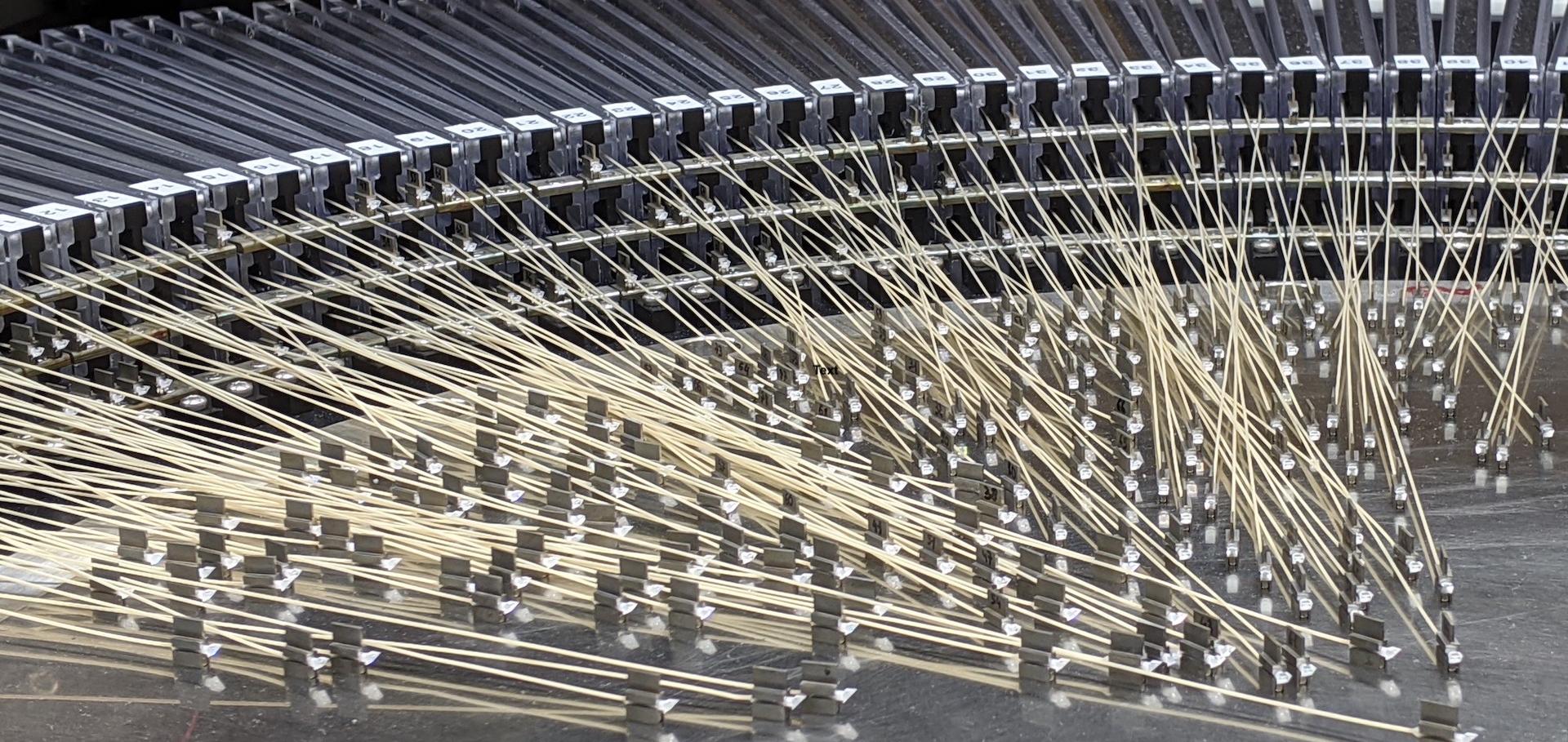
The Australian Astronomical Observatory's 'tilting spine' fibre positioning technology has been redeveloped to provide superior performance in a smaller package. The new design offers demonstrated closed-loop positioning errors of <2.8 μm RMS in only five moves (~10 s excluding metrology overheads) and an improved capacity for open-loop tracking during observations. Tilt-induced throughput losses have been halved by lengthening spines while maintaining excellent accuracy. New low-voltage multilayer piezo actuator technology has reduced a spine's peak drive amplitude from ~150V to <10V, simplifying the control electronics design, reducing the system's overall size, and improving modularity. Every spine is now a truly independent unit with a dedicated drive circuit and no restrictions on the timing or direction of fibre motion.First results of tests on the WEAVE fibres
Abstract:
WEAVE is a new wide-field spectroscopy facility proposed for the prime focus of the 4.2m William Herschel Telescope. The facility comprises a new 2-degree field of view prime focus corrector with a 1000-multiplex fibre positioner, a small number of individually deployable integral field units, and a large single integral field unit. The IFUs (Integral Field Units) and the MOS (Multi Object Spectrograph) fibres can be used to feed a dual-beam spectrograph that will provide full coverage of the majority of the visible spectrum in a single exposure at a spectral resolution of ~5000 or modest wavelength coverage in both arms at a resolution ~20000. The instrument is expected to be on-sky by the first quarter of 2018 to provide spectroscopic sampling of the fainter end of the Gaia astrometric catalogue, chemical labeling of stars to V~17, and dedicated follow up of substantial numbers of sources from the medium deep LOFAR surveys. After a brief description of the Fibre System, we describe the fibre test bench, its calibration, and some test results. We have to verify 1920 fibres from the MOS bundles and 740 fibres from the mini-IFU bundles with the test bench. In particular, we present the Focal Ratio Degradation of a cable.Manufacturing process for the WEAVE Prime Focus Corrector optics for the 4.2m William Herschel Telescope
Abstract:
In this paper, we detail the manufacturing process for the lenses that will constitute the new two-degree field-of-view Prime Focus Corrector (PFC) for the 4.2m William Herschel Telescope (WHT) optimised for the upcoming WEAVE Multi-Object Spectroscopy (MOS) facility. The corrector, including an Atmospheric Dispersion Corrector (ADC), is made of six large lenses, the largest being 1.1-meter diameter. We describe how the prescriptions of the optical design were translated into manufacturing specifications for the blanks and lenses. We explain how the as-built glass blank parameters were fed back into the optical design and how the specifications for the lenses were subsequently modified. We review the critical issues for the challenging manufacturing process and discuss the trade-offs that were necessary to deliver the lenses while maintaining the optimal optical performance. A short description of the lens optical testing is also presented. Finally, the subsequent manufacturing steps, including assembly, integration, and alignment are outlined.The WEAVE focus translation system: from design to construction
Abstract:
WEAVE is a new wide-field spectroscopy facility proposed for the prime focus of the 4.2m William Herschel Telescope (WHT), placed in La Palma, Canary Islands, Spain.
To allow for the compensation of the effects of temperature-induced and gravity-induced image degradation, the WEAVE prime focus assembly will be translated along the telescope optical axis. The assembly comprises the prime focus corrector with integrated ADC, a central mount for the corrector, an instrument rotator and a twin-focal-plane fibre positioner. Translation is accomplished through the use of a set of purpose-built actuators; collectively referred to as the Focus Translation System (FTS), formed by four independently-controlled Focus Translation Units (FTUs), eight vanes connecting the FTUs to a central can, and a central can hosting WEAVE Instrument. Each FTU is capable of providing a maximum stroke of ±4mm with sufficient, combined force to move the five-tonne assembly with a positional accuracy of ±20µm at a resolution of 5µm. The coordinated movement of the four FTUs allows ±3mm WEAVE focus adjustment in the optical axis and ±0.015º tilt correction in one axis. The control of the FTS is accomplished through a PLC-based subsystem that receives positional demands from the higher-level Instrument Control System.
SENER has been responsible for designing, manufacturing and testing the FTS and the equipment required to manipulate and store the FTS together with the instrument.
This manuscript describes the final design of the FTS along with the analyses and simulations that were performed, discusses the manufacturing procedures and the results of early verification prior to integration with the telescope. The plans for mounting the whole system on the telescope are also discussed.