


Emergence of Robust Zonal Jets in a Differentially Heated Rotating Annulus
Copernicus Publications (2026)
Abstract:
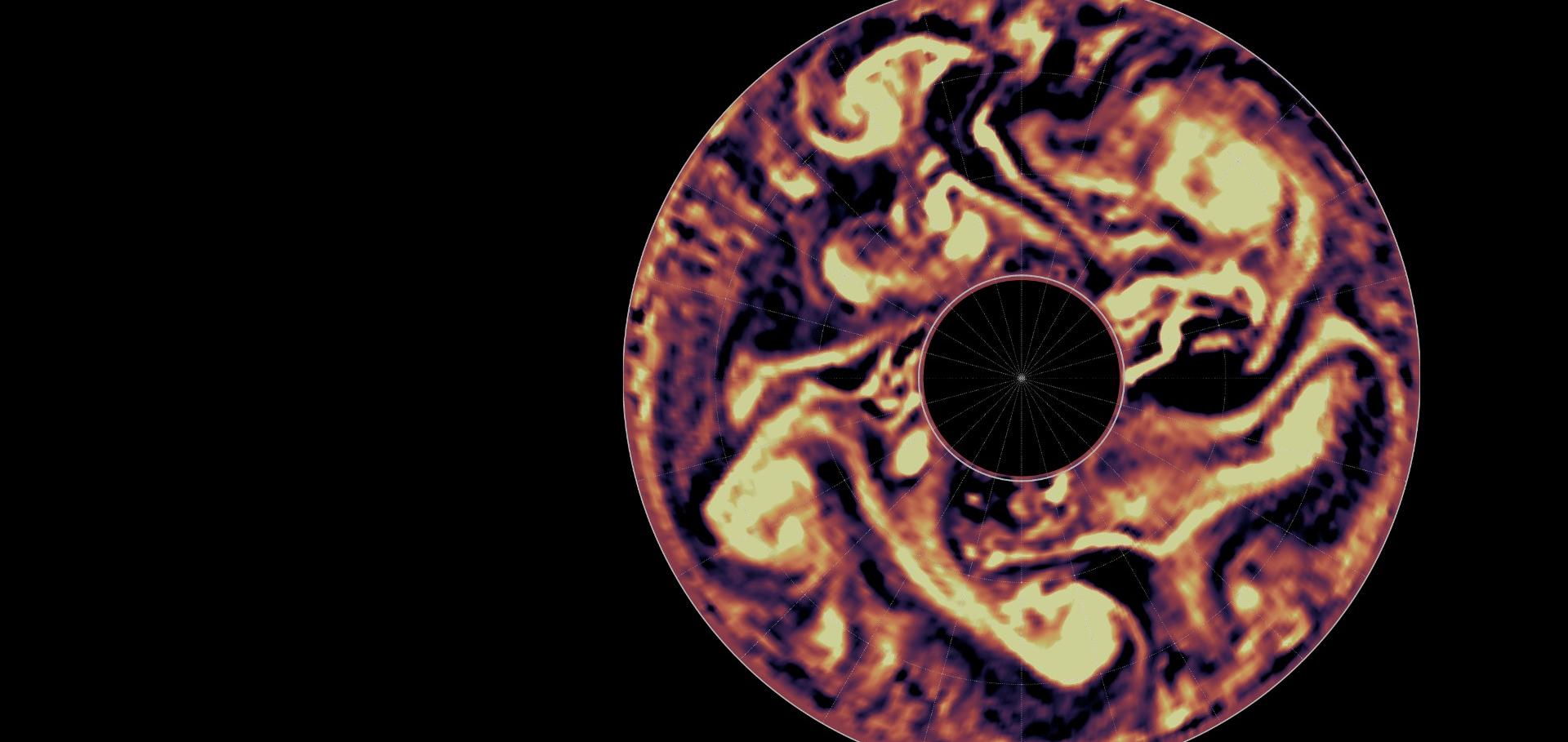
The midlatitude atmospheres of gas giant planets are characteristic of strong and persistent zonal jets; however, the processes governing their formation and the associated energy pathways remain less understood. To investigate these mechanisms, we conducted a laboratory study of zonal jets driven by thermal forcing in an annular cylindrical tank partially filled with distilled water as the working fluid. Heating is applied at the outer boundary, cooling at the inner boundary, the bottom is thermally insulated, and the top is a free surface. An array of laser diodes embedded in the inner cylinder generates an annular laser sheet, enabling the measurement of velocity fields at a fixed height using particle image velocimetry. By systematically varying the rotation rate and the imposed temperature contrast, we adjusted the steepness of the free surface, thus the topographic β effect, and the thermal forcing strength, respectively. The non-dimensional controlling parameter, thermal Rossby number, RoT, ranges from 0.0012 to 0.01 and Taylor number, Ta, from 2.3 × 10¹⁰ to1.7 × 1011. We discerned the emergence of robust zonal jets, of which the zonal-mean kinetic energy accounts for up to 70% of the total kinetic energy, corresponding to a zonostrophic index of 2.7. In this regime, two coherent and persistent prograde jets form near the inner and outer boundaries. The radial profile of the potential vorticity develops toward a pronounced staircase-like structure, consistent with previous numerical studies (Scott and Dritschel, J. Fluid Mech., 2012). Analysis of the inter-scale energy transfer reveals a dominant interaction between the zonal-mean flow and eddies, while the kinetic energy spectrum of the zonal-mean component exhibits k−5 (where k denotes the wavenumber), in agreement with the theory of zonostrophic turbulence (Sukoriansky and Galperin, PRL, 2002). Figure 1: A snapshot of azimuthal velocity contour for RoT = 7.1 × 10⁻³, Ta = 1.44 × 10¹¹ and β =49.7 m−1 s−1.Stratification-dependent enstrophy-controlled regime in geostrophic turbulence
Physical Review Letters American Physical Society (APS) (2026)
Experimental dataset of baroclinic-driven zonal jet flows
University of Oxford (2026)
Abstract:
This dataset comprises two-component horizontal velocity fields from experiments in a rotating, differentially heated fluid annulus. The experiments were conducted at the GFDLab, University of Oxford.Experimental dataset of sandwiched baroclinic flows over a bottom conical plate
University of Oxford (2025)
Abstract:
This dataset comprises time-resolved, two-component horizontal velocity fields from experiments in a rotating, differentially heated fluid annulus. The experiments were conducted at the GFDLab, University of Oxford.Predicting internal boundary layer growth following a roughness change in thermally neutral and stable boundary layers
Journal of Fluid Mechanics Cambridge University Press 1016 (2025) R4