


The super fine-grained detector for the T2K neutrino oscillation experiment
Nuclear Instruments and Methods in Physics Research Section A Accelerators Spectrometers Detectors and Associated Equipment Elsevier (2026) 171882
Abstract:
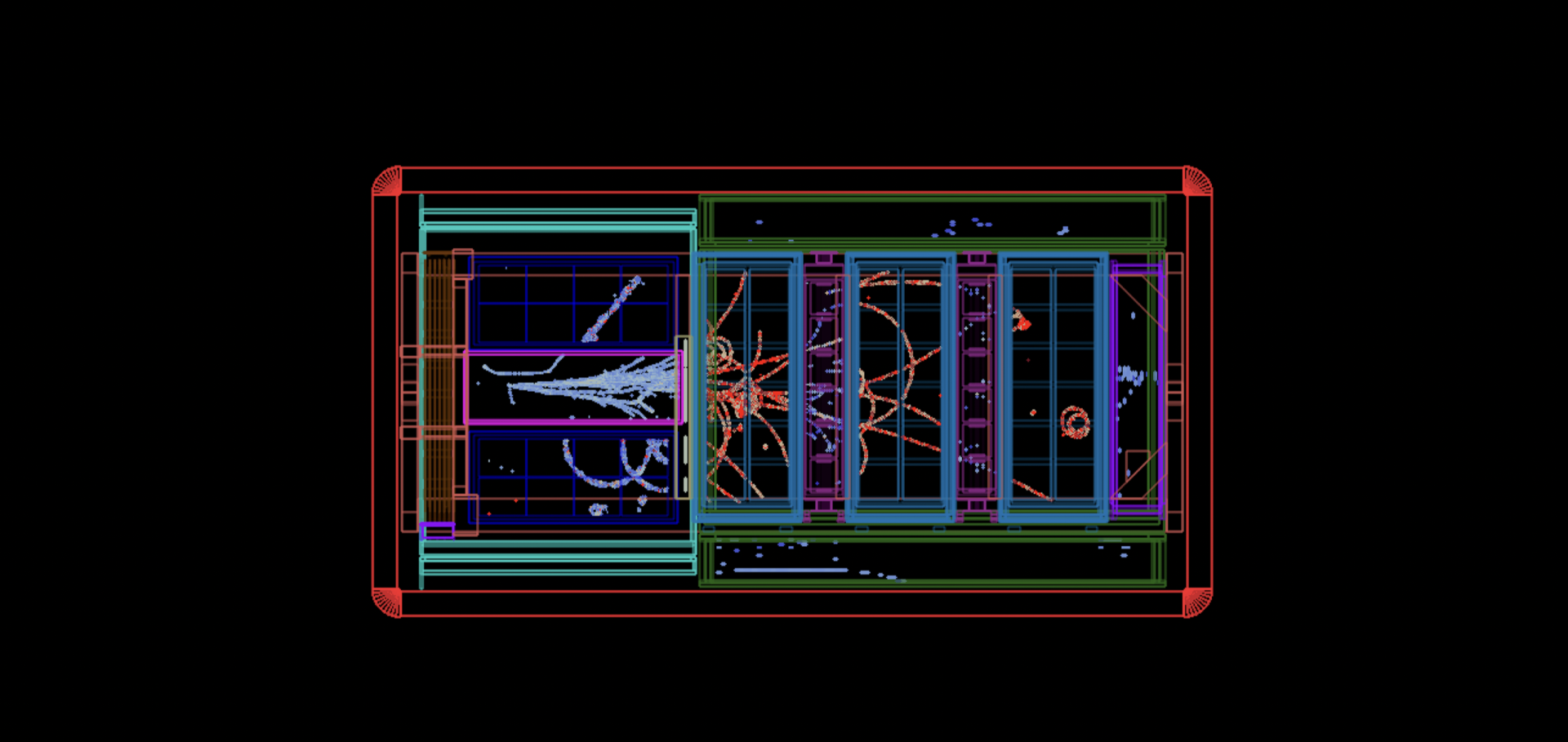
The magnetised near detector ND280 of the long-baseline neutrino experiment T2K has been upgraded to improve its detection performance and, consequently, enhance our understanding of neutrino-nucleus interactions, reducing the systematic uncertainties in measurements of the neutrino oscillation parameters. A key component of the upgrade is a novel segmented plastic scintillator detector, called the Super Fine-Grained Detector (SuperFGD), made of approximately 2 million optically isolated 1 cm 3 cubes read out by three orthogonal wavelength-shifting fibres. Scintillation photons are detected by 55,888 Hamamatsu Multi-Pixel Photon Counters. The SuperFGD provides 3D images of neutrino interactions by tracking the final-state charged particles produced isotropically, including protons down to a threshold of around 330 MeV/ c . The high light yield of SuperFGD greatly improves particle identification and the sub-nanosecond time resolution provides an excellent identification of Michel electrons. The SuperFGD is also able to detect neutrons from neutrino interactions and, for the first time in a neutrino experiment, to reconstruct their kinetic energy using a fine detector segmentation and by measuring the time-of-flight with sub-nanosecond precision. In this article the details of the detector design, construction and performance are described. The detector was installed in ND280 and successfully commissioned with cosmic data in 2023 and, later, with the T2K neutrino beam. The detector response has been characterised with the 2023 and 2024 data and the results are reported in this article.Testing T2K’s Bayesian constraints with priors in alternate parameterisations
European Physical Journal C 85:12 (2025) 1414
Abstract:
Bayesian analysis results require a choice of prior distribution. In long-baseline neutrino oscillation physics, the usual parameterisation of the mixing matrix induces a prior that privileges certain neutrino mass and flavour state symmetries. Here we study the effect of privileging alternate symmetries on the results of the T2K experiment. We find that constraints on the level of CP violation (as given by the Jarlskog invariant) are robust under the choices of prior considered in the analysis. On the other hand, the degree of octant preference for the atmospheric angle depends on which symmetry has been privileged.Measurements of neutrino oscillation parameters from the T2K experiment using $$3.6\times 10^{21}$$ protons on target
The European Physical Journal C SpringerOpen 83:9 (2023) 782
Abstract:
We present the first measurement of differential cross sections for charged-current muon neutrino interactions on argon with one muon, two protons, and no pions in the final state. These final states are dominated by two-nucleon knockout interactions, which are complicated to model and for which there is currently limited information about the characteristics of these interactions in existing neutrino-nucleus scattering data. Detailed investigations of two-nucleon knockout are vital to support upcoming experiments exploring the nature of the neutrino. Among the different kinematic quantities measured, the opening angle between the two protons, the angle between the total proton momentum and the muon, and the total transverse momentum of the final state system are most sensitive to the underlying physics processes as embodied in various theoretical modelsSearch for electron antineutrino appearance in a long-baseline muon antineutrino beam
Physical Review Letters American Physical Society 124:16 (2020) 161802