


Geometric quantum computation
J MOD OPTIC 47:14-15 (2000) 2501-2513
Abstract:
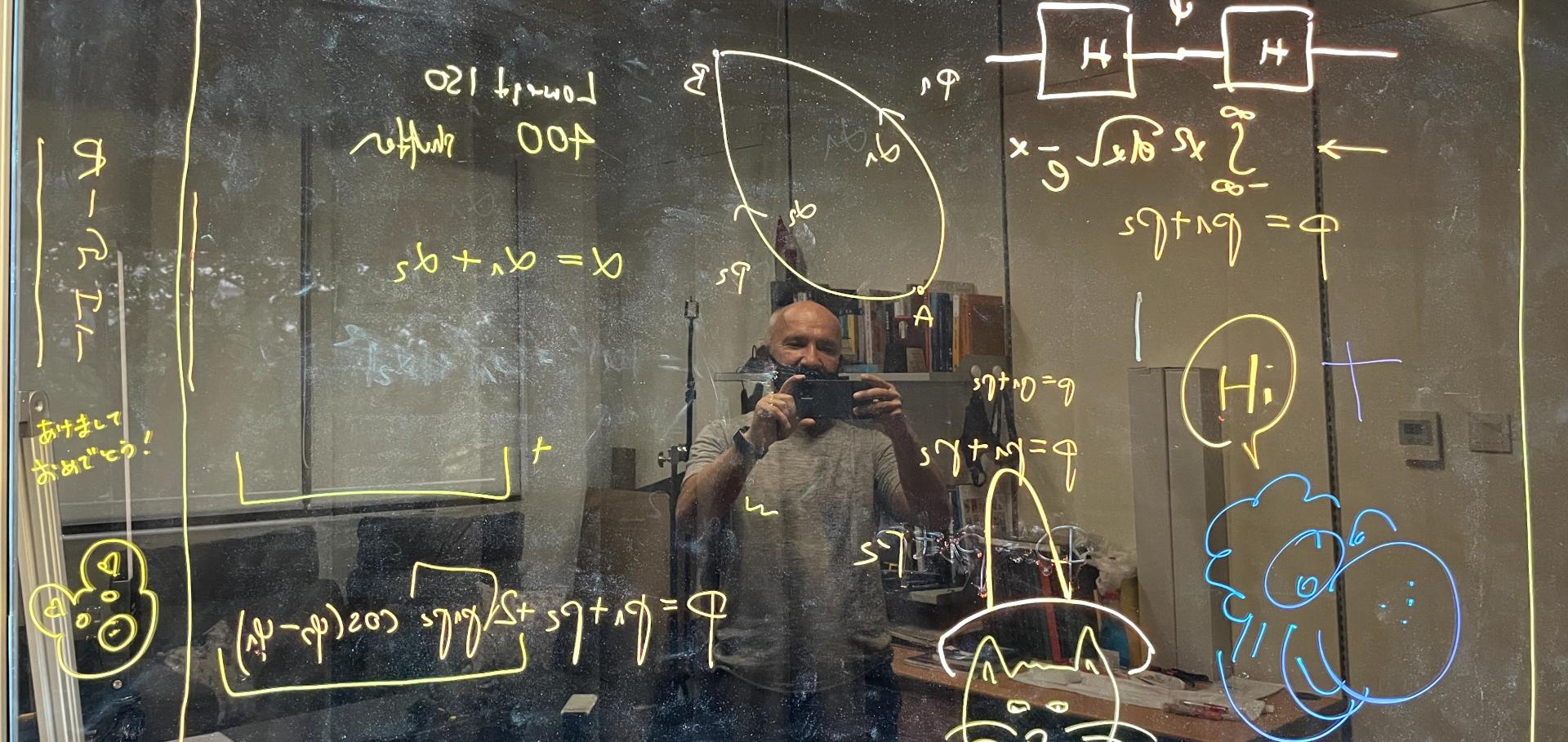
We describe in detail a general strategy for implementing a conditional geometric phase between two spins. Combined with single-spin operations, this simple operation is a universal gate for quantum computation, in that any unitary transformation can be implemented with arbitrary precision using only single-spin operations and conditional phase shifts. Thus quantum geometrical phases can form the basis of any quantum computation. Moreover, as the induced conditional phase depends only on the geometry of the paths executed by the spins it is resilient to certain types of errors and offers the potential of a naturally fault-tolerant way of performing quantum computation.Geometric phases for mixed states in interferometry.
Phys Rev Lett 85:14 (2000) 2845-2849
Abstract:
We provide a physical prescription based on interferometry for introducing the total phase of a mixed state undergoing unitary evolution, which has been an elusive concept in the past. We define the parallel transport condition that provides a connection form for obtaining the geometric phase for mixed states. The expression for the geometric phase for mixed state reduces to well known formulas in the pure state case when a system undergoes noncyclic and unitary quantum evolution.Scalable quantum computation with cavity QED systems
Physical Review A Atomic Molecular and Optical Physics 62:3 (2000) 032306-032301
Abstract:
A scheme for implementing quantum logic operations within a cavity of QED configuration is presented. This scheme is particularly suitable for the direct implementation of some useful many-qubit quantum gates. From a general point of view, the scheme is analogous to the linear ion trap scheme, except that the high-Q cavities play the role of the ions, and the atoms play the role of the quantum bus.Toward scalable quantum computation with cavity QED systems
ArXiv quant-ph/0004107 (2000)