Home
Department Of Physics text logo
  • Research
    • Our research
    • Our research groups
    • Our research in action
    • Research funding support
    • Summer internships for undergraduates
  • Study
    • Undergraduates
    • Postgraduates
  • Engage
    • For alumni
    • For business
    • For schools
    • For the public
  • Support
Menu
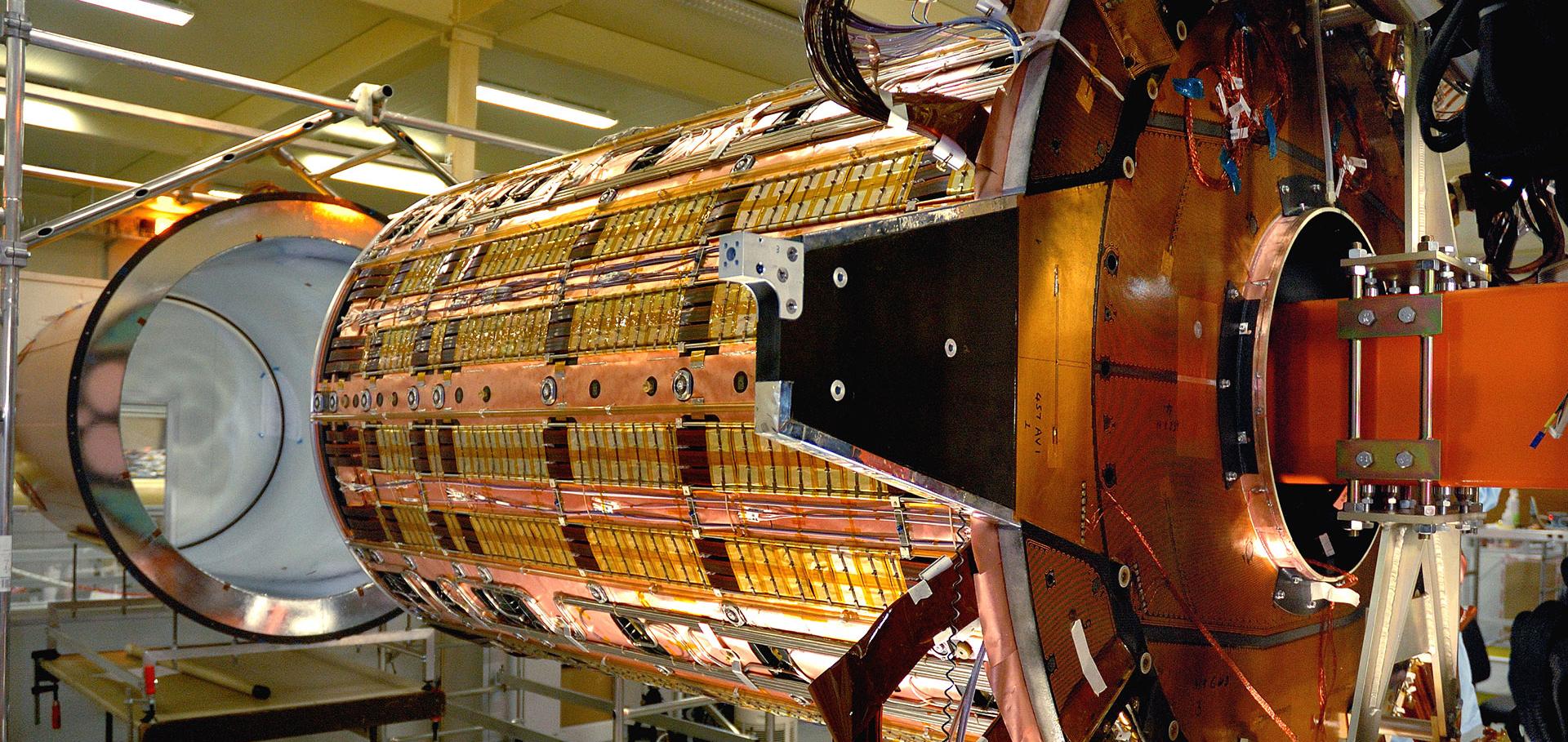
Insertion of STC into TRT at the Department of Physics, Oxford
Credit: CERN

Dr Caroline Fengler

PDRA

Sub department

  • Particle Physics
caroline.fengler@physics.ox.ac.uk
Denys Wilkinson Building, room 665a
  • About
  • Publications

First Constraints on General Neutrino Interactions Based on KATRIN Data

Physical Review Letters American Physical Society (APS) 134:25 (2025) 251801

Authors:

M Aker, D Batzler, A Beglarian, J Beisenkötter, M Biassoni, B Bieringer, Y Biondi, F Block, B Bornschein, L Bornschein, M Böttcher, M Carminati, A Chatrabhuti, S Chilingaryan, BA Daniel, M Descher, D Díaz Barrero, PJ Doe, O Dragoun, G Drexlin, F Edzards, K Eitel, E Ellinger, R Engel, S Enomoto, A Felden, C Fengler, C Fiorini, JA Formaggio, C Forstner, FM Fränkle, G Gagliardi, K Gauda, AS Gavin, W Gil, F Glück, R Grössle, N Gutknecht, V Hannen, L Hasselmann, K Helbing, H Henke, S Heyns, R Hiller, D Hillesheimer, D Hinz, T Höhn, A Huber, A Jansen, K Khosonthongkee, C Köhler, L Köllenberger, A Kopmann, N Kovač, L La Cascio, T Lasserre, J Lauer, TL Le, O Lebeda, B Lehnert, G Li, A Lokhov, M Machatschek, M Mark, A Marsteller, K McMichael, C Melzer, S Mertens, S Mohanty, J Mostafa, K Müller, A Nava, H Neumann, S Niemes, A Onillon, DS Parno, M Pavan, U Pinsook, AWP Poon, JML Poyato, F Priester, J Ráliš, S Ramachandran, RGH Robertson, C Rodenbeck, M Röllig, R Sack, A Saenz, R Salomon, P Schäfer, K Schlösser, M Schlösser, L Schlüter, S Schneidewind, M Schrank, J Schürmann, AK Schütz, A Schwemmer, A Schwenck, J Seeyangnok, M Šefčík, D Siegmann, F Simon, J Songwadhana, F Spanier, D Spreng, W Sreethawong, M Steidl, J Štorek, X Stribl, M Sturm, N Suwonjandee, N Tan Jerome, HH Telle, LA Thorne, T Thümmler, N Titov, I Tkachev, K Urban, K Valerius, D Vénos, C Weinheimer, S Welte, J Wendel, M Wetter, C Wiesinger, JF Wilkerson, J Wolf, S Wüstling, J Wydra, W Xu, S Zadorozhny, G Zeller

Abstract:

The precision measurement of the tritium β-decay spectrum performed by the KATRIN experiment provides a unique way to search for general neutrino interactions (GNIs). All theoretically allowed GNI terms at dimension 6 involving neutrinos are incorporated into a low-energy effective field theory, and can be identified by specific signatures in the measured tritium β spectrum. In this Letter an effective description of the impact of GNIs on the β spectrum is formulated and the first constraints on the effective GNI parameters are derived based on the 4×10^{6} electrons collected in the second measurement campaign of KATRIN in 2019. In addition, constraints on selected types of interactions are investigated, thereby exploring the potential of KATRIN to search for more specific new physics cases, including a right-handed W boson, a charged Higgs boson, or leptoquarks.
More details from the publisher
More details
More details

Sterile-neutrino search based on 259 days of KATRIN data.

Nature 648:8092 (2025) 70-75

Abstract:

Neutrinos are the most abundant fundamental matter particles in the Universe and play a crucial part in particle physics and cosmology. Neutrino oscillation, discovered about 25 years ago, shows that the three known species mix with each other. Anomalous results from reactor and radioactive-source experiments<sup>1</sup> suggest a possible fourth neutrino state, the sterile neutrino, which does not interact through the weak force. The Karlsruhe Tritium Neutrino (KATRIN) experiment<sup>2</sup>, primarily designed to measure the neutrino mass using tritium β-decay, also searches for sterile neutrinos suggested by these anomalies. A sterile-neutrino signal would appear as a distortion in the β-decay energy spectrum, characterized by a discontinuity in curvature (kink) related to the sterile-neutrino mass. This signature, which depends only on the shape of the spectrum rather than its absolute normalization, offers a robust, complementary approach to reactor experiments. Here we report the analysis of the energy spectrum of 36 million tritium β-decay electrons recorded in 259 measurement days within the last 40 eV below the endpoint. The results exclude a substantial part of the parameter space suggested by the gallium anomaly and challenge the Neutrino-4 claim. Together with other neutrino-disappearance experiments, KATRIN probes sterile-to-active mass splittings from a fraction of an eV<sup>2</sup> to several hundred eV<sup>2</sup>, excluding light sterile neutrinos with mixing angles above a few per cent.
More details from the publisher
More details
More details

Measurement of the inhomogeneity of the KATRIN tritium source electric potential by high-resolution spectroscopy of conversion electrons from 83mKr

European Physical Journal C Springer Nature 85:7 (2025) ARTN 757

Authors:

H Acharya, M Aker, D Batzler, A Beglarian, J Beisenkötter, M Biassoni, B Bieringer, Y Biondi, F Block, B Bornschein, L Bornschein, M Böttcher, M Carminati, A Chatrabhuti, S Chilingaryan, Ba Daniel, M Descher, D Díaz Barrero, O Dragoun, G Drexlin, F Edzards, K Eitel, E Ellinger, R Engel, S Enomoto, A Felden, C Fengler, C Fiorini, Ja Formaggio, C Forstner, Fm Fränkle, G Gagliardi, K Gauda, As Gavin, W Gil, F Glück, R Größle, V Gupta, K Habib, V Hannen, L Hasselmann, K Helbing, S Heyns, R Hiller, D Hillesheimer, D Hinz, T Höhn, A Huber, A Jansen, K Khosonthongkee

Abstract:

Precision spectroscopy of the electron spectrum of the tritium β$$\upbeta $$-decay near the kinematic endpoint is a direct method to determine the effective electron antineutrino mass. The KArlsruhe TRItium Neutrino (KATRIN) experiment aims to determine this quantity with a sensitivity of better than 0.3eV$${0.3}{\hbox { eV}}$$ (90%$$90\%$$ C.L.). An inhomogeneous electric potential in the tritium source of KATRIN can lead to distortions of the β$$\upbeta $$-spectrum, which directly impact the neutrino-mass observable. This effect can be quantified through precision spectroscopy of the conversion-electrons of co-circulated metastable 83mKr$$^{83\text {m}}\text {Kr}$$. Therefore, dedicated, several-weeks long measurement campaigns have been performed within the KATRIN data taking schedule. In this work, we infer the tritium source potential observables from these measurements, and present their implications for the neutrino-mass determination.
More details from the publisher
More details
More details

Direct neutrino-mass measurement based on 259 days of KATRIN data.

Science (New York, N.Y.) 388:6743 (2025) 180-185

Authors:

KATRIN Collaboration†, Max Aker, Dominic Batzler, Armen Beglarian, Jan Behrens, Justus Beisenkötter, Matteo Biassoni, Benedikt Bieringer, Yanina Biondi, Fabian Block, Steffen Bobien, Matthias Böttcher, Beate Bornschein, Lutz Bornschein, Tom S Caldwell, Marco Carminati, Auttakit Chatrabhuti, Suren Chilingaryan, Byron A Daniel, Karol Debowski, Martin Descher, Deseada Díaz Barrero, Peter J Doe, Otokar Dragoun, Guido Drexlin, Frank Edzards, Klaus Eitel, Enrico Ellinger, Ralph Engel, Sanshiro Enomoto, Arne Felden, Caroline Fengler, Carlo Fiorini, Joseph A Formaggio, Christian Forstner, Florian M Fränkle, Kevin Gauda, Andrew S Gavin, Woosik Gil, Ferenc Glück, Steffen Grohmann, Robin Grössle, Rainer Gumbsheimer, Nathanael Gutknecht, Volker Hannen, Leonard Hasselmann, Norman Haußmann, Klaus Helbing, Hanna Henke, Svenja Heyns, Stephanie Hickford, Roman Hiller, David Hillesheimer, Dominic Hinz, Thomas Höhn, Anton Huber, Alexander Jansen, Christian Karl, Jonas Kellerer, Khanchai Khosonthongkee, Matthias Kleifges, Manuel Klein, Joshua Kohpeiß, Christoph Köhler, Leonard Köllenberger, Andreas Kopmann, Neven Kovač, Alojz Kovalík, Holger Krause, Luisa La Cascio, Thierry Lasserre, Joscha Lauer, Thanh-Long Le, Ondřej Lebeda, Bjoern Lehnert, Gen Li, Alexey Lokhov, Moritz Machatschek, Martin Mark, Alexander Marsteller, Eric L Martin, Christin Melzer, Susanne Mertens, Shailaja Mohanty, Jalal Mostafa, Klaus Müller, Andrea Nava, Holger Neumann, Simon Niemes, Anthony Onillon, Diana S Parno, Maura Pavan, Udomsilp Pinsook, Alan WP Poon, Jose Manuel Lopez Poyato, Stefano Pozzi, Florian Priester, Jan Ráliš, Shivani Ramachandran, RG Hamish Robertson, Caroline Rodenbeck, Marco Röllig, Carsten Röttele, Milos Ryšavý, Rudolf Sack, Alejandro Saenz, Richard Salomon, Peter Schäfer, Magnus Schlösser, Klaus Schlösser, Lisa Schlüter, Sonja Schneidewind, Ulrich Schnurr, Michael Schrank, Jannis Schürmann, Ann-Kathrin Schütz, Alessandro Schwemmer, Adrian Schwenck, Michal Šefčík, Daniel Siegmann, Frank Simon, Felix Spanier, Daniela Spreng, Warintorn Sreethawong, Markus Steidl, Jaroslav Štorek, Xaver Stribl, Michael Sturm, Narumon Suwonjandee, Nicholas Tan Jerome, Helmut H Telle, Larisa A Thorne, Thomas Thümmler, Simon Tirolf, Nikita Titov, Igor Tkachev, Korbinian Urban, Kathrin Valerius, Drahoslav Vénos, Christian Weinheimer, Stefan Welte, Jürgen Wendel, Christoph Wiesinger, John F Wilkerson, Joachim Wolf, Sascha Wüstling, Johanna Wydra, Weiran Xu, Sergey Zadorozhny, Genrich Zeller

Abstract:

That neutrinos carry a nonvanishing rest mass is evidence of physics beyond the Standard Model of elementary particles. Their absolute mass holds relevance in fields from particle physics to cosmology. We report on the search for the effective electron antineutrino mass with the KATRIN experiment. KATRIN performs precision spectroscopy of the tritium β-decay close to the kinematic endpoint. On the basis of the first five measurement campaigns, we derived a best-fit value of [Formula: see text] eV2, resulting in an upper limit of mν < 0.45 eV at 90% confidence level. Stemming from 36 million electrons collected in 259 measurement days, a substantial reduction of the background level, and improved systematic uncertainties, this result tightens KATRIN's previous bound by a factor of almost two.
More details from the publisher
More details
More details

Measurement of the electric potential and the magnetic field in the shifted analysing plane of the KATRIN experiment

European Physical Journal C Springer Nature 84:12 (2024) ARTN 1258

Authors:

M Aker, D Batzler, A Beglarian, J Behrens, J Beisenkötter, M Biassoni, B Bieringer, Y Biondi, F Block, S Bobien, M Böttcher, B Bornschein, L Bornschein, Ts Caldwell, M Carminati, A Chatrabhuti, S Chilingaryan, Ba Daniel, K Debowski, M Descher, D Díaz Barrero, Pj Doe, O Dragoun, G Drexlin, F Edzards, K Eitel, E Ellinger, R Engel, S Enomoto, A Felden, C Fengler, C Fiorini, Ja Formaggio, C Forstner, Fm Fränkle, K Gauda, As Gavin, W Gil, F Glück, R Grössle, R Gumbsheimer, V Hannen, L Hasselmann, N Haußmann, K Helbing, S Heyns, S Hickford, R Hiller, D Hillesheimer, D Hinz

Abstract:

The projected sensitivity of the effective electron neutrino-mass measurement with the KATRIN experiment is below 0.3 eV (90 % CL) after 5 years of data acquisition. The sensitivity is affected by the increased rate of the background electrons from KATRIN’s main spectrometer. A special shifted-analysing-plane (SAP) configuration was developed to reduce this background by a factor of two. The complex layout of electromagnetic fields in the SAP configuration requires a robust method of estimating these fields. We present in this paper a dedicated calibration measurement of the fields using conversion electrons of gaseous 83m$$^\textrm{83m}$$Kr, which enables the neutrino-mass measurements in the SAP configuration.
More details from the publisher
More details
More details

Pagination

  • Current page 1
  • Page 2
  • Next page Next
  • Last page Last

Footer Menu

  • Contact us
  • Giving to the Dept of Physics
  • Work with us
  • Media

User account menu

  • Log in

Follow us

FIND US

Clarendon Laboratory,

Parks Road,

Oxford,

OX1 3PU

CONTACT US

Tel: +44(0)1865272200

University of Oxfrod logo Department Of Physics text logo
IOP Juno Champion logo Athena Swan Silver Award logo

© University of Oxford - Department of Physics

Cookies | Privacy policy | Accessibility statement

Built by: Versantus

  • Home
  • Research
  • Study
  • Engage
  • Our people
  • News & Comment
  • Events
  • Our facilities & services
  • About us
  • Giving to Physics
  • Current students
  • Staff intranet