

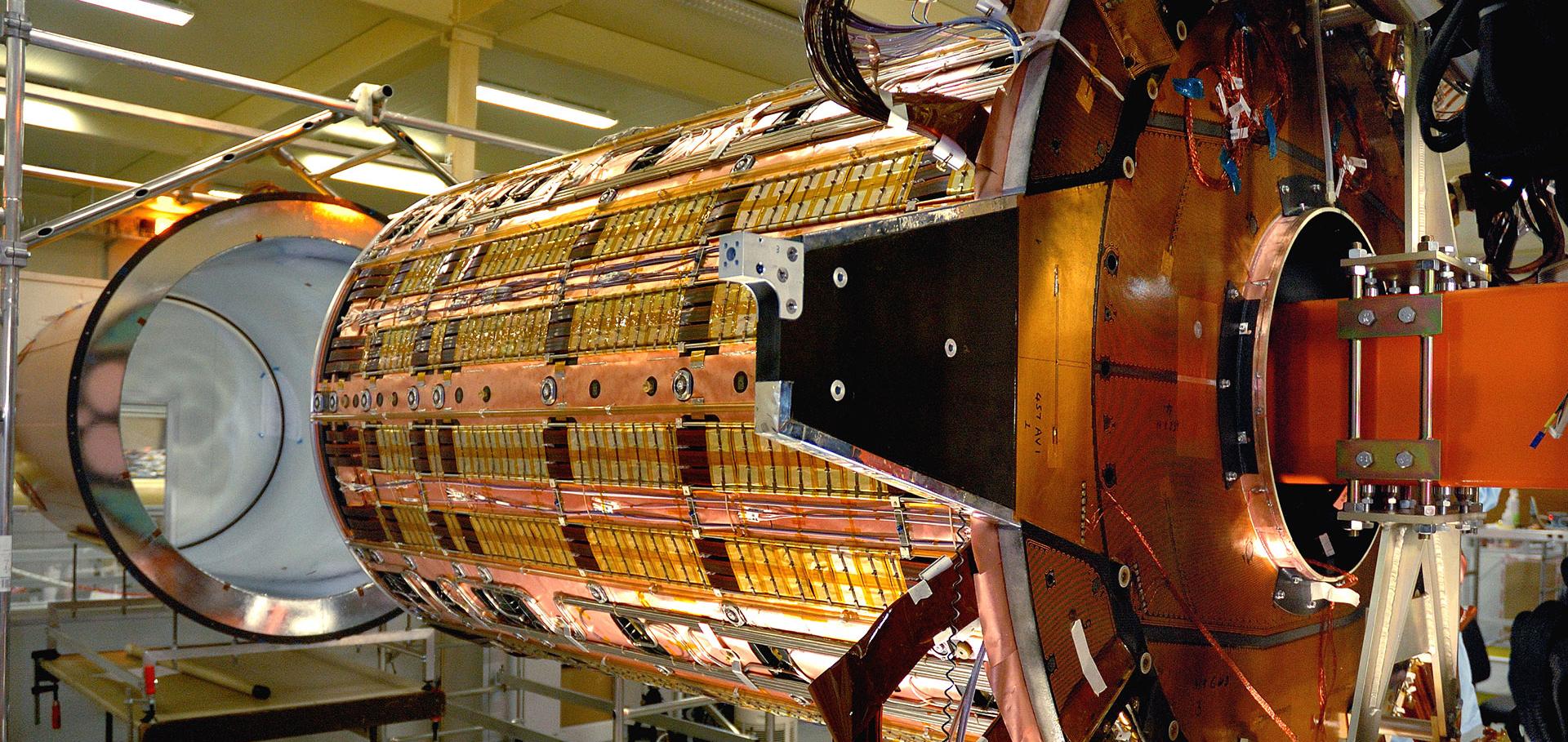

Design and performance of improved Column Parallel CCD, CPC2
Nuclear Instruments and Methods in Physics Research, Section A: Accelerators, Spectrometers, Detectors and Associated Equipment 621:1-3 (2010) 192-204
Abstract:
The Linear Collider Flavour Identification (LCFI) Collaboration is developing the sensors, readout electronics and mechanical support structures for the vertex detector of the International Linear Collider (ILC). High speed readout is needed to ensure that the occupancy due to the pair production background at the ILC is kept below the 1% level. In order to satisfy this requirement, Column Parallel CCDs (CPCCDs), Column Parallel Readout chips (CPRs) and Column Parallel Driver chips (CPDs) have been developed. The CPCCD has to operate at a clock frequency of 50 MHz, which represents a difficult technical challenge due to the large sensor capacitance. The design and performance of the second generation CPCCD sensors, CPC2, and the new driver chip, CPD1, which meet these challenging requirements, are described. © 2010 Elsevier B.V. All rights reserved.A QCD analysis of ZEUS diffractive data
Nuclear Physics B 831:1-2 (2010) 1-25
Abstract:
ZEUS inclusive diffractive-cross-section measurements have been used in a DGLAP next-to-leading-order QCD analysis to extract the diffractive parton distribution functions. Data on diffractive dijet production in deep inelastic scattering have also been included to constrain the gluon density. Predictions based on the extracted parton densities are compared to diffractive charm and dijet photoproduction data. © 2010 Elsevier B.V.Measurement of isolated photon production in deep inelastic ep scattering
Physics Letters, Section B: Nuclear, Elementary Particle and High-Energy Physics 687:1 (2010) 16-25
Abstract:
Isolated photon production in deep inelastic ep scattering has been measured with the ZEUS detector at HERA using an integrated luminosity of 320 pb - 1. Measurements were made in the isolated-photon transverse-energy and pseudorapidity ranges 4 < E Tγ < 15 GeV and - 0.7 < η γ < 0.9 for exchanged photon virtualities, Q 2, in the range 10 < Q 2 < 350 GeV 2 and for invariant masses of the hadronic system W X > 5 GeV. Differential cross sections are presented for inclusive isolated photon production as functions of Q 2, x, E Tγ and η γ. Leading-logarithm parton-shower Monte Carlo simulations and perturbative QCD predictions give a reasonable description of the data over most of the kinematic range. © 2010 Elsevier B.V.Measurement of dijet photoproduction for events with a leading neutron at HERA
Nuclear Physics B 827:1-2 (2010) 1-33
Abstract:
Differential cross sections for dijet photoproduction and this process in association with a leading neutron, e ++p→e ++jet+jet+X(+n), have been measured with the ZEUS detector at HERA using an integrated luminosity of 40 pb -1. The fraction of dijet events with a leading neutron was studied as a function of different jet and event variables. Single- and double-differential cross sections are presented as a function of the longitudinal fraction of the proton momentum carried by the leading neutron, x L, and of its transverse momentum squared, pT2. The dijet data are compared to inclusive DIS and photoproduction results; they are all consistent with a simple pion-exchange model. The neutron yield as a function of x L was found to depend only on the fraction of the proton beam energy going into the forward region, independent of the hard process. No firm conclusion can be drawn on the presence of rescattering effects. © 2009 Elsevier B.V.Events with an isolated lepton and missing transverse momentum and measurement of W production at HERA
Journal of High Energy Physics 2010:3 (2010)