Home
Department Of Physics text logo
  • Research
    • Our research
    • Our research groups
    • Our research in action
    • Research funding support
    • Summer internships for undergraduates
  • Study
    • Undergraduates
    • Postgraduates
  • Engage
    • For alumni
    • For business
    • For schools
    • For the public
  • Support
Menu
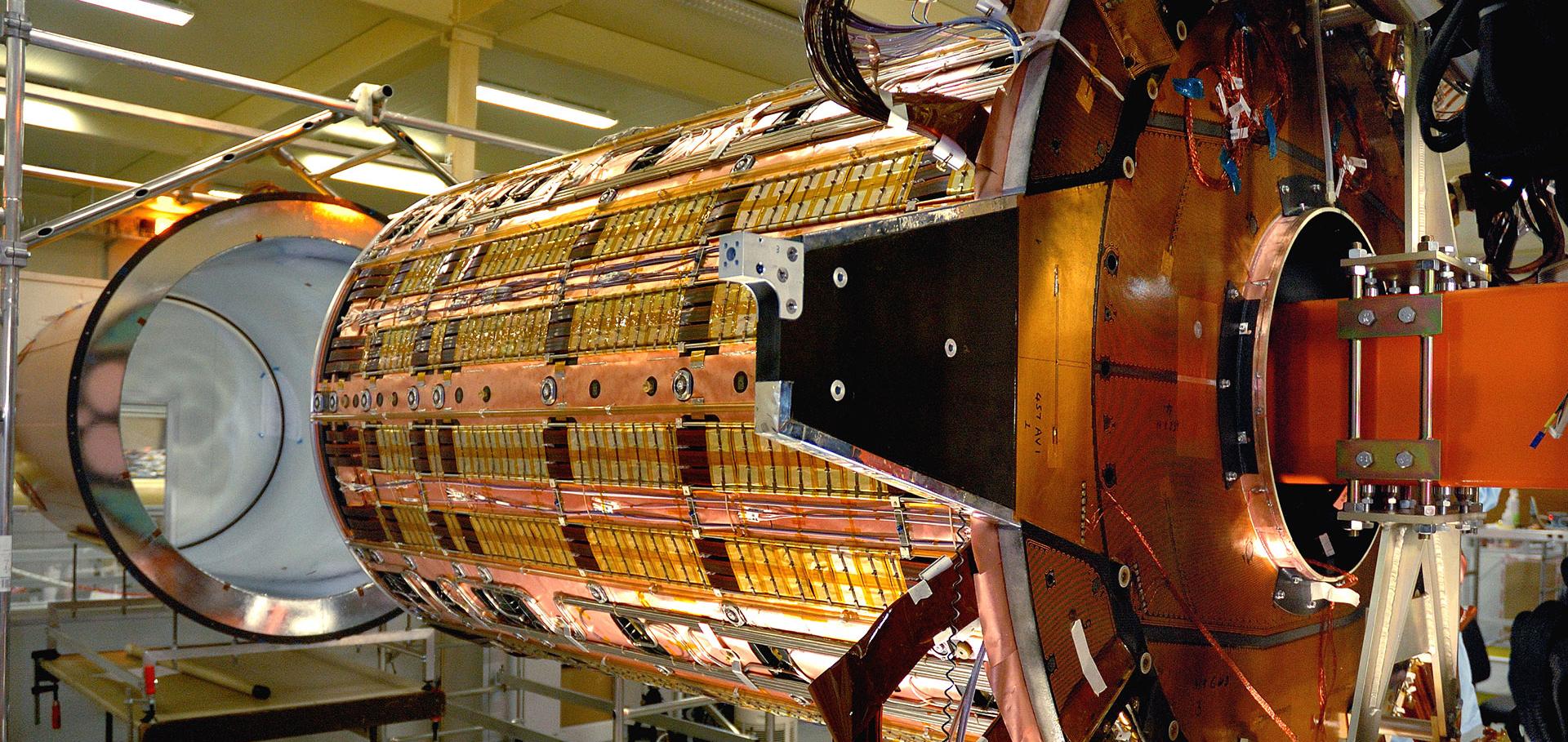
Insertion of STC into TRT at the Department of Physics, Oxford
Credit: CERN

Dr Elizabeth Gallas

Database Design Engineer

Research theme

  • Fundamental particles and interactions

Sub department

  • Particle Physics

Research groups

  • ATLAS
  • Accelerator Neutrinos
  • About
  • Metadata and Databases
  • Publications

A programmatic view of metadata, metadata services, and metadata flow in ATLAS

Journal of Physics: Conference Series 396:PART 5 (2012)

Authors:

D Malon, S Albrand, E Gallas, G Stewart

Abstract:

The volume and diversity of metadata in an experiment of the size and scope of ATLAS are considerable. Even the definition of metadata may seem context-dependent: data that are primary for one purpose may be metadata for another. ATLAS metadata services must integrate and federate information from inhomogeneous sources and repositories, map metadata about logical or physics constructs to deployment and production constructs, provide a means to associate metadata at one level of granularity with processing or decision-making at another, offer a coherent and integrated view to physicists, and support both human use and programmatic access. In this paper we consider ATLAS metadata, metadata services, and metadata flow principally from the illustrative perspective of how disparate metadata are made available to executing jobs and, conversely, how metadata generated by such jobs are returned. We describe how metadata are read, how metadata are cached, and how metadata generated by jobs and the tasks of which they are a part are communicated, associated with data products, and preserved. We also discuss the principles that guide decision-making about metadata storage, replication, and access..
More details from the publisher
More details

ATLAS file and dataset metadata collection and use

Journal of Physics: Conference Series 396:PART 5 (2012)

Authors:

S Albrand, EJ Gallas, J Fulachier, F Lambert

Abstract:

The ATLAS Metadata Interface ("AMI") was designed as a generic cataloguing system, and as such it has found many uses in the experiment including software release management, tracking of reconstructed event sizes and control of dataset nomenclature. The primary use of AMI is to provide a catalogue of datasets (file collections) which is searchable using physics criteria. In this paper we discuss the various mechanisms used for filling the AMI dataset and file catalogues. By correlating information from different sources we can derive aggregate information which is important for physics analysis; for example the total number of events contained in dataset, and possible reasons for missing events such as a lost file. Finally we will describe some specialized interfaces which were developed for the Data Preparation coordinators. These interfaces manipulate information from both the dataset domain held in AMI, and the run-indexed information held in the ATLAS COMA application (Conditions and Configuration MetadatA)..
More details from the publisher
More details

ATLAS search for a heavy gauge boson decaying to a charged lepton and a neutrino in pp collisions at √s =7 TeV

European Physical Journal C 72:12 (2012)

Authors:

G Aad, T Abajyan, B Abbott, J Abdallah, S Abdel Khalek, AA Abdelalim, O Abdinov, R Aben, B Abi, M Abolins, OS Abouzeid, H Abramowicz, H Abreu, BS Acharya, L Adamczyk, DL Adams, TN Addy, J Adelman, S Adomeit, P Adragna, T Adye, S Aefsky, JA Aguilar-Saavedra, M Agustoni, M Aharrouche, SP Ahlen, F Ahles, A Ahmad, M Ahsan, G Aielli, T Akdogan, TPA Åkesson, G Akimoto, AV Akimov, MS Alam, MA Alam, J Albert, S Albrand, M Aleksa, IN Aleksandrov, F Alessandria, C Alexa, G Alexander, G Alexandre, T Alexopoulos, M Alhroob, M Aliev, G Alimonti, J Alison, BMM Allbrooke, PP Allport, SE Allwood-Spiers, J Almond, A Aloisio, R Alon, A Alonso, F Alonso, A Altheimer, B Alvarez Gonzalez, MG Alviggi, K Amako, C Amelung, VV Ammosov, SP Amor Dos Santos, A Amorim, N Amram, C Anastopoulos, LS Ancu, N Andari, T Andeen, CF Anders, G Anders, KJ Anderson, A Andreazza, V Andrei, ML Andrieux, XS Anduaga, P Anger, A Angerami, F Anghinolfi, A Anisenkov, N Anjos, A Annovi, A Antonaki, M Antonelli, A Antonov, J Antos, F Anulli, M Aoki, S Aoun, L Aperio Bella, R Apolle, G Arabidze, I Aracena, Y Arai, ATH Arce, S Arfaoui, JF Arguin, E Arik, M Arik

Abstract:

The ATLAS detector at the LHC is used to search for high-mass states, such as heavy charged gauge bosons (Wʹ), decaying to a charged lepton (electron or muon) and a neutrino. Results are presented based on the analysis of pp collisions at a center-of-mass energy of 7 TeV corresponding to an integrated luminosity of 4.7 fb−1. No excess beyond Standard Model expectations is observed. AWʹ with Sequential Standard Model couplings is excluded at the 95% credibility level for masses up to 2.55 TeV. Excited chiral bosons (W*) with equivalent coupling strength are excluded for masses up to 2.42 TeV.
More details from the publisher
More details

Conditions and configuration metadata for the ATLAS experiment

Journal of Physics: Conference Series 396:PART 5 (2012)

Authors:

EJ Gallas, S Albrand, J Fulachier, F Lambert, KE Pachal, JCL Tseng, Q Zhang

Abstract:

In the ATLAS experiment, a system called COMA (Conditions/Configuration Metadata for ATLAS), has been developed to make globally important run-level metadata more readily accessible. It is based on a relational database storing directly extracted, refined, reduced, and derived information from system-specific database sources as well as information from non-database sources. This information facilitates a variety of unique dynamic interfaces and provides information to enhance the functionality of other systems. This presentation will give an overview of the components of the COMA system, enumerate its diverse data sources, and give examples of some of the interfaces it facilitates. We list important principles behind COMA schema and interface design, and how features of these principles create coherence and eliminate redundancy among the components of the overall system. In addition, we elucidate how interface logging data has been used to refine COMA content and improve the value and performance of end-user reports and browsers..
More details from the publisher
More details

Evolution of grid-wide access to database resident information in ATLAS using Frontier

Journal of Physics: Conference Series 396:PART 5 (2012)

Authors:

D Barberis, F Bujor, J De Stefano, AL Dewhurst, D Dykstra, D Front, E Gallas, CF Gamboa, F Luehring, R Walker

Abstract:

The ATLAS experiment deployed Frontier technology worldwide during the initial year of LHC collision data taking to enable user analysis jobs running on the Worldwide LHC Computing Grid to access database resident data. Since that time, the deployment model has evolved to optimize resources, improve performance, and streamline maintenance of Frontier and related infrastructure. In this presentation we focus on the specific changes in the deployment and improvements undertaken, such as the optimization of cache and launchpad location, the use of RPMs for more uniform deployment of underlying Frontier related components, improvements in monitoring, optimization of fail-over, and an increasing use of a centrally managed database containing site specific information (for configuration of services and monitoring). In addition, analysis of Frontier logs has allowed us a deeper understanding of problematic queries and understanding of use cases. Use of the system has grown beyond user analysis and subsystem specific tasks such as calibration and alignment, extending into production processing areas, such as initial reconstruction and trigger reprocessing. With a more robust and tuned system, we are better equipped to satisfy the still growing number of diverse clients and the demands of increasingly sophisticated processing and analysis..
More details from the publisher
More details

Pagination

  • First page First
  • Previous page Prev
  • …
  • Page 286
  • Page 287
  • Page 288
  • Page 289
  • Current page 290
  • Page 291
  • Page 292
  • Page 293
  • Page 294
  • …
  • Next page Next
  • Last page Last

Footer Menu

  • Contact us
  • Giving to the Dept of Physics
  • Work with us
  • Media

User account menu

  • Log in

Follow us

FIND US

Clarendon Laboratory,

Parks Road,

Oxford,

OX1 3PU

CONTACT US

Tel: +44(0)1865272200

University of Oxfrod logo Department Of Physics text logo
IOP Juno Champion logo Athena Swan Silver Award logo

© University of Oxford - Department of Physics

Cookies | Privacy policy | Accessibility statement

Built by: Versantus

  • Home
  • Research
  • Study
  • Engage
  • Our people
  • News & Comment
  • Events
  • Our facilities & services
  • About us
  • Giving to Physics
  • Current students
  • Staff intranet