

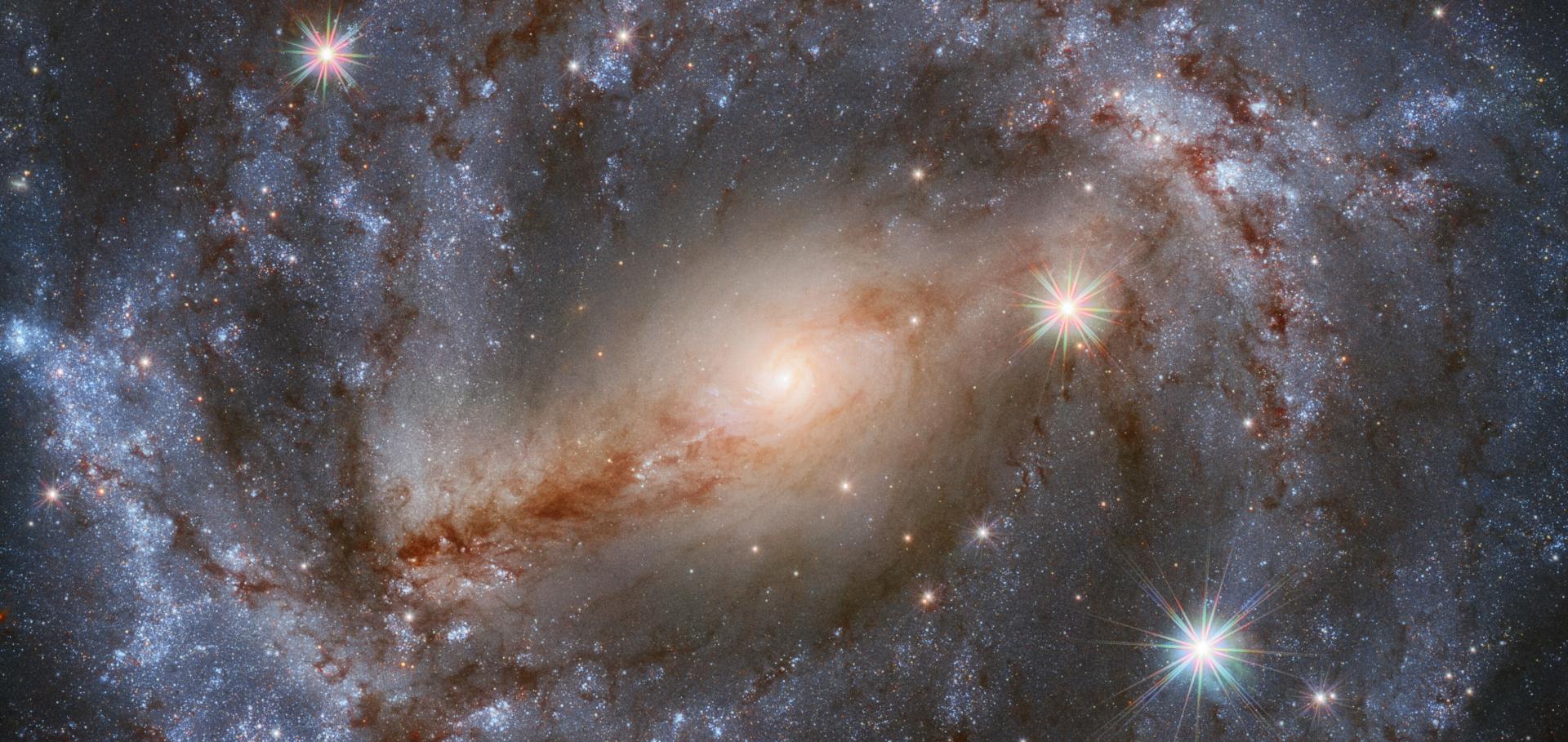

A radio-jet-driven outflow in the Seyfert 2 galaxy NGC 2110?
Astronomy & Astrophysics EDP Sciences 675 (2023) a58
The role of grain size in active galactic nuclei torus dust models
Astronomy & Astrophysics EDP Sciences 676 (2023) A73-A73
Abstract:
Fits the infrared spectra from the nuclear regions of AGN can place constraints on the dust properties, distribution, and geometry by comparison with models. However, none of the currently available models fully describe the observations of AGN currently available. Among the aspects least explored, here we focus on the role of dust grain size. We offer the community a new spectral energy distribution (SED) library, hereinafter [GoMar23] model, which is based on the two-phase torus model developed before with the inclusion of the grain size as a model parameter, parameterized by the maximum grain size Psize or equivalently the mass-weighted average grain size . We created 691,200 SEDs using the SKIRT code, where the maximum grain size can vary within the range Psize = 0.01 - 10.0um ( = 0.007 - 3.41um). We fit this new and several existing libraries to a sample of 68 nearby and luminous AGNs with Spitzer/IRS spectra dominated by AGN-heated dust. We find that the [GoMar23] model can adequately reproduce up to 85-88% of the spectra. The dust grain size parameter significantly improves the final fit in up to 90% of these spectra. Statistical tests indicate that the grain size is the third most important parameter in the fitting procedure (after the size and half opening angle of the torus). The requirement of a foreground extinction by our model is lower compared to purely clumpy models. We find that 41% of our sample requires that the maximum dust grain size is as large as Psize =10um (= 3.41um). Nonetheless, we also remark that disk+wind and clumpy torus models are still required to reproduce the spectra of a non-negligible fraction of objects, suggesting the need for several dust geometries to explain the infrared continuum of AGN. This work provides tentative evidence for dust grain growth in the proximity of the AGN.Comment: 26 pages, 14 figures, 4 tables, accepted for publication in A&AGN feedback in action in the molecular gas ring of the Seyfert galaxy NGC 7172
Astronomy & Astrophysics EDP Sciences 675 (2023) A88-A88
Abstract:
We present new ALMA observations of the CO(3-2) transition and 854micron continuum at 0.06-0.3" resolution, together with new VLT/SINFONI observations of NGC7172. This is a luminous (bolometric luminosity of ~10^44 erg/s) Seyfert galaxy that belongs to the Galaxy Activity, Torus, and Outflow Survey (GATOS). The CO(3-2) observations reveal the presence of a highly inclined cold molecular gas ring with an approximate radius of 3-4"~540-720 pc, which is likely associated with an inner Lindblad resonance of a putative stellar bar. There are noncircular motions in the VLT/SINFONI [SiVI]1.96micron and H2 at 2.12micron, and ALMA CO(3-2) velocity fields. After subtracting the stellar velocity field, we detected [SiVI] blueshifted velocities of a few hundred km/s to the south of the AGN. They trace outflowing ionized gas outside the plane of the galaxy and out to projected distances of ~200 pc. The CO(3-2) position-velocity diagram along the kinematic minor axis displays noncircular motions with observed velocities of up to ~150 km/s. Assuming that these are taking place in the disk of the galaxy, the observed velocity signs imply that the molecular gas ring is not only rotating but also outflowing. We derived an integrated cold molecular gas mass outflow rate of ~40 Msun/yr for the ring. Using the 854micron map, we resolved a 32 pc radius torus with a gas mass of 8x10^5 Msun. These torus properties are similar to other Seyfert galaxies in the GATOS sample. We measured a decreased cold molecular gas concentration in the nuclear-torus region relative to the circumnuclear region when compared to other less luminous Seyfert galaxies. We conclude that the effects of AGN feedback in NGC7172, which are likely caused by the AGN wind and/or the moderate luminosity radio jet, are seen as a large-scale outflowing molecular gas ring and accompanying redistribution of molecular gas in the nuclear regions.Comment: Accepted for publication to A&The obscured nucleus and shocked environment of VV 114E revealed by JWST/MIRI spectroscopy
Monthly Notices of the Royal Astronomical Society Oxford University Press (OUP) 519:3 (2023) 3691-3705
Absence of nuclear polycyclic aromatic hydrocarbon emission from a compact starburst: The case of the type-2 quasar Mrk 477
Astronomy & Astrophysics EDP Sciences 669 (2022) L5-L5