Home
Department Of Physics text logo
  • Research
    • Our research
    • Our research groups
    • Our research in action
    • Research funding support
    • Summer internships for undergraduates
  • Study
    • Undergraduates
    • Postgraduates
  • Engage
    • For alumni
    • For business
    • For schools
    • For the public
  • Support
Menu
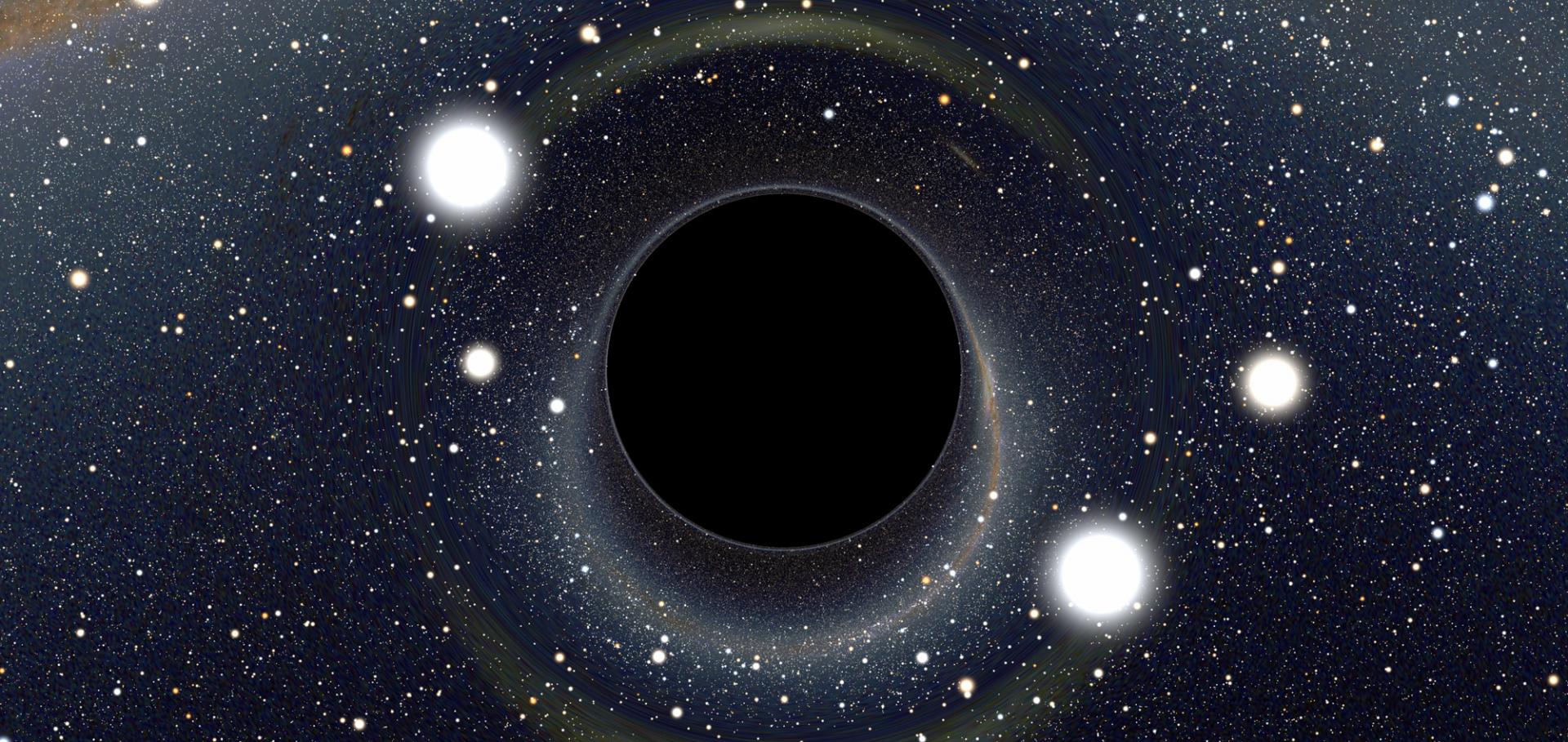
Black Hole

Lensing of space time around a black hole. At Oxford we study black holes observationally and theoretically on all size and time scales - it is some of our core work.

Credit: ALAIN RIAZUELO, IAP/UPMC/CNRS. CLICK HERE TO VIEW MORE IMAGES.

Dr. James Gillanders

PDRA

Research theme

  • Astronomy and astrophysics

Sub department

  • Astrophysics

Research groups

  • Hintze Centre for Astrophysical Surveys
james.gillanders@physics.ox.ac.uk
DWB, room TOWER
  • About
  • Publications

A structured jet explains the extreme GRB 221009A

Science Advances American Association for the Advancement of Science (AAAS) 9:23 (2023) eadi1405

Authors:

Brendan O'Connor, Eleonora Troja, Geoffrey Ryan, Paz Beniamini, Hendrik van Eerten, Jonathan Granot, Simone Dichiara, Roberto Ricci, Vladimir Lipunov, James H Gillanders, Ramandeep Gill, Michael Moss, Shreya Anand, Igor Andreoni, Rosa L Becerra, David AH Buckley, Nathaniel R Butler, Stephen B Cenko, Aristarkh Chasovnikov, Joseph Durbak, Carlos Francile, Erica Hammerstein, Alexander J van der Horst, Mansi M Kasliwal, Chryssa Kouveliotou, Alexander S Kutyrev, William H Lee, Gokul P Srinivasaragavan, Vladislav Topolev, Alan M Watson, Yuhan Yang, Kirill Zhirkov
More details from the publisher
More details
More details

A Sensitive Search for Supernova Emission Associated with the Extremely Energetic and Nearby GRB 221009A

The Astrophysical Journal Letters American Astronomical Society 949:2 (2023) L39-L39

Authors:

Gokul P Srinivasaragavan, Brendan O’Connor, S Bradley Cenko, Alexander J Dittmann, Sheng Yang, Jesper Sollerman, GC Anupama, Sudhanshu Barway, Varun Bhalerao, Harsh Kumar, Vishwajeet Swain, Erica Hammerstein, Isiah Holt, Shreya Anand, Igor Andreoni, Michael W Coughlin, Simone Dichiara, Avishay Gal-Yam, M Coleman Miller, Jaime Soon, Roberto Soria, Joseph Durbak, James H Gillanders, Sibasish Laha, Anna M Moore

Abstract:

We report observations of the optical counterpart of the long gamma-ray burst (LGRB) GRB 221009A. Due to the extreme rarity of being both nearby ($z = 0.151$) and highly energetic ($E_{\gamma,\mathrm{iso}} \geq 10^{54}$ erg), GRB 221009A offers a unique opportunity to probe the connection between massive star core collapse and relativistic jet formation across a very broad range of $\gamma$-ray properties. Adopting a phenomenological power-law model for the afterglow and host galaxy estimates from high-resolution Hubble Space Telescope imaging, we use Bayesian model comparison techniques to determine the likelihood of an associated SN contributing excess flux to the optical light curve. Though not conclusive, we find moderate evidence ($K_{\rm{Bayes}}=10^{1.2}$) for the presence of an additional component arising from an associated supernova, SN 2022xiw, and find that it must be substantially fainter ($<$ 67% as bright at the 99% confidence interval) than SN 1998bw. Given the large and uncertain line-of-sight extinction, we attempt to constrain the supernova parameters ($M_{\mathrm{Ni}}$, $M_{\mathrm{ej}}$, and $E_{\mathrm{KE}}$) under several different assumptions with respect to the host galaxy's extinction. We find properties that are broadly consistent with previous GRB-associated SNe: $M_{\rm{Ni}}=0.05$ - $0.25 \, \rm{M_\odot}$, $M_{\rm{ej}}=3.5$ - $11.1 \, \rm{M_\odot}$, and $E_{\rm{KE}} = (1.6$ - $5.2) \times 10^{52} \, \rm{erg}$. We note that these properties are weakly constrained due to the faintness of the supernova with respect to the afterglow and host emission, but we do find a robust upper limit on the $M_{\rm{Ni}}$ of $M_{\rm{Ni}}<0.36\, \rm{M_\odot}$. Given the tremendous range in isotropic gamma-ray energy release exhibited by GRBs (7 orders of magnitude), the SN emission appears to be decoupled from the central engine in these systems.Comment: 18 pages, accepted to ApJL, 4 tables, 5 figures. Updated abstract in Previe
More details from the publisher
Details from ORA
More details

Panning for gold, but finding helium: Discovery of the ultra-stripped supernova SN 2019wxt from gravitational-wave follow-up observations

Astronomy & Astrophysics EDP Sciences 675 (2023) A201-A201

Authors:

I Agudo, L Amati, T An, FE Bauer, S Benetti, MG Bernardini, R Beswick, K Bhirombhakdi, T de Boer, M Branchesi, SJ Brennan, E Brocato, MD Caballero-García, E Cappellaro, N Castro Rodríguez, AJ Castro-Tirado, KC Chambers, E Chassande-Mottin, S Chaty, T-W Chen, A Coleiro, S Covino, F D’Ammando, P D’Avanzo, V D’Elia, A Fiore, A Flörs, M Fraser, S Frey, C Frohmaier, M Fulton, L Galbany, C Gall, H Gao, J García-Rojas, G Ghirlanda, S Giarratana, JH Gillanders, M Giroletti, BP Gompertz, M Gromadzki, KE Heintz, J Hjorth, Y-D Hu, ME Huber, A Inkenhaag, L Izzo, ZP Jin, PG Jonker, DA Kann

Abstract:

Most stripped envelope supernova progenitors are formed through binary interaction, losing hydrogen and/or helium from their outer layers. An emerging class of supernovae with the highest degree of envelope-stripping are thought to be the product of stripping by a NS companion. However, relatively few examples are known and the outcomes of such systems can be diverse and are poorly understood at present. Here, we present spectroscopic observations and high cadence multi-band photometry of SN 2023zaw, a low ejecta mass and rapidly evolving supernova. SN 2023zaw was discovered in a nearby spiral galaxy at D = 39.7 Mpc, with significant Milky Way extinction, $E(B-V) = 0.21$, and significant (but uncertain) host extinction. Bayesian evidence comparison reveals that nickel is not the only power source and an additional energy source is required to explain our observations. Our models suggest an ejecta mass of $M_{\rm ej} \sim 0.07\,\rm M_\odot$ and a synthesised nickel mass of $M_{\rm ej} \sim 0.007\,\rm M_\odot$ is required to explain the explosion. However an additional heating from a magnetar or interaction with circumstellar material is required to power the early light curve
More details from the publisher
Details from ORA
More details

A Sensitive Search for Supernova Emission Associated with the Extremely Energetic and Nearby GRB 221009A

(2023)

Authors:

Gokul P Srinivasaragavan, Brendan O' Connor, S Bradley Cenko, Alexander J Dittmann, Sheng Yang, Jesper Sollerman, GC Anupama, Sudhanshu Barway, Varun Bhalerao, Harsh Kumar, Vishwajeet Swain, Erica Hammerstein, Isiah Holt, Shreya Anand, Igor Andreoni, Michael W Coughlin, Simone Dichiara, Avishay Gal-Yam, M Coleman Miller, Jaime Soon, Roberto Soria, Joseph Durbak, James H Gillanders, Sibasish Laha, Anna M Moore, Fabio Ragosta, Eleonora Troja
More details from the publisher
Details from ArXiV

A structured jet explains the extreme GRB 221009A

(2023)

Authors:

B O'Connor, E Troja, G Ryan, P Beniamini, H van Eerten, J Granot, S Dichiara, R Ricci, V Lipunov, JH Gillanders, R Gill, M Moss, S Anand, I Andreoni, RL Becerra, DAH Buckley, NR Butler, SB Cenko, A Chasovnikov, J Durbak, C Francile, E Hammerstein, AJ van der Horst, M Kasliwal, C Kouveliotou, AS Kutyrev, WH Lee, G Srinivasaragavan, V Topolev, AM Watson, YH Yang, K Zhirkov
More details from the publisher
Details from ArXiV

Pagination

  • First page First
  • Previous page Prev
  • …
  • Page 5
  • Page 6
  • Page 7
  • Page 8
  • Current page 9
  • Page 10
  • Page 11
  • Page 12
  • Page 13
  • …
  • Next page Next
  • Last page Last

Footer Menu

  • Contact us
  • Giving to the Dept of Physics
  • Work with us
  • Media

User account menu

  • Log in

Follow us

FIND US

Clarendon Laboratory,

Parks Road,

Oxford,

OX1 3PU

CONTACT US

Tel: +44(0)1865272200

University of Oxfrod logo Department Of Physics text logo
IOP Juno Champion logo Athena Swan Silver Award logo

© University of Oxford - Department of Physics

Cookies | Privacy policy | Accessibility statement

Built by: Versantus

  • Home
  • Research
  • Study
  • Engage
  • Our people
  • News & Comment
  • Events
  • Our facilities & services
  • About us
  • Giving to Physics
  • Current students
  • Staff intranet