Home
Department Of Physics text logo
  • Research
    • Our research
    • Our research groups
    • Our research in action
    • Research funding support
    • Summer internships for undergraduates
  • Study
    • Undergraduates
    • Postgraduates
  • Engage
    • For young people
    • For teachers
    • For the public
    • For alumni
    • For business
  • Support
Menu
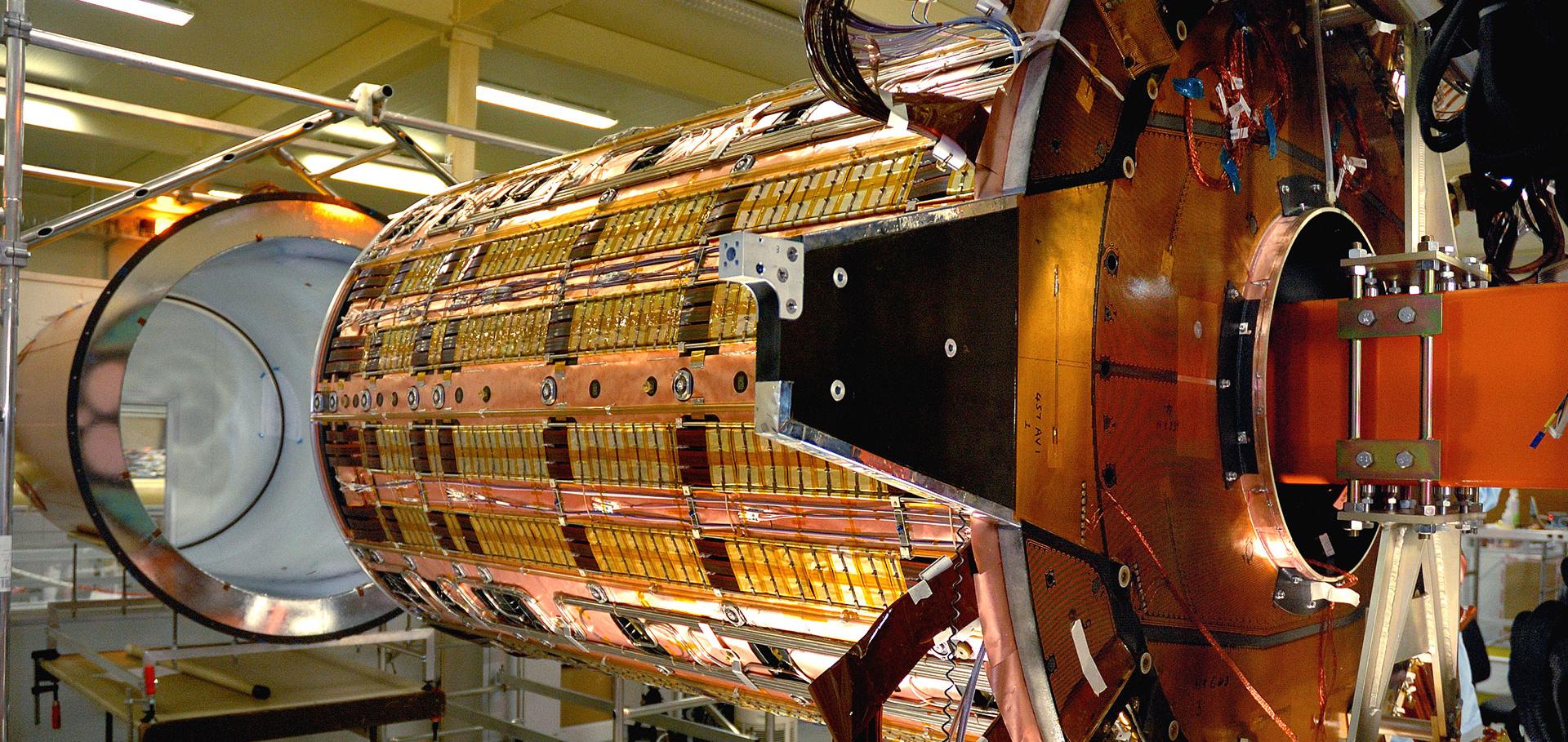
Insertion of STC into TRT at the Department of Physics, Oxford
Credit: CERN

Professor Claire Gwenlan

Professor of Physics

Research theme

  • Fundamental particles and interactions

Sub department

  • Particle Physics

Research groups

  • ATLAS
  • Future Colliders
  • ePIC
claire.gwenlan@physics.ox.ac.uk
Telephone: 01865 (2)73384
Denys Wilkinson Building, room 678
  • About
  • Publications

A posteriori inclusion of PDFs in NLO QCD final-state calculations: The APPLGRID Project

Proceedings of Science (2010)

Authors:

T Carli, D Clements, A Cooper-Sarkar, C Gwenlan, GP Salam, F Siegert, P Starovoitov, M Sutton

Abstract:

The calculation of cross-sections at Next-to-Leading order in QCD involves the integration over the final state phase space in order to cancel the infra-red divergences. For the calculation of cross sections for jet observables in deep-inelastic scattering or at hadron-hadron colliders this integration requires the Monte Carlo generation of a large number of event weights, and must be repeated for any calculation with a different choice of parton densities within the proton or different choice of factorisation or renormalisation scale. This makes the full calculation with many of the available parton density function error sets, or any iterative fit of the parton densities themselves, prohibitive in terms of the processing time required. A method for the a posteriori inclusion of the parton densities in the calculation is presented. In this method, the Monte Carlo weights from the integration over the hard-subprocess phase space are stored in a look-up table so that the full calculation need be performed only once, after which the cross section can be obtained with any parton density set by a fast convolution with the stored weights. A detailed example from inclusive jet production at the LHC is presented. © Copyright owned by the author(s) under the terms of the Creative Commons Attribution-NonCommercial-ShareAlike Licence.

Commissioning of the ATLAS Muon Spectrometer with cosmic rays

European Physical Journal C 70:3 (2010) 875-916

Authors:

The ATLAS Collaboration, G Aad, B Abbott, J Abdallah, AA Abdelalim, A Abdesselam, O Abdinov, B Abi, M Abolins, H Abramowicz, H Abreu, BS Acharya, DL Adams, TN Addy, J Adelman, C Adorisio, P Adragna, T Adye, S Aefsky, JA Aguilar-Saavedra, M Aharrouche, SP Ahlen, F Ahles, A Ahmad, H Ahmed, M Ahsan, G Aielli, T Akdogan, TPA Åkesson, G Akimoto, AV Akimov, A Aktas, MS Alam, MA Alam, S Albrand, M Aleksa, IN Aleksandrov, C Alexa, G Alexander, G Alexandre, T Alexopoulos, M Alhroob, M Aliev, G Alimonti, J Alison, M Aliyev, PP Allport, SE Allwood-Spiers, J Almond, A Aloisio, R Alon, A Alonso, MG Alviggi, K Amako, C Amelung, A Amorim, G Amorós, N Amram, C Anastopoulos, T Andeen, CF Anders, KJ Anderson, A Andreazza, V Andrei, XS Anduaga, A Angerami, F Anghinolfi, N Anjos, A Annovi, A Antonaki, M Antonelli, S Antonelli, J Antos, B Antunovic, F Anulli, S Aoun, G Arabidze, I Aracena, Y Arai, ATH Arce, JP Archambault, S Arfaoui, JF Arguin, T Argyropoulos, M Arik, AJ Armbruster, O Arnaez, C Arnault, A Artamonov, D Arutinov, M Asai, S Asai, R Asfandiyarov, S Ask, B Åsman, D Asner, L Asquith, K Assamagan, A Astbury, A Astvatsatourov

Abstract:

The ATLAS detector at the Large Hadron Collider has collected several hundred million cosmic ray events during 2008 and 2009. These data were used to commission the Muon Spectrometer and to study the performance of the trigger and tracking chambers, their alignment, the detector control system, the data acquisition and the analysis programs. We present the performance in the relevant parameters that determine the quality of the muon measurement. We discuss the single element efficiency, resolution and noise rates, the calibration method of the detector response and of the alignment system, the track reconstruction efficiency and the momentum measurement. The results show that the detector is close to the design performance and that the Muon Spectrometer is ready to detect muons produced in high energy proton-proton collisions. © 2010 CERN for the benefit of the ATLAS collaboration.
More details from the publisher
More details

Drift Time Measurement in the ATLAS Liquid Argon Electromagnetic Calorimeter using Cosmic Muons

European Physical Journal C 70:3 (2010) 755-785

Authors:

The ATLAS Collaboration, G Aad, B Abbott, J Abdallah, AA Abdelalim, A Abdesselam, O Abdinov, B Abi, M Abolins, H Abramowicz, H Abreu, BS Acharya, DL Adams, TN Addy, J Adelman, C Adorisio, P Adragna, T Adye, S Aefsky, JA Aguilar-Saavedra, M Aharrouche, SP Ahlen, F Ahles, A Ahmad, H Ahmed, M Ahsan, G Aielli, T Akdogan, TPA Åkesson, G Akimoto, AV Akimov, A Aktas, MS Alam, MA Alam, J Albert, S Albrand, M Aleksa, IN Aleksandrov, F Alessandria, C Alexa, G Alexander, G Alexandre, T Alexopoulos, M Alhroob, M Aliev, G Alimonti, J Alison, M Aliyev, PP Allport, SE Allwood-Spiers, J Almond, A Aloisio, R Alon, A Alonso, MG Alviggi, K Amako, C Amelung, VV Ammosov, A Amorim, G Amorós, N Amram, C Anastopoulos, T Andeen, CF Anders, KJ Anderson, A Andreazza, V Andrei, XS Anduaga, A Angerami, F Anghinolfi, N Anjos, A Antonaki, M Antonelli, S Antonelli, J Antos, B Antunovic, F Anulli, S Aoun, G Arabidze, I Aracena, Y Arai, ATH Arce, JP Archambault, S Arfaoui, JF Arguin, T Argyropoulos, E Arik, M Arik, AJ Armbruster, O Arnaez, C Arnault, A Artamonov, D Arutinov, M Asai, S Asai, R Asfandiyarov, S Ask, B Åsman, D Asner, L Asquith

Abstract:

The ionization signals in the liquid argon of the ATLAS electromagnetic calorimeter are studied in detail using cosmic muons. In particular, the drift time of the ionization electrons is measured and used to assess the intrinsic uniformity of the calorimeter gaps and estimate its impact on the constant term of the energy resolution. The drift times of electrons in the cells of the second layer of the calorimeter are uniform at the level of 1.3% in the barrel and 2.8% in the endcaps. This leads to an estimated contribution to the constant term of (0.290.04 0.05)% in the barrel and (0.540.04 0.06)% in the endcaps. The same data are used to measure the drift velocity of ionization electrons in liquid argon, which is found to be 4.61±0.07 mm/μs at 88.5 K and 1 kV/mm. © 2010 CERN for the benefit of the ATLAS collaboration.
More details from the publisher
More details

Inclusive dijet cross sections in neutral current deep inelastic scattering at HERA

European Physical Journal C 70:4 (2010) 965-982

Authors:

H Abramowicz, I Abt, L Adamczyk, M Adamus, R Aggarwal, S Antonelli, P Antonioli, A Antonov, M Arneodo, V Aushev, Y Aushev, O Bachynska, A Bamberger, AN Barakbaev, G Barbagli, G Bari, F Barreiro, D Bartsch, M Basile, O Behnke, J Behr, U Behrens, L Bellagamba, A Bertolin, S Bhadra, M Bindi, C Blohm, V Bokhonov, T Bołd, EG Boos, K Borras, D Boscherini, D Bot, SK Boutle, I Brock, E Brownson, R Brugnera, N Brümmer, A Bruni, G Bruni, B Brzozowska, PJ Bussey, JM Butterworth, B Bylsma, A Caldwell, M Capua, R Carlin, CD Catterall, S Chekanov, J Chwastowski, J Ciborowski, R Ciesielski, L Cifarelli, F Cindolo, A Contin, AM Cooper-Sarkar, N Coppola, M Corradi, F Corriveau, M Costa, G D'Agostini, F Dal Corso, J del Peso, RK Dementiev, S De Pasquale, M Derrick, RCE Devenish, D Dobur, BA Dolgoshein, G Dolinska, AT Doyle, V Drugakov, LS Durkin, S Dusini, Y Eisenberg, PF Ermolov, A Eskreys, S Fang, S Fazio, J Ferrando, MI Ferrero, J Figiel, M Forrest, B Foster, S Fourletov, G Gach, A Galas, E Gallo, A Garfagnini, A Geiser, I Gialas, LK Gladilin, D Gladkov, C Glasman, O Gogota, YA Golubkov, P Göttlicher, I Grabowska-Bołd, J Grebenyuk, I Gregor

Abstract:

Single- and double-differential inclusive dijet cross sections in neutral current deep inelastic ep scattering have been measured with the ZEUS detector using an integrated luminosity of 374 pb-1. The measurement was performed at large values of the photon virtuality, Q2, between 125 and 20 000 GeV2. The jets were reconstructed with the kT cluster algorithm in the Breit reference frame and selected by requiring their transverse energies in the Breit frame, ET,Bjet, to be larger than 8 GeV. In addition, the invariant mass of the dijet system, Mjj, was required to be greater than 20 GeV. The cross sections are described by the predictions of next-to-leading-order QCD. © 2010 The Author(s).
More details from the publisher

Measurement of high-Q2 charged current deep inelastic scattering cross sections with a longitudinally polarised positron beam at HERA

European Physical Journal C 70:4 (2010) 945-963

Authors:

H Abramowicz, I Abt, L Adamczyk, M Adamus, R Aggarwal, S Antonelli, P Antonioli, A Antonov, M Arneodo, V Aushev, Y Aushev, O Bachynska, A Bamberger, AN Barakbaev, G Barbagli, G Bari, F Barreiro, D Bartsch, M Basile, O Behnke, J Behr, U Behrens, L Bellagamba, A Bertolin, S Bhadra, M Bindi, C Blohm, V Bokhonov, T Bołd, EG Boos, K Borras, D Boscherini, D Bot, SK Boutle, I Brock, E Brownson, R Brugnera, N Brümmer, A Bruni, G Bruni, B Brzozowska, PJ Bussey, JM Butterworth, B Bylsma, A Caldwell, M Capua, R Carlin, CD Catterall, S Chekanov, J Chwastowski, J Ciborowski, R Ciesielski, L Cifarelli, F Cindolo, A Contin, AM Cooper-Sarkar, N Coppola, M Corradi, F Corriveau, M Costa, G D'Agostini, F Dal Corso, J del Peso, RK Dementiev, S De Pasquale, M Derrick, RCE Devenish, D Dobur, BA Dolgoshein, G Dolinska, AT Doyle, V Drugakov, LS Durkin, S Dusini, Y Eisenberg, PF Ermolov, A Eskreys, S Fang, S Fazio, J Ferrando, MI Ferrero, J Figiel, M Forrest, B Foster, S Fourletov, G Gach, A Galas, E Gallo, A Garfagnini, A Geiser, I Gialas, LK Gladilin, D Gladkov, C Glasman, O Gogota, YA Golubkov, P Göttlicher, I Grabowska-Bołd, J Grebenyuk, I Gregor

Abstract:

Measurements of the cross sections for charged current deep inelastic scattering in e+p collisions with a longitudinally polarised positron beam are presented. The measurements are based on a data sample with an integrated luminosity of 132 pb-1 collected with the ZEUS detector at HERA at a centre-of-mass energy of 318 GeV. The total cross section is presented at positive and negative values of the longitudinal polarisation of the positron beams. The single-differential cross-sections dσ/dQ2, dσ/dx and dσ/dy are presented for Q2>200 GeV2. The reduced cross-section σ̃ is presented in the kinematic range 2002<60000 GeV2 and 0.006
More details from the publisher
Details from ORA

Pagination

  • First page First
  • Previous page Prev
  • …
  • Page 313
  • Page 314
  • Page 315
  • Page 316
  • Current page 317
  • Page 318
  • Page 319
  • Page 320
  • Page 321
  • …
  • Next page Next
  • Last page Last

Footer Menu

  • Contact us
  • Giving to the Dept of Physics
  • Work with us
  • Media

User account menu

  • Log in

Follow us

FIND US

Clarendon Laboratory,

Parks Road,

Oxford,

OX1 3PU

CONTACT US

Tel: +44(0)1865272200

University of Oxfrod logo Department Of Physics text logo
IOP Juno Champion logo Athena Swan Silver Award logo

© University of Oxford - Department of Physics

Cookies | Privacy policy | Accessibility statement

Built by: Versantus

  • Home
  • Research
  • Study
  • Engage
  • Our people
  • News & Comment
  • Events
  • Our facilities & services
  • About us
  • Giving to Physics
  • Current students
  • Staff intranet