Home
Department Of Physics text logo
  • Research
    • Our research
    • Our research groups
    • Our research in action
    • Research funding support
    • Summer internships for undergraduates
  • Study
    • Undergraduates
    • Postgraduates
  • Engage
    • For alumni
    • For business
    • For schools
    • For the public
  • Support
Menu
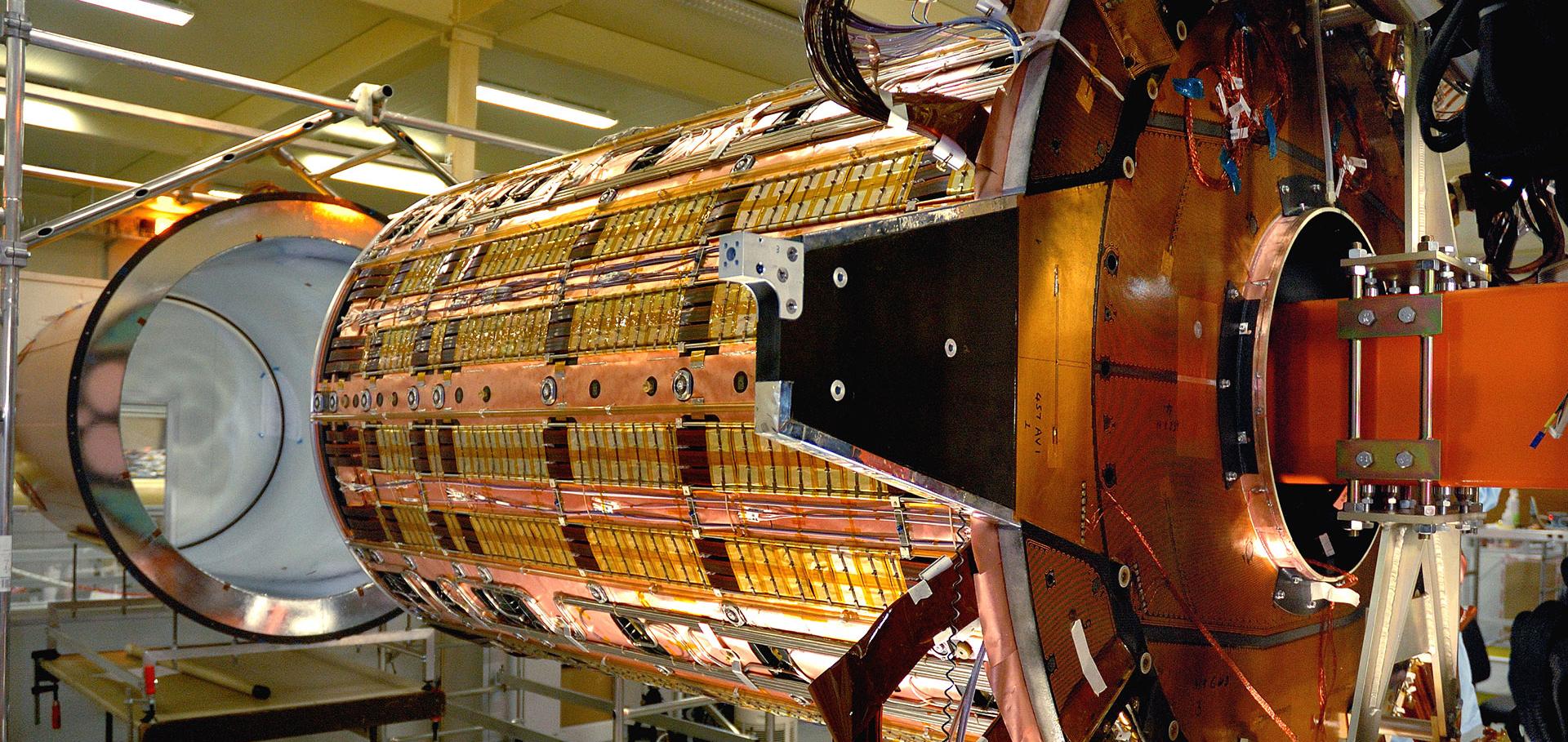
Insertion of STC into TRT at the Department of Physics, Oxford
Credit: CERN

Sub department

  • Particle Physics

Research groups

  • LHCb
Neville.Harnew@physics.ox.ac.uk
Telephone: 01865 (2)73316
Denys Wilkinson Building, room 654
  • About
  • Publications

Rapidity dependence of the charged particle multiplicity distributions in e+e- annihilation at 29 GeV

Physics Letters B 168:3 (1986) 299-304

Authors:

M Derrick, KK Gan, P Kooijman, JS Loos, B Musgrave, LE Price, J Schlereth, K Sugano, JM Weiss, DE Wood, D Blockus, B Brabson, SW Gray, C Jung, H Neal, H Ogren, DR Rust, M Valdata-Nappi, C Akerlof, G Bonvicini, J Chapman, D Errede, N Harnew, P Kesten, DI Meyer, D Nitz, AA Seidl, R Thun, T Trinko, M Willutzky, S Abachi, P Baringer, I Beltrami, BG Bylsma, R Debonte, D Koltick, FJ Loeffler, EH Low, RL McIlwain, DH Miller, CR Ng, LK Rangan, EI Shibata, B Cork

Abstract:

The charged particle multiplicity distribution for e+e- annihilations at s = 29 GeV has been measured using the High Resolution Spectrometer at PEP. The multiplicity distribution, expressed as a function of the mean, shows KNO scaling when compared to e+e- data at other energies. Multiplicity distributions for particles selected in different central rapidity spans are presented. All of these are well presented by the Negative binomial distribution. As the rapidity span is narrowed, the distributions become broader and approach a constant value of the parameter k. © 1986.
More details from the publisher
More details

New results from Bhabha scattering at 29 GeV

Physics Letters B 166:4 (1986) 463-467

Authors:

M Derrick, KK Gan, P Kooijman, JS Loos, B Musgrave, LE Price, J Schlereth, K Sugano, JM Weiss, DE Wood, D Blockus, B Brabson, SW Gray, C Jung, H Neal, H Ogren, DR Rust, M Valdata-Nappi, C Akerlof, G Bonvicini, J Chapman, D Errede, N Harnew, P Kesten, DI Meyer, D Nitz, AA Seidl, R Thun, T Trinko, M Willutzky, S Abachi, P Baringer, I Beltrami, BG Bylsma, R Debonte, D Koltick, FJ Loeffler, EH Low, RL McIlwain, DH Miller, CR Ng, LK Rangan, EI Shibata, B Cork

Abstract:

Results are reported on a high statistics study of Bhabha scattering at 29 GeV in the polar angle region, |cos θ| < 0.55. The data are consistent with the standard model, and measure vector and axial-vector coupling constants of gv2 = 0.03 ± 0.09 and ga2 = 0.46±0.14. Limits on the QED-cutoff parameters are Λ+ > 154 GeV and Λ- > 220 GeV. Lower limits on scale parameters of composite models are in the range 0.9-2.8 TeV. The partial width of a hypothetical spin-zero boson decaying to e+e- has an upper limit which varies from 6 to 57 MeV corresponding to a boson mass in the range 45-80 GeV/c2. © 1986.
More details from the publisher
More details

Precision test of QED by direct comparison of e+e- → γγ and e+e- → e+e- at 29 GeV

Physics Letters B 166:4 (1986) 468-472

Authors:

M Derrick, KK Gan, P Kooijman, JS Loos, B Musgrave, LE Price, J Schlereth, K Sugano, JM Weiss, DE Wood, D Blockus, B Brabson, SW Gray, C Jung, H Neal, H Ogren, DR Rust, M Valdata-Nappi, C Akerlof, G Bonvicini, J Chapman, D Errede, N Harnew, P Kesten, DI Meyer, D Nitz, AA Seidl, R Thun, T Trinko, M Willutzky, S Abachi, P Baringer, I Beltrami, BG Bylsma, R Debonte, D Koltick, FJ Loeffler, EH Low, RL McIlwain, DH Miller, CR Ng, LK Rangan, EI Shibata, B Cork

Abstract:

The ratio of differential cross sections for the reactions e+e- → γγ and e+e- → e+e- is measured at s = 29 GeV in the central polar angle region, |cos θ| < 0.55, and compared to the same ratio calculated by QED to order α3. The ratio of these ratios, integrated over this angular region, is 1.007±0.009±0.008, demonstrating excellent agreement between theory and experiment. The 95% confidence limits on the QED cut-off parameters for the γγ final state are Λ+ > 59 GeV and Λ- > 59 GeV. © 1986.
More details from the publisher
More details

A study of three-jet events at the CERN {Mathematical expression} collider

Zeitschrift für Physik C Particles and Fields 30:3 (1986) 341-353

Authors:

JA Appel, P Bagnaia, M Banner, R Battiston, K Bernlöhr, K Borer, M Borghini, J Bürger, G Carboni, V Cavasinni, P Cenci, JC Chollet, AG Clark, A Codino, C Conta, P Darriulat, B De Lotto, T Del Prete, L Di Lella, J Dines-Hansen, K Einsweiler, R Engelmann, L Fayard, M Fraternali, D Froidevaux, JM Gaillard, O Gildemeister, VG Goggi, C Gössling, B Hahn, H Hänni, JR Hansen, P Hansen, N Harnew, T Himel, L Iconomidou-Fayard, K Jakobs, P Jenni, EE Kluge, O Kofoed-Hansen, E Lançon, M Livan, S Loucatos, B Madsen, P Mani, B Mansoulié, GC Mantovani, L Mapelli, K Meier, B Merkel, R Mollerud, M Moniez, R Moning, M Morganti, C Onions, MA Parker, G Parrour, F Pastore, M Pepe, H Plothow-Besch, M Polverel, JP Repellin, A Rimoldi, AF Rothenberg, A Roussarie, V Ruhlmann, G Sauvage, J Schacher, M Schlötelburg, F Stocker, M Swartz, J Teiger, SN Tovey, WY Tsang, M Valdata-Nappi, V Vercesi, AR Weidberg, M Wunsch, H Zaccone

Abstract:

The UA2 experiment, running at the CERN SPS {Mathematical expression} Collider, has performed a study of events containing three hard jets in the final state. The angular distributions of the three jets show evidence for gluon bremsstrahlung, in good agreement with a QCD model to leading order in the strong coupling constant αs. The yield of three-jet events relative to that of two-jet events provides a measure of the strong coupling constant: ;3K3/K2=0.23±0.01±0.04, where K2 and K3 represent the contributions arising from higher order corrections in α3 to the two- and three-jet exclusive cross-sections. A detailed discussion of the systematic and theoretical uncertainties is given. © 1986 Springer-Verlag.
More details from the publisher

Measurement of W± and Z0 properties at the CERN {Mathematical expression}p collider

Zeitschrift für Physik C Particles and Fields 30:1 (1986) 1-22

Authors:

JA Appel, P Bagnaia, M Banner, R Battiston, K Bernlöhr, K Borer, M Borghini, G Carboni, V Cavasinni, P Cenci, JC Chollet, AG Clark, A Codino, C Conta, P Darriulat, B De Lotto, T Del Prete, L Di Lella, J Dines-Hansen, K Einsweiler, R Engelmann, L Fayard, M Fraternali, D Froidevaux, JM Gaillard, O Gildemeister, VG Goggi, C Gössling, B Hahn, H Hänni, JR Hansen, P Hansen, N Harnew, T Himel, L Iconomidou-Fayard, K Jakobs, P Jenni, EE Kluge, O Kofoed-Hansen, E Lançon, M Livan, S Loucatos, B Madsen, P Mani, B Mansoulié, GC Mantovani, L Mapelli, K Meier, B Merkel, R Möllerud, M Moniez, R Moning, M Morganti, B Nilsson, C Onions, MA Parker, G Parrour, F Pastore, M Pepe, H Plothow-Besch, M Polverel, A Putzer, JP Repellin, AF Rothenberg, A Roussarie, V Ruhlmann, G Sauvage, J Schacher, M Schlötelburg, F Stocker, M Swartz, J Teiger, K Tittel, SN Tovey, WY Tsang, M Valdata-Nappi, V Vercesi, AR Weidberg, M Wunsch, H Zaccone

Abstract:

A study of W± and Z0 properties has been performed using the UA2 detector at the {Mathematical expression} collider. The data correspond to a total integrated luminosity of 142 nb-1 at {Mathematical expression}=546 GeV, and of 310 nb-1 at {Mathematical expression}=630 GeV. The experimental results are compared with the predictions of the Standard Model of the unified electroweak theory. © 1986 Springer-Verlag.
More details from the publisher

Pagination

  • First page First
  • Previous page Prev
  • …
  • Page 197
  • Page 198
  • Page 199
  • Page 200
  • Current page 201
  • Page 202
  • Page 203
  • Page 204
  • Page 205
  • …
  • Next page Next
  • Last page Last

Footer Menu

  • Contact us
  • Giving to the Dept of Physics
  • Work with us
  • Media

User account menu

  • Log in

Follow us

FIND US

Clarendon Laboratory,

Parks Road,

Oxford,

OX1 3PU

CONTACT US

Tel: +44(0)1865272200

University of Oxfrod logo Department Of Physics text logo
IOP Juno Champion logo Athena Swan Silver Award logo

© University of Oxford - Department of Physics

Cookies | Privacy policy | Accessibility statement

Built by: Versantus

  • Home
  • Research
  • Study
  • Engage
  • Our people
  • News & Comment
  • Events
  • Our facilities & services
  • About us
  • Giving to Physics
  • Current students
  • Staff intranet