

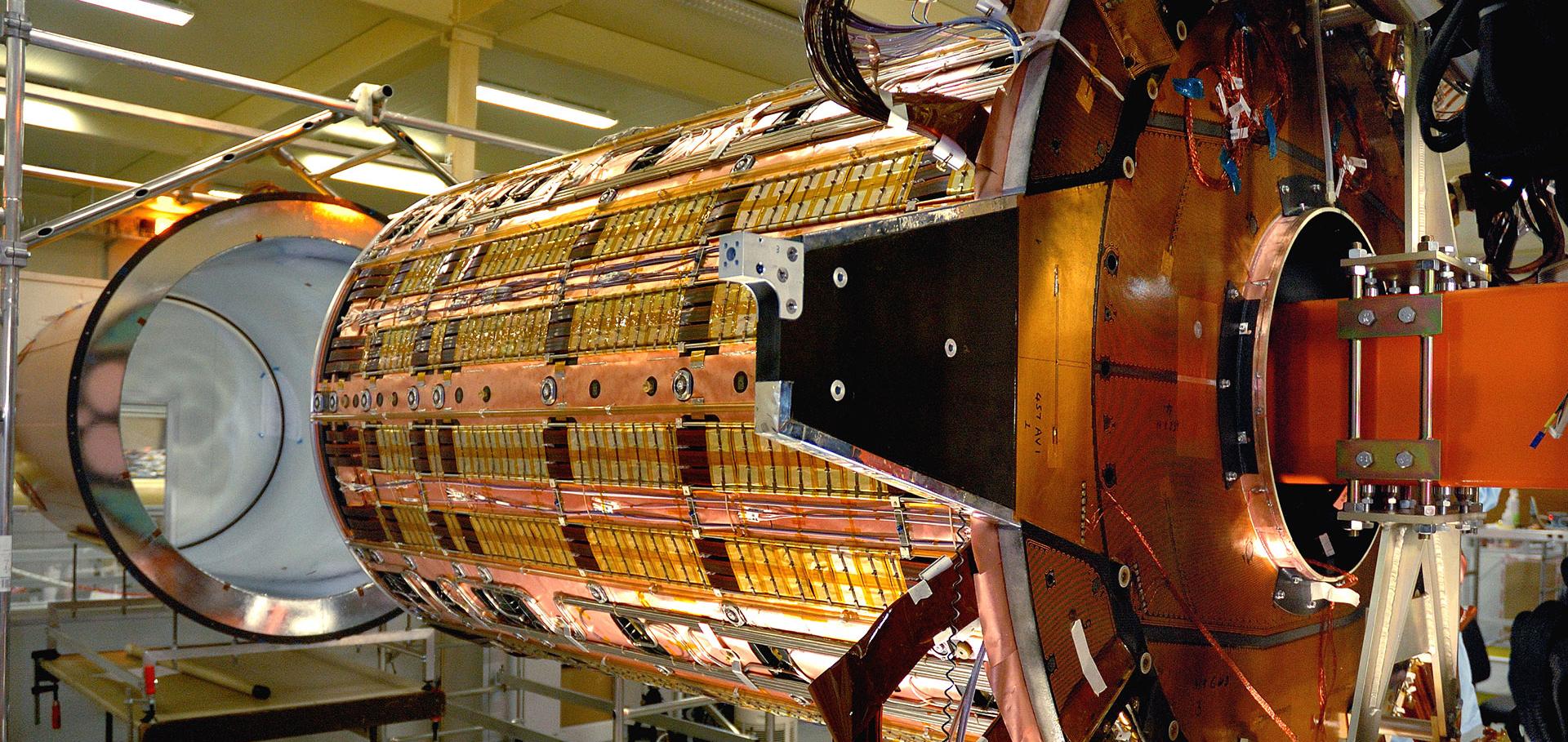

Combined performance tests before installation of the ATLAS semiconductor and transition radiation tracking detectors
Journal of Instrumentation 3:8 (2008)
Abstract:
The ATLAS (A Toroidal LHC ApparatuS) Inner Detector provides charged particle tracking in the centre of the ATLAS experiment at the Large Hadron Collider (LHC). The Inner Detector consists of three subdetectors: the Pixel Detector, the Semiconductor Tracker (SCT), and the Transition Radiation Tracker (TRT). This paper summarizes the tests that were carried out at the final stage of SCT+TRT integration prior to their installation in ATLAS. The combined operation and performance of the SCT and TRT barrel and endcap detectors was investigated through a series of noise tests, and by recording the tracks of cosmic rays. This was a crucial test of hardware and software of the combined tracker detector systems. The results of noise and cross-talk tests on the SCT and TRT in their final assembled configuration, using final readout and supply hardware and software, are reported. The reconstruction and analysis of the recorded cosmic tracks allowed testing of the offline analysis chain and verification of basic tracker performance parameters, such as efficiency and spatial resolution, in combined operation before installation. © 2008 IOP Publishing Ltd. and SISSA.Combined performance tests before installation of the ATLAS Semiconductor and Transition Radiation Tracking Detectors
JOURNAL OF INSTRUMENTATION 3 (2008) ARTN P08003
The integration and engineering of the ATLAS SemiConductor Tracker Barrel
JOURNAL OF INSTRUMENTATION 3 (2008) ARTN P10006
BlackMax: A black-hole event generator with rotation, recoil, split branes and brane tension
ArXiv 0711.3012 (2007)
Abstract:
We present a comprehensive black-hole event generator, BlackMax, which simulates the experimental signatures of microscopic and Planckian black-hole production and evolution at the LHC in the context of brane world models with low-scale quantum gravity. The generator is based on phenomenologically realistic models free of serious problems that plague low-scale gravity, thus offering more realistic predictions for hadron-hadron colliders. The generator includes all of the black-hole graybody factors known to date and incorporates the effects of black-hole rotation, splitting between the fermions, non-zero brane tension and black-hole recoil due to Hawking radiation (although not all simultaneously). The generator can be interfaced with Herwig and Pythia.Radiation hardness studies of VCSELs and PINS for the opto-links of the Atlas SemiConductor Tracker
NUCL INSTRUM METH A 579:2 (2007) 795-800