


Jet energy measurement and its systematic uncertainty in proton-proton collisions at [Formula: see text] TeV with the ATLAS detector.
European physical journal. C, Particles and fields Springer 75:1 (2015) 17
Abstract:
The jet energy scale (JES) and its systematic uncertainty are determined for jets measured with the ATLAS detector using proton-proton collision data with a centre-of-mass energy of [Formula: see text] TeV corresponding to an integrated luminosity of [Formula: see text][Formula: see text]. Jets are reconstructed from energy deposits forming topological clusters of calorimeter cells using the anti-[Formula: see text] algorithm with distance parameters [Formula: see text] or [Formula: see text], and are calibrated using MC simulations. A residual JES correction is applied to account for differences between data and MC simulations. This correction and its systematic uncertainty are estimated using a combination of in situ techniques exploiting the transverse momentum balance between a jet and a reference object such as a photon or a [Formula: see text] boson, for [Formula: see text] and pseudorapidities [Formula: see text]. The effect of multiple proton-proton interactions is corrected for, and an uncertainty is evaluated using in situ techniques. The smallest JES uncertainty of less than 1 % is found in the central calorimeter region ([Formula: see text]) for jets with [Formula: see text]. For central jets at lower [Formula: see text], the uncertainty is about 3 %. A consistent JES estimate is found using measurements of the calorimeter response of single hadrons in proton-proton collisions and test-beam data, which also provide the estimate for [Formula: see text] TeV. The calibration of forward jets is derived from dijet [Formula: see text] balance measurements. The resulting uncertainty reaches its largest value of 6 % for low-[Formula: see text] jets at [Formula: see text]. Additional JES uncertainties due to specific event topologies, such as close-by jets or selections of event samples with an enhanced content of jets originating from light quarks or gluons, are also discussed. The magnitude of these uncertainties depends on the event sample used in a given physics analysis, but typically amounts to 0.5-3 %.Search for microscopic black holes and string balls in final states with leptons and jets with the ATLAS detector at root s=8 TeV
Journal of High Energy Physics Springer Berlin Heidelberg 2014:8 (2014)
Abstract:
A search for an excess of events with multiple high transverse momentum objects including charged leptons and jets is presented, using 20.3 fb -1 of proton-proton collision data recorded by the ATLAS detector at the Large Hadron Collider in 2012 at a centre-of-mass energy of √s = 8 TeV. No excess of events beyond Standard Model expectations is observed. Using extra-dimensional models for black hole and string ball production and decay, exclusion contours are determined as a function of the mass threshold for production and the fundamental gravity scale for two, four and six extra dimensions. For six extra dimensions, mass thresholds of 4.8-6.2 TeV are excluded at 95 % confidence level, depending on the fundamental gravity scale and model assumptions. Upper limits on the fiducial cross-sections for non-Standard Model production of these final states are set.Operation and performance of the ATLAS semiconductor tracker
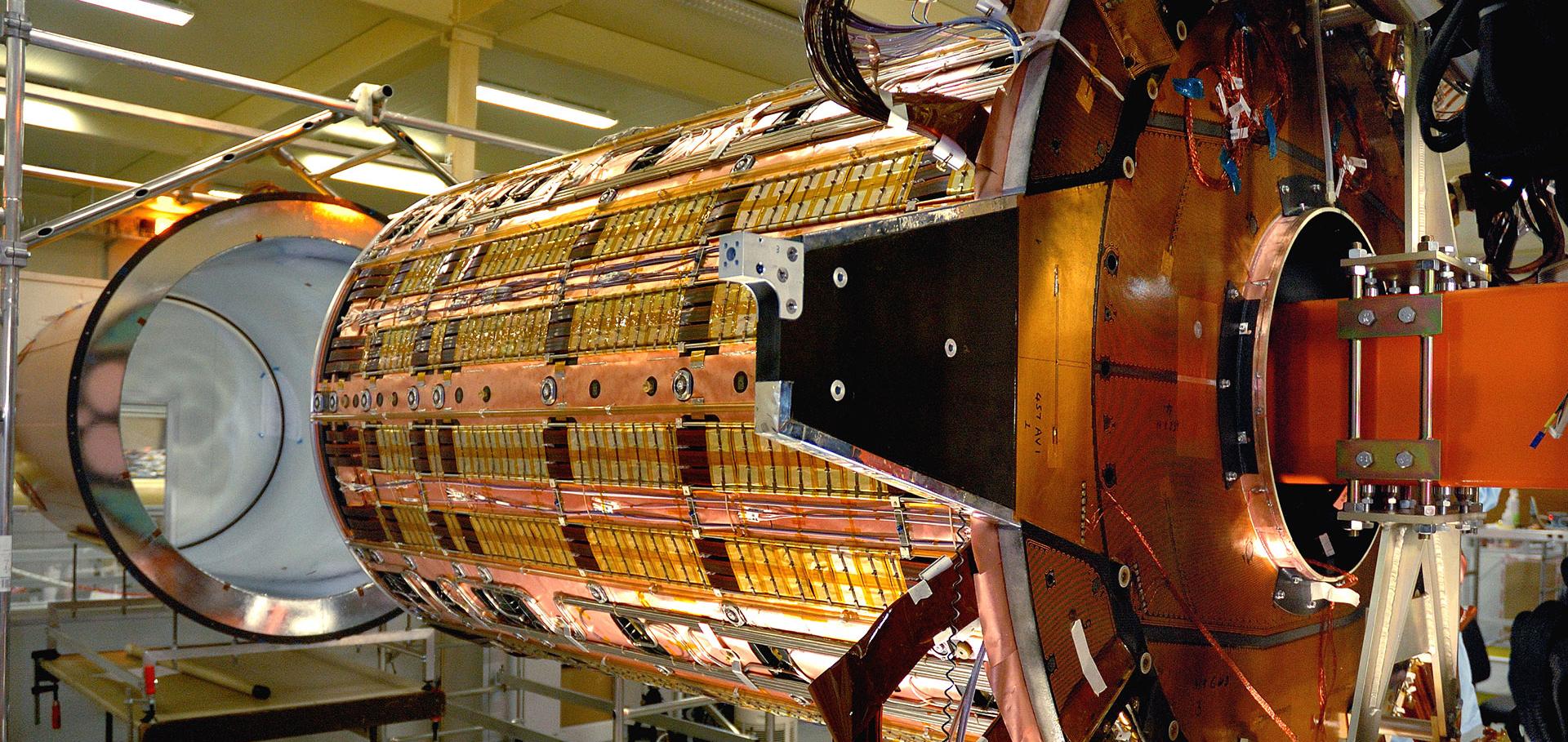
Journal of Instrumentation IOP Publishing 9:08 (2014) p08009-p08009
Search for quantum black hole production in high-invariant-mass lepton+jet final states using pp collisions at √s=8 TeV and the ATLAS detector
Physical Review Letters American Physical Society 112:9 (2014) 091804
Abstract:
This Letter presents a search for quantum black-hole production using 20.3 fb-1 of data collected with the ATLAS detector in pp collisions at the LHC at √s = 8 TeV. The quantum black holes are assumed to decay into a final state characterized by a lepton (electron or muon) and a jet. In either channel, no event with a lepton-jet invariant mass of 3.5 TeV or more is observed, consistent with the expected background. Limits are set on the product of cross sections and branching fractions for the lepton+jet final states of quantum black holes produced in a search region for invariant masses above 1 TeV. The combined 95% confidence level upper limit on this product for quantum black holes with threshold mass above 3.5 TeV is 0.18 fb. This limit constrains the threshold quantum black-hole mass to be above 5.3 TeV in the model considered.Search for microscopic black holes in a like-sign dimuon final state using large track multiplicity with the ATLAS detector
Physical Review D - Particles, Fields, Gravitation and Cosmology 88:7 (2013)