Home
Department Of Physics text logo
  • Research
    • Our research
    • Our research groups
    • Our research in action
    • Research funding support
    • Summer internships for undergraduates
  • Study
    • Undergraduates
    • Postgraduates
  • Engage
    • For alumni
    • For business
    • For schools
    • For the public
  • Support
Menu
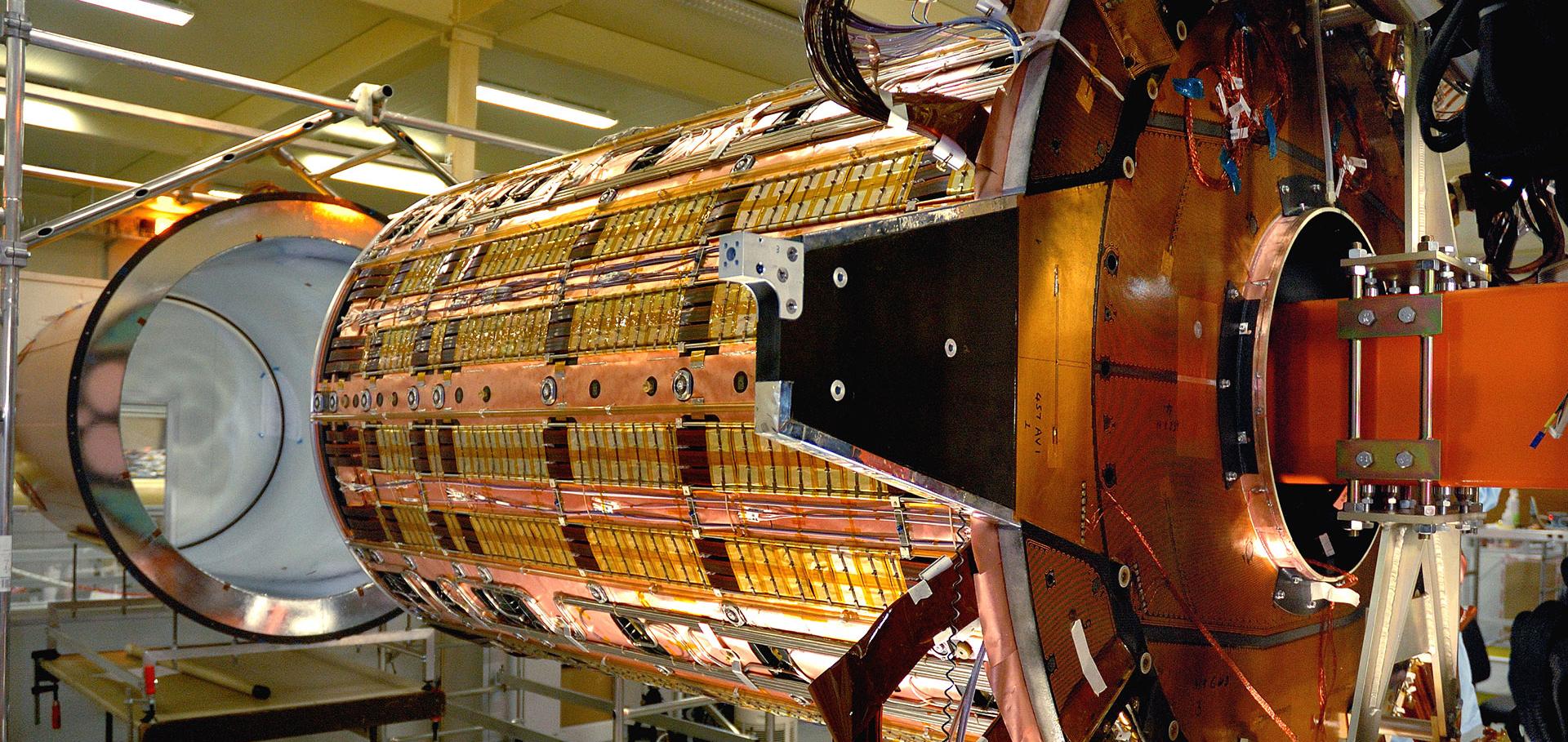
Insertion of STC into TRT at the Department of Physics, Oxford
Credit: CERN

Hans Kraus

Professor of Physics

Research theme

  • Particle astrophysics & cosmology

Sub department

  • Particle Physics

Research groups

  • LUX-ZEPLIN
Hans.Kraus@physics.ox.ac.uk
Telephone: 01865 (2)73361
Denys Wilkinson Building, room 623
  • About
  • Publications

New Limits on Double Electron Capture of $^{40}$Ca and $^{180}$W

(2016)

Authors:

G Angloher, M Bauer, P Bauer, I Bavykina, A Bento, C Bucci, L Canonica, C Ciemniak, X Defay, G Deuter, A Erb, FV Feilitzsch, N Ferreiro Iachellini, P Gorla, A Gütlein, D Hauff, P Huff, C Isaila, J Jochum, M Kiefer, M Kimmerle, H Kluck, H Kraus, J-C Lanfranchi, J Loebell, A Münster, C Pagliarone, F Petricca, S Pfister, W Potzel, F Pröbst, F Reindl, S Roth, K Rottler, C Sailer, K Schäffner, J Schieck, J Schmaler, S Scholl, S Schönert, W Seidel, MV Sivers, L Stodolsky, C Strandhagen, R Strauss, A Tanzke, V Tretyak, HH Trinh Thi, C Türkoğlu, M Uffinger, A Ulrich, I Usherov, S Wawoczny, M Willers, M Wüstrich, A Zöller
More details from the publisher

Constraints on low-mass WIMPs from the EDELWEISS-III dark matter search

(2016)

Authors:

EDELWEISS Collaboration, E Armengaud, Q Arnaud, C Augier, A Benoît, A Benoît, L Bergé, T Bergmann, J Billard, J Blümer, T de Boissière, G Bres, A Broniatowski, V Brudanin, P Camus, A Cazes, M Chapellier, F Charlieux, L Dumoulin, K Eitel, D Filosofov, N Foerster, N Fourches, G Garde, J Gascon, G Gerbier, A Giuliani, M Grollier, M Gros, L Hehn, S Hervé, G Heuermann, V Humbert, M De Jésus, Y Jin, S Jokisch, A Juillard, C Kéfélian, M Kleifges, V Kozlov, H Kraus, VA Kudryavtsev, H Le-Sueur, J Lin, M Mancuso, S Marnieros, A Menshikov, X-F Navick, C Nones, E Olivieri, P Pari, B Paul, M-C Piro, DV Poda, E Queguiner, M Robinson, H Rodenas, S Rozov, V Sanglard, B Schmidt, S Scorza, B Siebenborn, D Tcherniakhovski, L Vagneron, M Weber, E Yakushev, X Zhang
More details from the publisher

In-situ study of light production and transport in phonon/light detector modules for dark matter search

Nuclear Instruments and Methods in Physics Research Section A: Accelerators, Spectrometers, Detectors and Associated Equipment Elsevier (2016)

Authors:

M Kiefer, G Angloher, A Bento, C Bucci, L Canonica, A Erb, FV Feilitzsch, N Ferreiro Iachellini, P Gorla, A Gütlein, D Hauff, J Jochum, H Kluck, Hans Kraus, J-C Lanfranchi, J Loebell, A Münster, F Petricca, W Potzel, F Pröbst, F Reindl, S Roth, K Rottler, C Sailer, K Schäffner, J Schieck, S Schönert, W Seidel, MV Sivers, L Stodolsky, C Strandhagen, R Strauss, A Tanzke, C Türkoğlu, M Uffinger, A Ulrich, I Usherov, S Wawoczny, M Willers, M Wüstrich, A Zöller

Abstract:

The CRESST experiment (Cryogenic Rare Event Search with Superconducting Thermometers) searches for dark matter via the phonon and light signals of elastic scattering processes in scintillating crystals. The discrimination between a possible dark matter signal and background is based on the light yield. We present a new method for evaluating the two characteristics of a phonon/light detector module that determine how much of the deposited energy is converted to scintillation light and how efficiently a module detects the produced light. In contrast to former approaches with dedicated setups, we developed a method which allows us to use data taken with the cryogenic setup, during a dark matter search phase. In this way, we accounted for the entire process that occurs in a detector module, and obtained information on the light emission of the crystal as well as information on the performance of the module (light transport and detection). We found that with the detectors operated in CRESST-II phase 1, about 20% of the produced scintillation light is detected. A part of the light is likely absorbed by creating meta-stable excitations in the scintillating crystals. The light not detected is not absorbed entirely, as an additional light detector can help to increase the fraction of detected light.
More details from the publisher
Details from ORA
More details
More details

Cryogenic phonon-scintillation detectors with PMT readout for rare event search experiments

Astroparticle Physics (2016)

Authors:

X Zhang, J Lin, V Mikhailik, H Kraus
More details from the publisher
Details from ORA
More details

LUMINEU: a search for neutrinoless double beta decay based on ZnMoO$_4$ scintillating bolometers

(2016)

Authors:

E Armengaud, Q Arnaud, C Augier, A Benoit, A Benoit, L Berge, RS Boiko, T Bergmann, J Blumer, A Broniatowski, V Brudanin, P Camus, A Cazes, M Chapellier, F Charlieux, DM Chernyak, N Coron, P Coulter, FA Danevich, T de Boissiere, R Decourt, M De Jesus, L Devoyon, A-A Drillien, L Dumoulin, K Eitel, C Enss, D Filosofov, A Fleischmann, N Foerster, N Fourches, J Gascon, L Gastaldo, G Gerbier, A Giuliani, D Gray, M Gros, L Hehn, S Henry, S Herve, G Heuermann, V Humbert, IM Ivanov, A Juillard, C Kefelian, M Kleifges, H Kluck, VV Kobychev, F Koskas, V Kozlov, H Kraus, VA Kudryavtsev, H Le Sueur, M Loidl, P Magnier, EP Makarov, M Mancuso, P de Marcillac, S Marnieros, C Marrache-Kikuchi, A Menshikov, SG Nasonov, X-F Navick, C Nones, E Olivieri, P Pari, B Paul, Y Penichot, G Pessina, MC Piro, O Plantevin, DV Poda, T Redon, M Robinson, M Rodrigues, S Rozov, V Sanglard, B Schmidt, S Scorza VN Shlegel, B Siebenborn, O Strazzer, D Tcherniakhovski, M Tenconi, L Torres, VI Tretyak, L Vagneron, Ya V Vasiliev, M Velazquez, O Viraphong, RJ Walker, M Weber, E Yakushev, X Zhang, VN Zhdankov
More details from the publisher

Pagination

  • First page First
  • Previous page Prev
  • …
  • Page 26
  • Page 27
  • Page 28
  • Page 29
  • Current page 30
  • Page 31
  • Page 32
  • Page 33
  • Page 34
  • …
  • Next page Next
  • Last page Last

Footer Menu

  • Contact us
  • Giving to the Dept of Physics
  • Work with us
  • Media

User account menu

  • Log in

Follow us

FIND US

Clarendon Laboratory,

Parks Road,

Oxford,

OX1 3PU

CONTACT US

Tel: +44(0)1865272200

University of Oxfrod logo Department Of Physics text logo
IOP Juno Champion logo Athena Swan Silver Award logo

© University of Oxford - Department of Physics

Cookies | Privacy policy | Accessibility statement

Built by: Versantus

  • Home
  • Research
  • Study
  • Engage
  • Our people
  • News & Comment
  • Events
  • Our facilities & services
  • About us
  • Giving to Physics
  • Current students
  • Staff intranet