Home
Department Of Physics text logo
  • Research
    • Our research
    • Our research groups
    • Our research in action
    • Research funding support
    • Summer internships for undergraduates
  • Study
    • Undergraduates
    • Postgraduates
  • Engage
    • For alumni
    • For business
    • For schools
    • For the public
  • Support
Menu
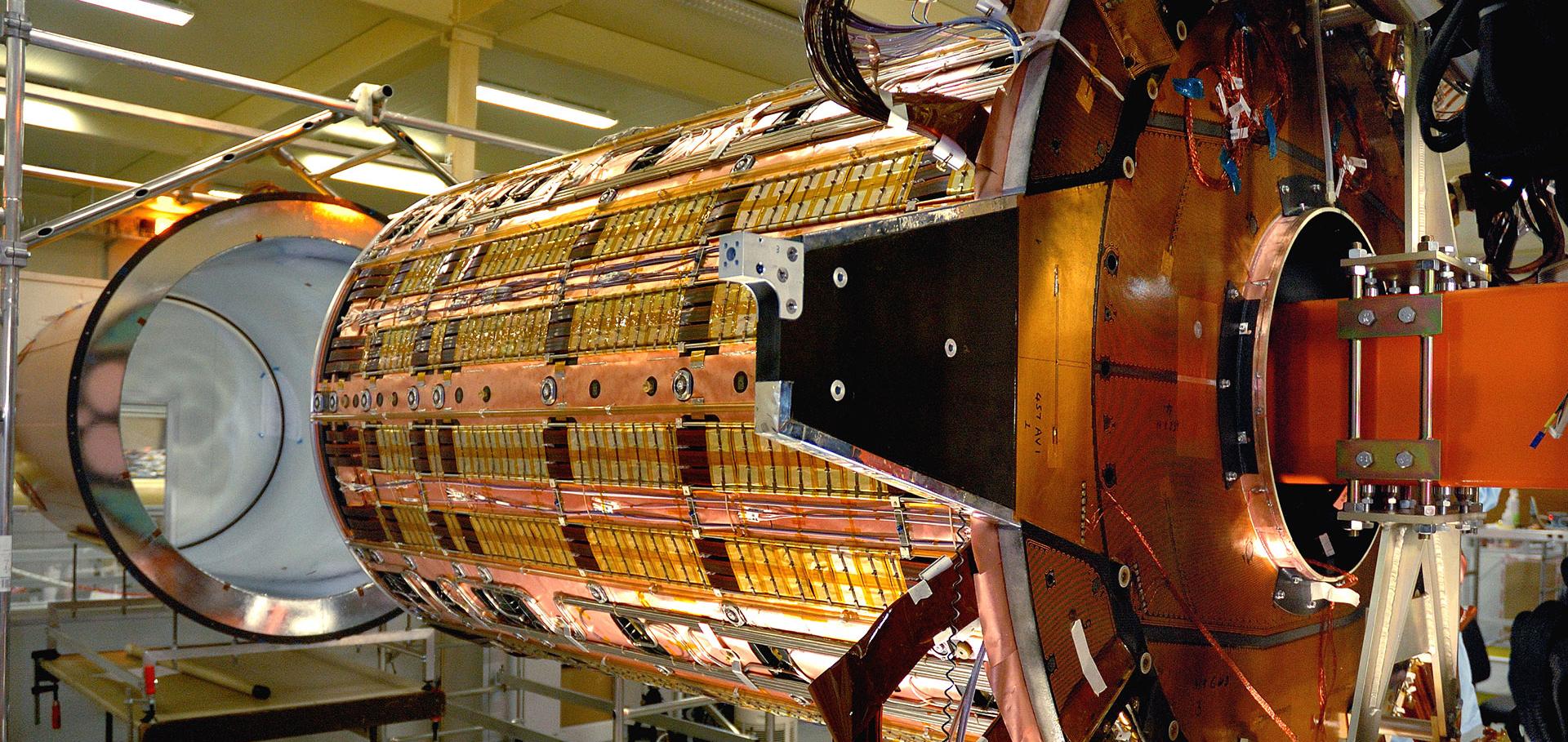
Insertion of STC into TRT at the Department of Physics, Oxford
Credit: CERN

Elizabeth Leason

Quantum Technology Fellow

Sub department

  • Particle Physics
elizabeth.leason@physics.ox.ac.uk
Denys Wilkinson Building, room 658b
  • About
  • Publications

Development of Superfluid Helium-3 Bolometry Using Nanowire Resonators with SQUID Readout for the QUEST-DMC Experiment

Journal of Low Temperature Physics Springer 222:2 (2026) 39

Authors:

E Leason, LV Levitin, S Autti, E Bloomfield, A Casey, N Darvishi, N Eng, P Franchini, RP Haley, PJ Heikkinen, A Jennings, A Kemp, J March-Russell, A Mayer, J Monroe, D Muenstermann, MT Noble, JR Prance, X Rojas, T Salmon, J Saunders, J Smirnov, R Smith, MD Thompson

Abstract:

Superfluid helium-3 bolometers can be utilised for dark matter direct detection searches. The extremely low heat capacity of the B phase of the superfluid helium-3 at ultra-low temperatures offers the potential to reach world leading sensitivity to spin-dependent interactions of dark matter in the sub-GeV/c2 mass range. Here, we describe the development of bolometry using both micron scale and sub-micron diameter vibrating wire resonators, with a SQUID amplifier-based readout scheme. Characterisation of the resonators and bolometer measurements are shown, including the use of nonlinear operation and the corresponding corrections. The bolometer contains two vibrating wire resonators, enabling heat injection calibration and simultaneous bolometer tracking measurements. Coincident events measured on both vibrating wire resonators verify their response. We also demonstrate proof of concept frequency multiplexed readout. Development of these measurement techniques lays the foundations for the use of superfluid helium-3 bolometers, instrumented with vibrating nanomechanical resonators, for future low-threshold dark matter searches.
More details from the publisher
Details from ORA
More details

Dark matter EFT landscape probed by QUEST-DMC

Journal of Cosmology and Astroparticle Physics IOP Publishing 2025:10 (2025) 44

Authors:

N Darvishi, S Autti, L Bloomfield, A Casey, N Eng, Paolo Franchini, Rp Haley, Pj Heikkinen, A Jennings, A Kemp, Elizabeth Leason, John March-Russell, A Mayer, Jocelyn Monroe, D Münstermann, Mt Noble, Jr Prance, X Rojas, T Salmon, J Saunders, J Smirnov, R Smith, Md Thompson, A Thomson, A Ting, V Tsepelin, Sm West, L Whitehead, De Zmeev

Abstract:

We present the projected sensitivity to non-relativistic Effective Field Theory (EFT) operators for dark matter (DM) direct detection using the QUEST-DMC experiment. QUEST-DMC employs superfluid Helium-3 as a target medium and measures energy deposition via nanomechanical resonators with SQUID-based readout to probe DM interactions. The experiment aims to explore new parameter space in the sub-GeV mass range, probing light DM and a broad range of interaction models. We analyse the sensitivity to a complete set of fourteen independent non-relativistic EFT operators, each parameterised by a Wilson coefficient that quantifies the strength of DM interactions with Standard Model particles. For each interaction channel, we determine the corresponding sensitivity ceiling due to attenuation of the DM flux incident on the detector, caused by DM scattering in the Earth and atmosphere. As a key component of this analysis, we provide the mapping between the non-relativistic EFT operators and the relativistic bilinear DM-nucleon interactions, and assess the interaction sensitivity to sub-GeV DM in the QUEST-DMC detector. Our findings demonstrate that QUEST-DMC provides a unique probe of DM interactions, particularly in previously unexplored parameter space for momentum- and velocity-dependent interactions, thereby expanding the search for viable DM candidates beyond traditional weakly interacting massive particles.
More details from the publisher
Details from ORA
More details

Footer Menu

  • Contact us
  • Giving to the Dept of Physics
  • Work with us
  • Media

User account menu

  • Log in

Follow us

FIND US

Clarendon Laboratory,

Parks Road,

Oxford,

OX1 3PU

CONTACT US

Tel: +44(0)1865272200

University of Oxfrod logo Department Of Physics text logo
IOP Juno Champion logo Athena Swan Silver Award logo

© University of Oxford - Department of Physics

Cookies | Privacy policy | Accessibility statement

Built by: Versantus

  • Home
  • Research
  • Study
  • Engage
  • Our people
  • News & Comment
  • Events
  • Our facilities & services
  • About us
  • Giving to Physics
  • Current students
  • Staff intranet