


CP violation in the quark sector
I am a graduate student studying for a Doctor of Philosophy in Particle Physics. Informally I go by the nickname George.
I analyse data from the LHCb experiment at the Large Hadron Collider (LHC) at CERN to perform measurements of the Cabibbo–Kobayashi–Maskawa (CKM) angle $\gamma$. Phenomenologically, $\gamma$ is, up to a small correction, the complex phase of the CKM matrix that gives rise to charge–parity symmetry breaking ($C\!P$ violation) in the quark sector of the Standard Model of particle physics. This complex phase enters when heavy quarks decay to lighter quarks via the weak interaction.
If all processes in the Universe conserved $C\!P$, then matter and antimatter would be present in equal amounts. In contrast, observations demonstrate that matter in the Universe greatly exceeds antimatter. The Standard Model predicts that the complex phase in the CKM matrix is the only mechanism that causes $C\!P$ violation in our Universe, which is not sufficient to explain the extent of the matter–antimatter asymmetry seen. Mechanisms beyond the Standard Model that could supplement this are being explored and measured—for example $C\!P$ violation arising from neutrino oscillations; yet taking into account the standard model contribution of the matter–antimatter symmetry is nevertheless key to our understanding of this problem.
In particular, I work on the determination of $\gamma$ using the decay channels $B^\pm \rightarrow Dh^\pm$, $D \rightarrow K_{S}^0 h'^+ h'^-$, where $h^{(}\!'\!^{)} = K, \pi$. $B$ and $D$ are mesons (particles containing a quark and an antiquark) that contain $b$ and $c$ quarks, respectively, while $K$ and $\pi$ are lighter mesons (kaons and pions) composed only of light-flavoured quarks. Currently, I am trying to understand the hadronic parameters associated with these decay channels using $e^+e^-\rightarrow\psi\left(3770\right)\rightarrow D\bar{D}$ data from the BESIII experiment in Beijing, China, where $\psi\left(3770\right)$ is predominantly a $1\,{}^{3}D_1$ state of the $c\bar c$ system.
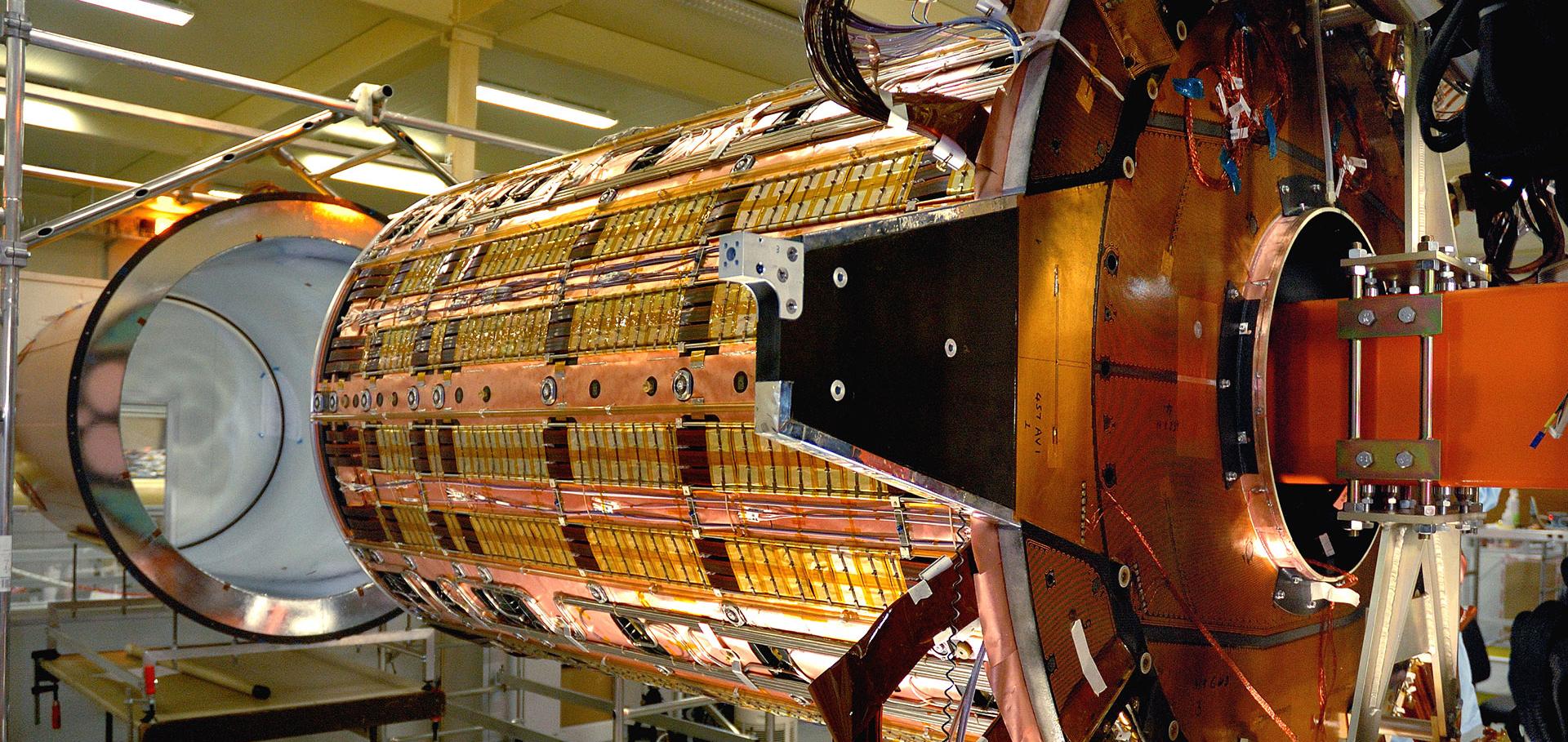
In addition, I work on the calibration of the LHCb detector in terms of the quantification of its particle identification capability. My main responsibility on that front is to characterise the detector performance in identifying protons passing through the detector, numerically examine the ability of the detector to correctly identify true protons and the rate at which protons are misidentified as kaons or pions.