Home
Department Of Physics text logo
  • Research
    • Our research
    • Our research groups
    • Our research in action
    • Research funding support
    • Summer internships for undergraduates
  • Study
    • Undergraduates
    • Postgraduates
  • Engage
    • For alumni
    • For business
    • For schools
    • For the public
  • Support
Menu
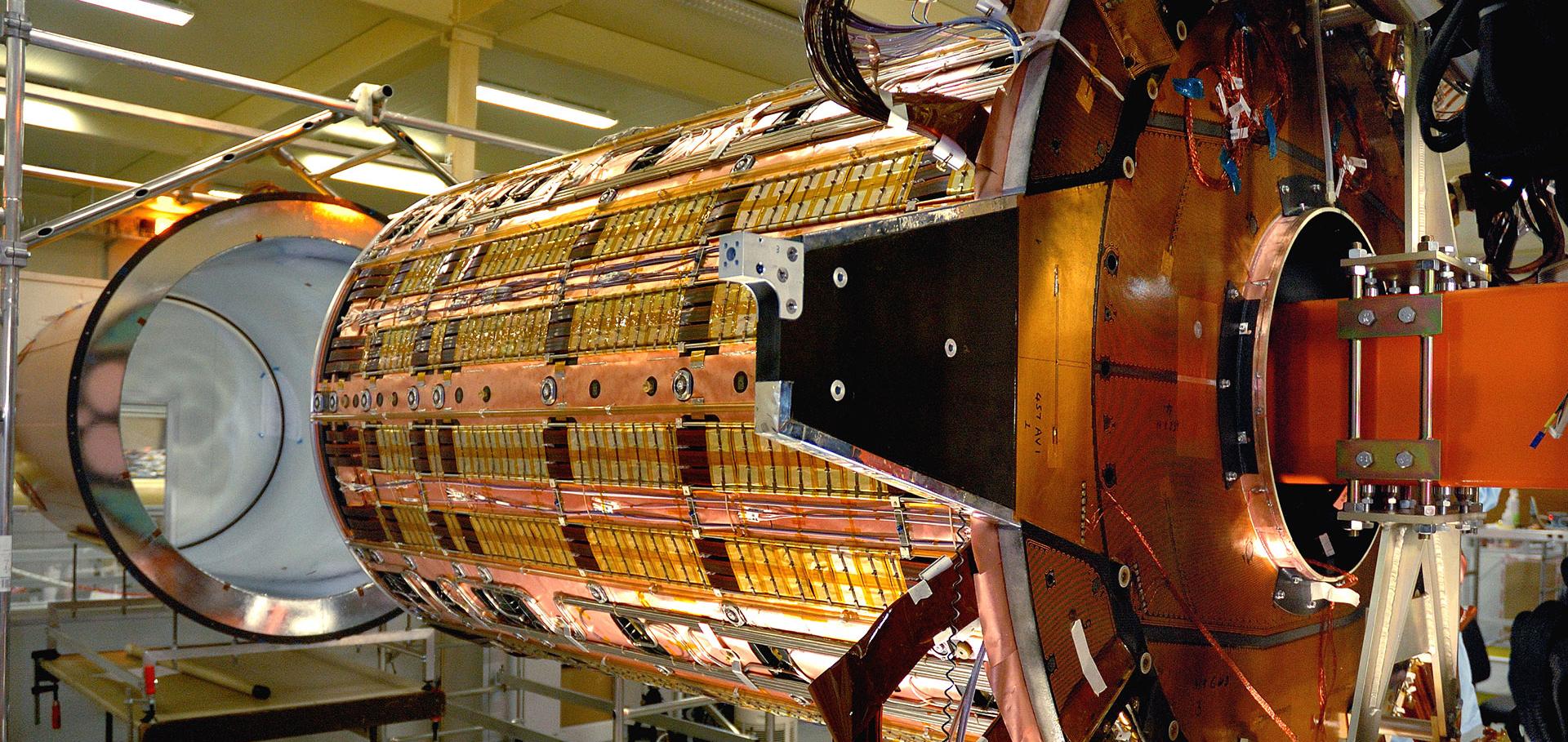
Insertion of STC into TRT at the Department of Physics, Oxford
Credit: CERN

Sneha Malde

Associate Professor of Physics

Sub department

  • Particle Physics

Research groups

  • LHCb
Sneha.Malde@physics.ox.ac.uk
Telephone: 01865 (2)73357
Denys Wilkinson Building, room 673
  • About
  • Publications

First observation of D⁰-D⁰ oscillations in D⁰ → K⁺π⁻π⁺π⁻ decays and measurement of the associated coherence parameters.

Physical Review Letters American Physical Society 116:24 (2016) 241801

Authors:

Shu-Faye Cheung, Tim Evans, Paolo Gandini, Thomas Hadavizadeh, Neville Harnew, Donal Hill, Pawel G Jalocha, Malcolm John, Oliver J Lupton, Sneha S Malde, Anita K Nandi, Stig Topp-Jorgenson, Guy R Wilkinson

Abstract:

Charm meson oscillations are observed in a time-dependent analysis of the ratio of D⁰ → K⁺π⁻π⁺π⁻ to D⁰ → K⁻π⁺π⁻π⁺ decay rates, using data corresponding to an integrated luminosity of 3.0  fb^⁻1 recorded by the LHCb experiment. The measurements presented are sensitive to the phase-space averaged ratio of doubly Cabibbo-suppressed to Cabibbo-favored amplitudes rDK3π and the product of the coherence factor RDK3π and a charm mixing parameter y'K3π. The constraints measured are rDK3π=(5.67±0.12)×10^-2, which is the most precise determination to date, and RDK3π . y'K3π=(0.3 ± 1.8) × 10^-3, which provides useful input for determinations of the CP-violating phase γ in B^± → DK^±, D → K∓π^±π^∓π^± decays. The analysis also gives the most precise measurement of the D⁰ → K⁺π⁻π⁺π⁻ branching fraction, and the first observation of D0 - D0 oscillations in this decay mode, with a significance of 8.2 standard deviations.
More details from the publisher
Details from ORA
More details
More details
Details from ArXiV

Measurement of CP observables in B +/- → DK +/- and B +/- → Dπ +/- with two- and four-body D decays

Physics Letters B Elsevier 760 (2016) 117-131

Authors:

R Aaij, C Abellán Beteta, B Adeva, Thomas Evans, Paolo Gandini, Thomas Hadavizadeh, Neville Harnew, Donal Hill, Pawel G Jalocha, Malcolm JJ John, Sneha Malde, Anita K Nandi, Stig Topp-Jorgenson, Guy R Wilkinson

Abstract:

Measurements of CP observables in B± → DK± and B± → Dπ± decays are presented where the D meson is reconstructed in the final states K±π∓, π±K∓, K+K−, π+π−, K±π∓π+π−, π±K∓π+π− and π+π−π+π−. This analysis uses a sample of charged B mesons from pp collisions collected by the LHCb experiment in 2011 and 2012, corresponding to an integrated luminosity of 3.0 fb^−1. Various CP-violating effects are reported and together these measurements provide important input for the determination of the unitarity triangle angle γ. The analysis of the four-pion D decay mode is the first of its kind.
More details from the publisher
Details from ORA
More details
Details from ArXiV

Search for B+c decays to the ppπ+ final state

Physics Letters B Elsevier 759 (2016) 313-321

Authors:

Shu-Faye Cheung, Tim Evans, Paolo Gandini, Barak R Gruberg Cadzon, Thomas Hadavizadeh, Neville Harnew, Donal Hill, Pawel G Jalocha, Malcolm John, Oliver J Lupton, Sneha S Malde, Anita K Nandi, Stig Topp-Jorgenson, Guy R Wilkinson

Abstract:

A search for the decays of the B+c meson to ppπ+ is performed for the first time using a data sample corresponding to an integrated luminosity of 3.0 fb-1 collected by the LHCb experiment in pp collisions at centre-of-mass energies of 7 and 8 TeV. No signal is found and an upper limit, at 95% confidence level, is set, fc/fu × B(B+c → ppπ+) < 3.6×10^-8 in the kinematic region m(pp) < 2.85 GeV/c^2, pT(B) < 20 GeV/c and 2.0 < y(B) < 4.5, where B is the branching fraction and fc(fu) is the fragmentation fraction of the b quark into a Bc+ (B+) meson.
More details from the publisher
Details from ORA
More details
Details from ArXiV
More details

Observation of Λb0 → ψ(2S)pK− and Λb0→ J/ψ π+ π− pK- decays and a measurement of the Λb0 baryon mass

Journal of High Energy Physics Springer 2016:5 (2016) 132

Authors:

Shu-Faye Cheung, Tim Evans, Paolo Gandini, Thomas Hadavizadeh, Neville Harnew, Donal Hill, Pawel G Jalocha, Malcolm JJ John, Oliver J Lupton, Sneha S Malde, Anita K Nandi, Stig Topp-Joergenson, Guy R Wilkinson

Abstract:

The decays Λb0→ ψ(2S)pK− and Λb0→ J/ψπ+π−pK−are observed in a data sample corresponding to an integrated luminosity of 3 fb^−1, collected in proton-proton collisions at 7 and 8 TeV centre-of-mass energies by the LHCb detector. The ψ(2S) mesons are reconstructed through the decay modes ψ(2S) → μ+μ−and ψ(2S) → J/ψπ+π−. The branching fractions relative to that of Λb0→ J/ψpK−are measured to be ℬ(Λb0→ψ(2S)pK−)/ℬ(Λb0→J/ψpK−) = (20.70±0.76±0.46±0.37) × 10^−2, ℬ(Λb0→ψ(2S)pK−)/ℬ(Λb0→J/ψpK−) = (20.86±0.96±1.34)×10^−2 where the first uncertainties are statistical, the second are systematic and the third is related to the knowledge of J/ψ and ψ(2S) branching fractions. The mass of the Λb0baryon is measured to be M(Λb0) = 5619.65 ± 0.17 ± 0.17MeV/c2, where the uncertainties are statistical and systematic.
More details from the publisher
Details from ORA

Measurement of the mass and lifetime of the Ωb- baryon

Physical Review D - Particles, Fields, Gravitation and Cosmology 93:9 (2016)

Authors:

R Aaij, C Abellán Beteta, B Adeva, M Adinolfi, Z Ajaltouni, S Akar, J Albrecht, F Alessio, M Alexander, S Ali, G Alkhazov, P Alvarez Cartelle, AA Alves, S Amato, S Amerio, Y Amhis, L An, L Anderlini, G Andreassi, M Andreotti, JE Andrews, RB Appleby, O Aquines Gutierrez, F Archilli, P D'Argent, A Artamonov, M Artuso, E Aslanides, G Auriemma, M Baalouch, S Bachmann, JJ Back, A Badalov, C Baesso, S Baker, W Baldini, RJ Barlow, C Barschel, S Barsuk, W Barter, V Batozskaya, V Battista, A Bay, L Beaucourt, J Beddow, F Bedeschi, I Bediaga, LJ Bel, V Bellee, N Belloli, I Belyaev, E Ben-Haim, G Bencivenni, S Benson, J Benton, A Berezhnoy, R Bernet, A Bertolin, F Betti, MO Bettler, M Van Beuzekom, S Bifani, P Billoir, T Bird, A Birnkraut, A Bizzeti, T Blake, F Blanc, J Blouw, S Blusk, V Bocci, A Bondar, N Bondar, W Bonivento, A Borgheresi, S Borghi, M Borisyak, M Borsato, M Boubdir, TJV Bowcock, E Bowen, C Bozzi, S Braun, M Britsch, T Britton, J Brodzicka, E Buchanan, C Burr, A Bursche, J Buytaert, S Cadeddu, R Calabrese, S malde, G wilkinson, N harnew, M john, P gandini, W qian

Abstract:

© 2016 CERN, for the LHCb Collaboration. Published by the American Physical Society under the terms of the http://creativecommons.org/licenses/by/3.0/ Creative Commons Attribution 3.0 License. Further distribution of this work must maintain attribution to the author(s) and the published article's title, journal citation, and DOI.A proton-proton collision data sample, corresponding to an integrated luminosity of 3 fb-1 collected by LHCb at s=7 and 8 TeV, is used to reconstruct 63±9 Ωb-→Ωc0π-, Ωc0→pK-K-π+ decays. Using the Ξb-→Ξc0π-, Ξc0→pK-K-π+ decay mode for calibration, the lifetime ratio and the absolute lifetime of the Ωb- baryon are measured to be τΩb-/τΞb-=1.11±0.16±0.03, τΩb-=1.78±0.26±0.05±0.06 ps, where the uncertainties are statistical, systematic and from the calibration mode (for τΩb- only). A measurement is also made of the mass difference, mΩb - mΞb-, and the corresponding Ωb- mass, which yields mΩb - mΞb-=247.4±3.2±0.5 MeV/c2, mΩb-=6045.1±3.2±0.5±0.6 MeV/c2. These results are consistent with previous measurements.
More details from the publisher
Details from ORA
More details

Pagination

  • First page First
  • Previous page Prev
  • …
  • Page 196
  • Page 197
  • Page 198
  • Page 199
  • Current page 200
  • Page 201
  • Page 202
  • Page 203
  • Page 204
  • …
  • Next page Next
  • Last page Last

Footer Menu

  • Contact us
  • Giving to the Dept of Physics
  • Work with us
  • Media

User account menu

  • Log in

Follow us

FIND US

Clarendon Laboratory,

Parks Road,

Oxford,

OX1 3PU

CONTACT US

Tel: +44(0)1865272200

University of Oxfrod logo Department Of Physics text logo
IOP Juno Champion logo Athena Swan Silver Award logo

© University of Oxford - Department of Physics

Cookies | Privacy policy | Accessibility statement

Built by: Versantus

  • Home
  • Research
  • Study
  • Engage
  • Our people
  • News & Comment
  • Events
  • Our facilities & services
  • About us
  • Giving to Physics
  • Current students
  • Staff intranet