Home
Department Of Physics text logo
  • Research
    • Our research
    • Our research groups
    • Our research in action
    • Research funding support
    • Summer internships for undergraduates
  • Study
    • Undergraduates
    • Postgraduates
  • Engage
    • For alumni
    • For business
    • For schools
    • For the public
  • Support
Menu
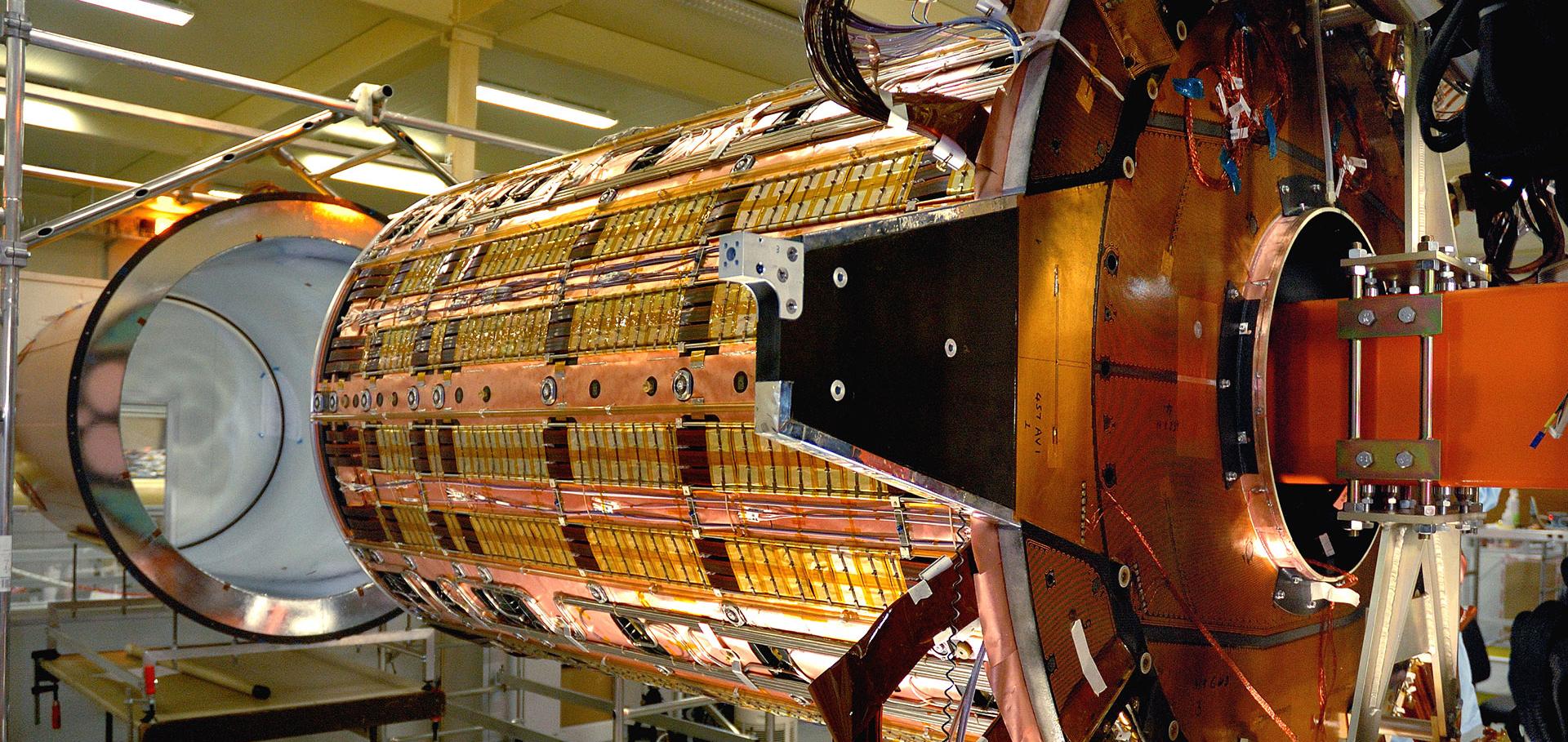
Insertion of STC into TRT at the Department of Physics, Oxford
Credit: CERN

Sneha Malde

Associate Professor of Physics

Sub department

  • Particle Physics

Research groups

  • LHCb
Sneha.Malde@physics.ox.ac.uk
Telephone: 01865 (2)73357
Denys Wilkinson Building, room 673
  • About
  • Publications

Measurement of forward W and Z boson production in pp collisions at √s=8 TeV

Journal of High Energy Physics Springer Berlin Heidelberg 2016:155 (2016)

Authors:

R Aaij, C Abellán Beteta, B Adeva, SF Cheung, T Evans, P Gandini, R Gauld, E Greening, T Hadavizadeh, Neville Harnew, D Hill, N Hussain, J Jalocha, M John, O Lupton, S Malde, A Nandi, E Smith, S Stevenson, C Thomas, S Topp-Joergensen, N Torr, G Wilkinson

Abstract:

Measurements are presented of electroweak boson production using data from $pp$ collisions at a centre-of-mass energy of $\sqrt{s} = 8\mathrm{\,Te\kern -0.1em V}$. The analysis is based on an integrated luminosity of $2.0\mathrm{\,fb}^{-1}$ recorded with the LHCb detector. The bosons are identified in the $W\rightarrow\mu\nu$ and $Z\rightarrow\mu^{+}\mu^{-}$ decay channels. The cross-sections are measured for muons in the pseudorapidity range $2.0 < \eta < 4.5$, with transverse momenta $p_{\rm T} > 20{\mathrm{\,Ge\kern -0.1em V\!/}c}$ and, in the case of the $Z$ boson, a dimuon mass within $60 < M_{\mu^{+}\mu^{-}} < 120{\mathrm{\,Ge\kern -0.1em V\!/}c^{2}}$. The results are \begin{align*} \sigma_{W^{+}\rightarrow\mu^{+}\nu} &= 1093.6 \pm 2.1 \pm 7.2 \pm 10.9 \pm 12.7{\rm \,pb} \, , \sigma_{W^{-}\rightarrow\mu^{-}\bar{\nu}} &= \phantom{0}818.4 \pm 1.9 \pm 5.0 \pm \phantom{0}7.0 \pm \phantom{0}9.5{\rm \,pb} \, , \sigma_{Z\rightarrow\mu^{+}\mu^{-}} &= \phantom{00}95.0 \pm 0.3 \pm 0.7 \pm \phantom{0}1.1 \pm \phantom{0}1.1{\rm \,pb} \, , \end{align*} where the first uncertainties are statistical, the second are systematic, the third are due to the knowledge of the LHC beam energy and the fourth are due to the luminosity determination. The evolution of the $W$ and $Z$ boson cross-sections with centre-of-mass energy is studied using previously reported measurements with $1.0\mathrm{\,fb}^{-1}$ of data at $7\mathrm{\,Te\kern -0.1em V}$. Differential distributions are also presented. Results are in good agreement with theoretical predictions at next-to-next-to-leading order in perturbative quantum chromodynamics.
More details from the publisher
Details from ORA
More details
Details from ArXiV

Search for the lepton-flavour violating decay D^0→e^±μ^∓

Physics Letters B Elsevier 754 (2016) 167-175

Authors:

R Aaij, CA Beteta, B Adeva, Neville Harnew

Abstract:

Search for the lepton-flavour violating decay D0 → e±μ∓

A search for the lepton-flavour violating decay D0 → e±μ∓ is made with a dataset corresponding to an integrated luminosity of 3.0 fb−1 of proton–proton collisions at centre-of-mass energies of 7 TeV and 8 TeV, collected by the LHCb experiment. Candidate D0 mesons are selected using the decay D∗+ → D0π+ and the D0 → e±μ∓ branching fraction is measured using the decay mode D0 → K−π+ as a normalization channel. No significant excess of D0 → e±μ∓ candidates over the expected background is seen, and a limit is set on the branching fraction, 𝓑(D0 → e±μ∓) < 1.3 × 10⁻⁸, at 90% confidence level. This is an order of magnitude lower than the previous limit and it further constrains the parameter space in some leptoquark models and in supersymmetric models with R-parity violation.

More details from the publisher
Details from ORA
More details

First observation of the decay B(s)^0 → K(S)^0K∗(892)^0 at LHCb

Journal of High Energy Physics Springer Verlag 2016:12 (2016)

Authors:

R Aaij, B Adeva, M Adinolfi, Neville Harnew

Abstract:

First observation of the decay Bs0 → KS0K∗(892)0 at LHCb

A search for B(s)0 → KS0K∗(892)0 decays is performed using pp collision data, corresponding to an integrated luminosity of 1.0 fb−1, collected with the LHCb detector at a centre-of-mass energy of 7 TeV. The Bs0 → KS0K∗(892)0 decay is observed for the first time, with a significance of 7.1 standard deviations. The branching fraction is measured to be
𝓑(Bs0 → K̅0K∗(892)0) + 𝓑(Bs0 → K0K̅∗(892)0)=(16.4 ± 3.4 ± 2.3) × 10−6,
where the first uncertainty is statistical and the second is systematic. No evidence is found for the decay B0 → KS0K∗(892)0 and an upper limit is set on the branching fraction, 𝓑(B0 → K̅0K∗(892)0) + 𝓑(B0 → K0K̅∗(892)0) < 0.96 × 10⁻⁶, at 90 % confidence level. All results are consistent with Standard Model predictions.

More details from the publisher
Details from ORA
More details

Amplitude analysis of B−→D+π−π− decays

Physical Review D American Physical Society 94:7 (2016) 072001

Authors:

Shu-Faye Cheung, Tim Evans, Paolo Gandini, Barak R Gruberg Cazon, Thomas Hadavizadeh, Neville Harnew, D Hill, N Hussain, Pawel Jalocha, Malcolm JJ John, Oliver S Lupton, Sneha S Malde, Anita K Nandi, W Qian, S Stevenson, C Thomas, Stig Topp-Joergenson, Guy R Wilkinson

Abstract:

The Dalitz plot analysis technique is used to study the resonant substructures of B−→D+π−π− decays in a data sample corresponding to 3.0  fb−1 of pp collision data recorded by the LHCb experiment during 2011 and 2012. A model-independent analysis of the angular moments demonstrates the presence of resonances with spins 1, 2 and 3 at high D+π− mass. The data are fitted with an amplitude model composed of a quasi-model-independent function to describe the D+π− S wave together with virtual contributions from the D∗(2007)0 and B*0 states, and components corresponding to the D∗2(2460)0, D∗1(2680)0, D∗3(2760)0 and D∗2(3000)0 resonances. The masses and widths of these resonances are determined together with the branching fractions for their production in B−→D+π−π− decays. The D+π− S wave has phase motion consistent with that expected due to the presence of the D∗0(2400)0 state. These results constitute the first observations of the D∗3(2760)0 and D∗2(3000)0 resonances, with significances of 10σ and 6.6σ, respectively.
More details from the publisher
Details from ORA
More details

Measurement of the CKM angle γ using B0 → DK*0 with D → KS0π+π− decays

Journal of High Energy Physics Springer Berlin Heidelberg 2016:8 (2016)

Abstract:

A model-dependent amplitude analysis of the decay B0 → D(KS0π+π−)K∗0 is performed using proton-proton collision data corresponding to an integrated luminosity of 3.0 fb−1, recorded at √s=7 and 8 TeV by the LHCb experiment. The CP violation observables x± and y±, sensitive to the CKM angle γ, are measured to bex−=−0.15±0.14±0.03±0.01,y−=0.25±0.15±0.06±0.01,x+=0.05±0.24±0.04±0.01,y+=−0.65−0.23+0.24±0.08±0.01, where the first uncertainties are statistical, the second systematic and the third arise from the uncertainty on the D → KS0π+π− amplitude model. These are the most precise measurements of these observables. They correspond to γ = (80−22+21)° and rB0=0.39±0.13, where rB0 is the magnitude of the ratio of the suppressed and favoured B0 → DK+π− decay amplitudes, in a Kπ mass region of ±50 MeV around the K*(892)0 mass and for an absolute value of the cosine of the K*0 decay angle larger than 0.4.[Figure not available: see fulltext.]
More details from the publisher
Details from ORA
More details
Details from ArXiV

Pagination

  • First page First
  • Previous page Prev
  • …
  • Page 202
  • Page 203
  • Page 204
  • Page 205
  • Current page 206
  • Page 207
  • Page 208
  • Page 209
  • Page 210
  • …
  • Next page Next
  • Last page Last

Footer Menu

  • Contact us
  • Giving to the Dept of Physics
  • Work with us
  • Media

User account menu

  • Log in

Follow us

FIND US

Clarendon Laboratory,

Parks Road,

Oxford,

OX1 3PU

CONTACT US

Tel: +44(0)1865272200

University of Oxfrod logo Department Of Physics text logo
IOP Juno Champion logo Athena Swan Silver Award logo

© University of Oxford - Department of Physics

Cookies | Privacy policy | Accessibility statement

Built by: Versantus

  • Home
  • Research
  • Study
  • Engage
  • Our people
  • News & Comment
  • Events
  • Our facilities & services
  • About us
  • Giving to Physics
  • Current students
  • Staff intranet