Home
Department Of Physics text logo
  • Research
    • Our research
    • Our research groups
    • Our research in action
    • Research funding support
    • Summer internships for undergraduates
  • Study
    • Undergraduates
    • Postgraduates
  • Engage
    • For alumni
    • For business
    • For schools
    • For the public
  • Support
Menu
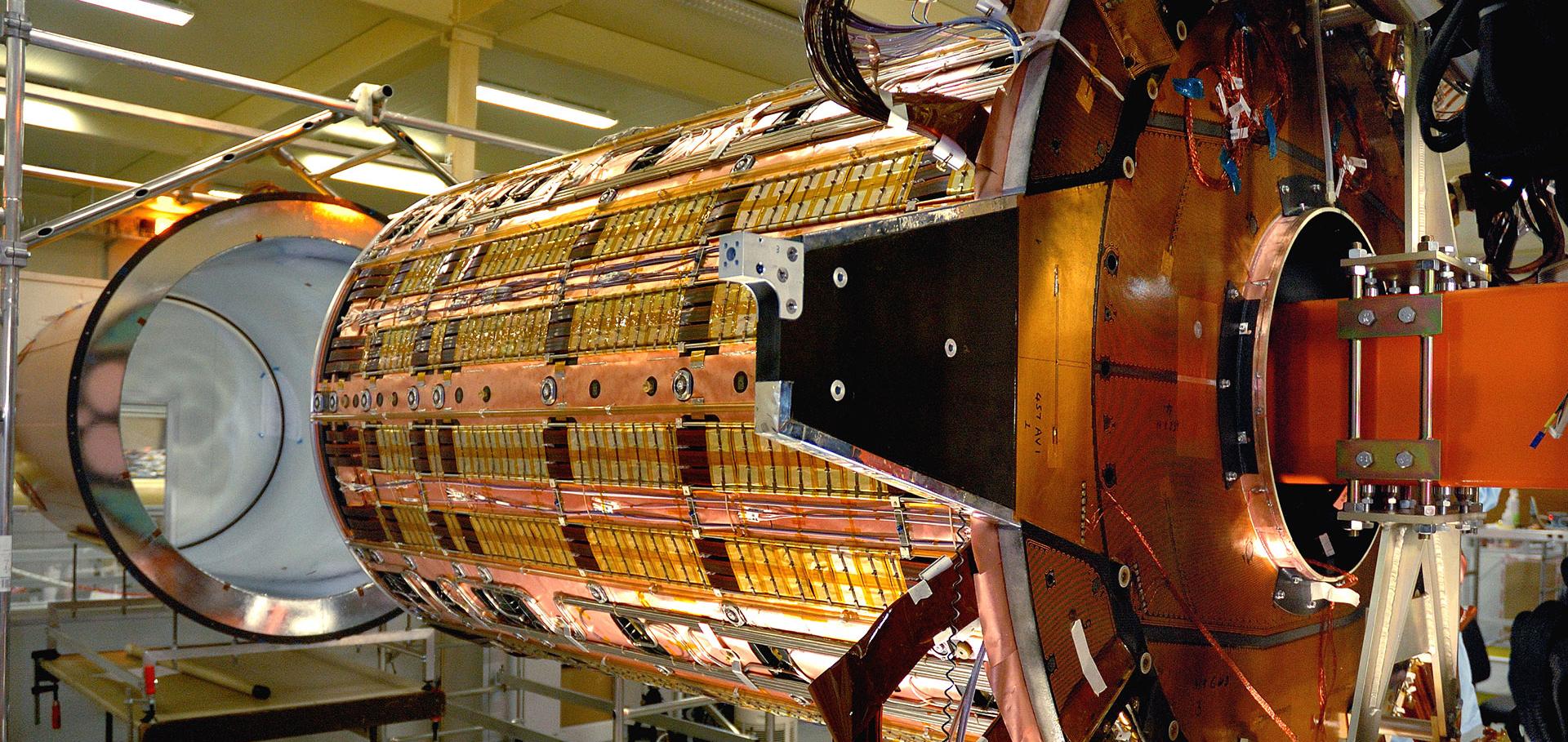
Insertion of STC into TRT at the Department of Physics, Oxford
Credit: CERN

Sneha Malde

Associate Professor of Physics

Sub department

  • Particle Physics

Research groups

  • LHCb
Sneha.Malde@physics.ox.ac.uk
Telephone: 01865 (2)73357
Denys Wilkinson Building, room 673
  • About
  • Publications

Water as a contrast medium: a re-evaluation using the multidetector-row computed tomography.

Am Surg 79:7 (2013) 728-733

Authors:

Tafadzwa P Makarawo, Edsa Negussie, Sachit Malde, Jacqueline Tilak, Jennifer Gayagoy, Jenna Watson, Faiz Francis, Denis Lincoln, Michael J Jacobs

Abstract:

Water as an intraluminal negative contrast medium produces improved image quality with reduced artefact. However, rapid absorption of oral water in the bowel relative to speed and timing of image capturing has limited its clinical application. These findings predate advances in multidetector-row computed tomography (CT). To re-evaluate differences in image quality, we studied image clarity and luminal distention between the same group of patients who received both a pancreas protocol CT (PPCT) that uses oral water and a conventional positive oral contrast scan. We reviewed 66 patients who had previously undergone both a PPCT and an oral contrast abdominal CT. CT images were independently reviewed by two board-certified radiologists who scored degree of hollow viscus distention and visualization of mural detail using a Likert 5-point scale. Results were evaluated by using the Wilcoxon-signed rank test. Student's t test was applied to evaluate the differences in radiation dosage and Spearman's correlational test was used to evaluate interrater correlation between the radiologists. In comparing the mean radiation dosage, there was no statistical difference between the two protocols, and there was good interrater association with ratios of 0.595 and 0.51 achieved for the PPCT and conventional oral scan, respectively. The Wilcoxon signed-rank test showed statistical differences in the stomach (P < 0.001) for both clarity (P < 0.001) and distention (P < 0.001), the duodenum for both clarity (P < 0.001) and distention (P = 0.02), and the ileum for distention (P = 0.02) with the PPCT having a better median score for organ clarity in the stomach and duodenum and better luminal distention in the stomach, equal distention in the duodenum, and slightly worse distention in the ileum. For the remainder of the bowel and organs evaluated, there was no statistically significant difference in the ratings between the two protocols. Using present CT scan technology, water can be an effective contrast medium causing better or equal distention in the bowel and better or equal clarity than routine barium contrast. This calls for a need to reconsider the use of water as a contrast medium in clinical practice.
More details
More details from the publisher
More details

Observation of Bc+→J/ψDs+ and Bc+→J/ψDs*+ decays

Physical Review D - Particles, Fields, Gravitation and Cosmology 87:11 (2013)

Authors:

R Aaij, C Abellan Beteta, B Adeva, M Adinolfi, C Adrover, A Affolder, Z Ajaltouni, J Albrecht, F Alessio, M Alexander, S Ali, G Alkhazov, P Alvarez Cartelle, AA Alves, S Amato, S Amerio, Y Amhis, L Anderlini, J Anderson, R Andreassen, RB Appleby, O Aquines Gutierrez, F Archilli, A Artamonov, M Artuso, E Aslanides, G Auriemma, S Bachmann, JJ Back, C Baesso, V Balagura, W Baldini, RJ Barlow, C Barschel, S Barsuk, W Barter, T Bauer, A Bay, J Beddow, F Bedeschi, I Bediaga, S Belogurov, K Belous, I Belyaev, E Ben-Haim, M Benayoun, G Bencivenni, S Benson, J Benton, A Berezhnoy, R Bernet, MO Bettler, M Van Beuzekom, A Bien, S Bifani, T Bird, A Bizzeti, PM Bjørnstad, T Blake, F Blanc, J Blouw, S Blusk, V Bocci, A Bondar, N Bondar, W Bonivento, S Borghi, A Borgia, TJV Bowcock, E Bowen, C Bozzi, T Brambach, J Van Den Brand, J Bressieux, D Brett, M Britsch, T Britton, NH Brook, H Brown, I Burducea, A Bursche, G Busetto, J Buytaert, S Cadeddu, O Callot, M Calvi, M Calvo Gomez, A Camboni, P Campana, D Campora Perez, A Carbone, G Carboni, R Cardinale, A Cardini, H Carranza-Mejia, L Carson, K Carvalho Akiba, G Casse, M Cattaneo, C Cauet

Abstract:

The decays Bc+→J/ψDs+ and Bc+→J/ψDs*+ are observed for the first time using a dataset, corresponding to an integrated luminosity of 3 fb-1, collected by the LHCb experiment in proton-proton collisions at center-of-mass energies of √s=7 and 8 TeV. The statistical significance for both signals is in excess of 9 standard deviations. The following ratios of branching fractions are measured to be B(Bc+→J/ ψDs+)B(Bc+→J/ψπ+)=2.90±0.57±0.24, B(Bc+→J/ψDs*+)B(Bc+→J/ψDs+)=2.37±0.56±0. 10, where the first uncertainties are statistical and the second systematic. The mass of the Bc+ meson is measured to be mBc+=6276.28±1. 44(stat)±0.36(syst) MeV/c2, using the Bc+→J/ψDs+ decay mode. © 2013 CERN.
More details from the publisher
More details
Details from ArXiV

Measurement of CP violation and the Bs0 meson decay width difference with Bs0→J/ψK+K- and Bs0→J/ψπ +π - Decays

Physical Review D - Particles, Fields, Gravitation and Cosmology 87:11 (2013)

Authors:

R Aaij, C Abellan Beteta, B Adeva, M Adinolfi, C Adrover, A Affolder, Z Ajaltouni, J Albrecht, F Alessio, M Alexander, S Ali, G Alkhazov, P Alvarez Cartelle, AA Alves, S Amato, S Amerio, Y Amhis, L Anderlini, J Anderson, R Andreassen, RB Appleby, O Aquines Gutierrez, F Archilli, A Artamonov, M Artuso, E Aslanides, G Auriemma, S Bachmann, JJ Back, C Baesso, V Balagura, W Baldini, RJ Barlow, C Barschel, S Barsuk, W Barter, T Bauer, A Bay, J Beddow, F Bedeschi, I Bediaga, S Belogurov, K Belous, I Belyaev, E Ben-Haim, M Benayoun, G Bencivenni, S Benson, J Benton, A Berezhnoy, R Bernet, MO Bettler, M Van Beuzekom, A Bien, S Bifani, T Bird, A Bizzeti, PM Bjørnstad, T Blake, F Blanc, J Blouw, S Blusk, V Bocci, A Bondar, N Bondar, W Bonivento, S Borghi, A Borgia, TJV Bowcock, E Bowen, C Bozzi, T Brambach, J Van Den Brand, J Bressieux, D Brett, M Britsch, T Britton, NH Brook, H Brown, I Burducea, A Bursche, G Busetto, J Buytaert, S Cadeddu, O Callot, M Calvi, M Calvo Gomez, A Camboni, P Campana, A Carbone, G Carboni, R Cardinale, A Cardini, H Carranza-Mejia, L Carson, K Carvalho Akiba, G Casse, M Cattaneo, C Cauet, M Charles

Abstract:

The time-dependent CP asymmetry in Bs0→J/ψK+K - decays is measured using pp collision data at √s=7 TeV, corresponding to an integrated luminosity of 1.0 fb-1, collected with the LHCb detector. The decay-time distribution is characterized by the decay widths ΓL and ΓH of the light and heavy mass eigenstates of the Bs0-B̄s0 system and by a CP-violating phase s. In a sample of 27 617 Bs0→J/ψK+K- decays, where the dominant contribution comes from Bs0→J/ψ decays, these parameters are measured to be s=0.07±0.09(stat) ±0.01(syst) rad, Γs≡(ΓL+Γ H)/2=0.663±0.005(stat)±0.006(syst) ps-1, and ΔΓs≡ΓL-ΓH=0. 100±0.016(stat)±0.003(syst) ps-1, corresponding to the single most precise determination of s, ΔΓs, and Γs. The result of performing a combined analysis with Bs0→J/ψπ+π- decays gives s=0.01±0.07(stat)±0.01(syst) rad, Γs= 0.661±0.004(stat)±0.006(syst) ps-1, and ΔΓs=0.106±0.011(stat)±0.007(syst) ps -1. All measurements are in agreement with the Standard Model predictions. © 2013 CERN. Published by the American Physical Society under the terms of the http://creativecommons.org/licenses/by/3.0/ Creative Commons Attribution 3.0 License. Further distribution of this work must maintain attribution to the author(s) and the published article's title, journal citation, and DOI.
More details from the publisher
More details
Details from ArXiV

Observations of BS0→ψ(2S)η and B(S)0→ψ(2S)π+π- decays

Nuclear Physics B 871:3 (2013) 403-419

Authors:

R Aaij, C Abellan Beteta, B Adeva, M Adinolfi, C Adrover, A Affolder, Z Ajaltouni, J Albrecht, F Alessio, M Alexander, S Ali, G Alkhazov, P Alvarez Cartelle, AA Alves, S Amato, S Amerio, Y Amhis, L Anderlini, J Anderson, R Andreassen, RB Appleby, O Aquines Gutierrez, F Archilli, A Artamonov, M Artuso, E Aslanides, G Auriemma, S Bachmann, JJ Back, C Baesso, V Balagura, W Baldini, RJ Barlow, C Barschel, S Barsuk, W Barter, T Bauer, A Bay, J Beddow, F Bedeschi, I Bediaga, S Belogurov, K Belous, I Belyaev, E Ben-Haim, M Benayoun, G Bencivenni, S Benson, J Benton, A Berezhnoy, R Bernet, MO Bettler, M van Beuzekom, A Bien, S Bifani, T Bird, A Bizzeti, PM Bjørnstad, T Blake, F Blanc, J Blouw, S Blusk, V Bocci, A Bondar, N Bondar, W Bonivento, S Borghi, A Borgia, TJV Bowcock, E Bowen, C Bozzi, T Brambach, J van den Brand, J Bressieux, D Brett, M Britsch, T Britton, NH Brook, H Brown, I Burducea, A Bursche, G Busetto, J Buytaert, S Cadeddu, O Callot, M Calvi, M Calvo Gomez, A Camboni, P Campana, A Carbone, G Carboni, R Cardinale, A Cardini, H Carranza-Mejia, L Carson, K Carvalho Akiba, G Casse, M Cattaneo, C Cauet, M Charles

Abstract:

First observations of the BS0→ψ(2S)η, B0→ψ(2S)π+π- and BS0→ψ(2S)π+π- decays are made using a dataset corresponding to an integrated luminosity of 1.0 fb-1 collected by the LHCb experiment in proton-proton collisions at a centre-of-mass energy of √s=7 TeV. The ratios of the branching fractions of each of the ψ(2S) modes with respect to the corresponding J/ψ decays are where the third uncertainty corresponds to the uncertainties of the dilepton branching fractions of the J/ψ and ψ(2S) meson decays. © 2013 CERN.
More details from the publisher

Measurement of the branching fractions of the decays Bs0→D ̄ 0K-π+ and B0→D ̄0K+π-

Physical Review D - Particles, Fields, Gravitation and Cosmology 87:11 (2013)

Authors:

R Aaij, C Abellan Beteta, B Adeva, M Adinolfi, C Adrover, A Affolder, Z Ajaltouni, J Albrecht, F Alessio, M Alexander, S Ali, G Alkhazov, P Alvarez Cartelle, AA Alves, S Amato, S Amerio, Y Amhis, L Anderlini, J Anderson, R Andreassen, RB Appleby, O Aquines Gutierrez, F Archilli, A Artamonov, M Artuso, E Aslanides, G Auriemma, S Bachmann, JJ Back, C Baesso, V Balagura, W Baldini, RJ Barlow, C Barschel, S Barsuk, W Barter, T Bauer, A Bay, J Beddow, F Bedeschi, I Bediaga, S Belogurov, K Belous, I Belyaev, E Ben-Haim, G Bencivenni, S Benson, J Benton, A Berezhnoy, R Bernet, MO Bettler, M Van Beuzekom, A Bien, S Bifani, T Bird, A Bizzeti, PM Bjørnstad, T Blake, F Blanc, J Blouw, S Blusk, V Bocci, A Bondar, N Bondar, W Bonivento, S Borghi, A Borgia, TJV Bowcock, E Bowen, C Bozzi, T Brambach, J Van Den Brand, J Bressieux, D Brett, M Britsch, T Britton, NH Brook, H Brown, I Burducea, A Bursche, G Busetto, J Buytaert, S Cadeddu, O Callot, M Calvi, M Calvo Gomez, A Camboni, P Campana, D Campora Perez, A Carbone, G Carboni, R Cardinale, A Cardini, H Carranza-Mejia, L Carson, K Carvalho Akiba, G Casse, L Castillo Garcia, M Cattaneo, C Cauet

Abstract:

The first observation of the decay Bs0→D̄0K -π+ is reported. The analysis is based on a data sample, corresponding to an integrated luminosity of 1.0 fb-1 of pp collisions, collected with the LHCb detector. The branching fraction relative to that of the topologically similar decay B0→D̄0π +π- is measured to be B(Bs0→D ̄0K-π+)B(B0→D ̄0π+π-)=1.18±0.05(stat) ±0.12(syst). In addition, the relative branching fraction of the decay B0→D̄0K+π- is measured to be B(B0→D̄0K+π-)B(B0→D ̄0π+π-)=0.106±0.007(stat) ±0.008(syst). © 2013 CERN. Published by the American Physical Society under the terms of the http://creativecommons.org/licenses/by/3.0/ Creative Commons Attribution 3.0 License. Further distribution of this work must maintain attribution to the author(s) and the published article's title, journal citation, and DOI.
More details from the publisher
More details
Details from ArXiV

Pagination

  • First page First
  • Previous page Prev
  • …
  • Page 247
  • Page 248
  • Page 249
  • Page 250
  • Current page 251
  • Page 252
  • Page 253
  • Page 254
  • Page 255
  • …
  • Next page Next
  • Last page Last

Footer Menu

  • Contact us
  • Giving to the Dept of Physics
  • Work with us
  • Media

User account menu

  • Log in

Follow us

FIND US

Clarendon Laboratory,

Parks Road,

Oxford,

OX1 3PU

CONTACT US

Tel: +44(0)1865272200

University of Oxfrod logo Department Of Physics text logo
IOP Juno Champion logo Athena Swan Silver Award logo

© University of Oxford - Department of Physics

Cookies | Privacy policy | Accessibility statement

Built by: Versantus

  • Home
  • Research
  • Study
  • Engage
  • Our people
  • News & Comment
  • Events
  • Our facilities & services
  • About us
  • Giving to Physics
  • Current students
  • Staff intranet