Home
Department Of Physics text logo
  • Research
    • Our research
    • Our research groups
    • Our research in action
    • Research funding support
    • Summer internships for undergraduates
  • Study
    • Undergraduates
    • Postgraduates
  • Engage
    • For young people
    • For teachers
    • For the public
    • For alumni
    • For business
  • Support
Menu
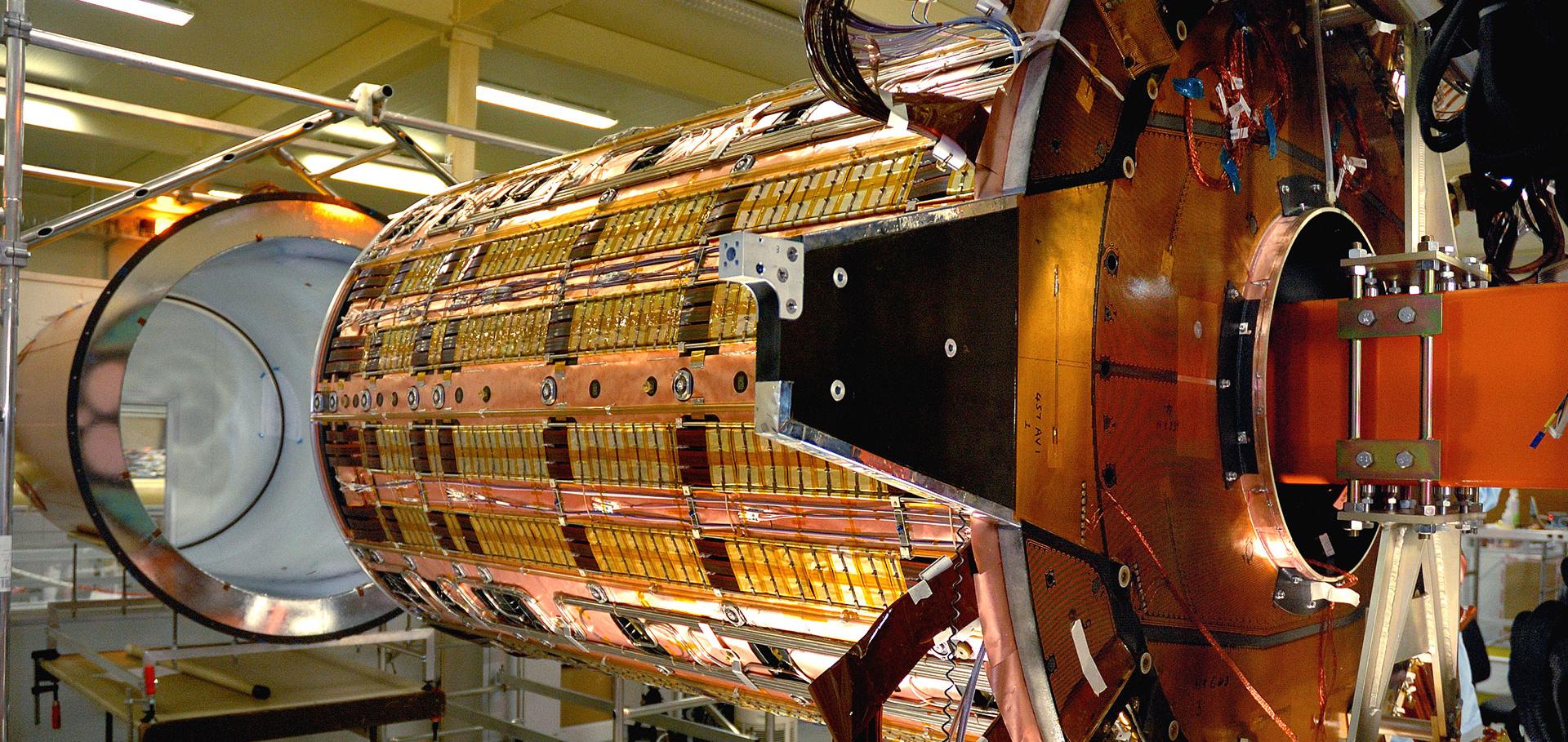
Insertion of STC into TRT at the Department of Physics, Oxford
Credit: CERN

Sneha Malde

Associate Professor of Physics

Sub department

  • Particle Physics

Research groups

  • LHCb
Sneha.Malde@physics.ox.ac.uk
Telephone: 01865 (2)73357
Denys Wilkinson Building, room 673
  • About
  • Publications

LHCb detector and performance

Proceedings of Science (2011)

Abstract:

The LHCb experiment at the CERN Large Hadron Collider (LHC) will measure the CKM parameters of the Unitarity Triangle with high precision, and is designed to discover physics beyond the Standard Model in rare heavy-flavour decays. The experiment is configured in the forward direction and covers a unique rapidity range at the LHC, 1.9 < & < 4.9. This paper describes the detector components of LHCb and the operating performances, focusing on the vertex locator, particle identification, calorimetry and muon system. In 2010, LHCb recorded a total of 37.7 pb-1 of data at √s = 7 TeV with a data-taking efficiency ofbetterthan90%. A selection of LHCb physics results will be shown, and the prospects for data taking in 2011 will be discussed. © Copyright owned by the author(s) under the terms of the Creative Commons Attribution-Non Commercial-Share Alike Licence.
More details from the publisher
More details
Details from ArXiV

Measurement of V0 production ratios in pp collisions at s√ = 0.9 and 7TeV

Journal of High Energy Physics 2011:8 (2011)

Authors:

R Aaij, B Adeva, M Adinolfi, C Adrover, A Affolder, Z Ajaltouni, J Albrecht, F Alessio, M Alexander, G Alkhazov, PA Cartelle, AA Alves, S Amato, Y Amhis, J Anderson, RB Appleby, OA Gutierrez, L Arrabito, A Artamonov, M Artuso, E Aslanides, G Auriemma, S Bachmann, JJ Back, DS Bailey, V Balagura, W Baldini, RJ Barlow, C Barschel, S Barsuk, W Barter, A Bates, C Bauer, T Bauer, A Bay, I Bediaga, K Belous, I Belyaev, E Ben-Haim, M Benayoun, G Bencivenni, S Benson, R Bernet, MO Bettler, M Van Beuzekom, A Bien, S Bifani, A Bizzeti, PM Bjørnstad, T Blake, F Blanc, C Blanks, J Blouw, S Blusk, A Bobrov, V Bocci, A Bondar, N Bondar, W Bonivento, S Borghi, A Borgia, TJV Bowcock, C Bozzi, T Brambach, J Van Den Brand, J Bressieux, D Brett, S Brisbane, M Britsch, T Britton, NH Brook, A Büchler-Germann, I Burducea, A Bursche, J Buytaert, S Cadeddu, JMC Carvajal, O Callot, M Calvi, MC Gomez, A Camboni, P Campana, A Carbone, G Carboni, R Cardinale, A Cardini, L Carson, KC Akiba, G Casse, M Cattaneo, M Charles, P Charpentier, N Chiapolini, XC Vidal, G Ciezarek, PEL Clarke, M Clemencic, HV Cliff, J Closier, C Coca

Abstract:

The Ā/A and Ā/K0S production ratios are measured by the LHCb detector from 0.3 nb-1 of pp collisions delivered by the LHC at s√ = 0.9TeV and 1.8 nb-1 at s√ = 7TeV. Both ratios are presented as a function of transverse momentum, pT, and rapidity, y, in the ranges 0.15 < pT < 2.50GeV/c and 2.0 < y < 4.5. Results at the two energies are in good agreement as a function of rapidity loss, Δy = ybeam - y, and are consistent with previous measurements. The ratio Ā/A, measuring the transport of baryon number from the collision into the detector, is smaller in data than predicted in simulation, particularly at high rapidity. The ratio Ā/K0S , measuring the baryon-to-meson suppression in strange quark hadronisation, is significantly larger than expected.
More details from the publisher

Measurement of the inclusive Φ cross-section in pp collisions at s=7 TeV

Physics Letters, Section B: Nuclear, Elementary Particle and High-Energy Physics 703:3 (2011) 267-273

Authors:

R Aaij, B Adeva, M Adinolfi, C Adrover, A Affolder, Z Ajaltouni, J Albrecht, F Alessio, M Alexander, G Alkhazov, P Alvarez Cartelle, AA Alves, S Amato, Y Amhis, J Anderson, RB Appleby, O Aquines Gutierrez, L Arrabito, A Artamonov, M Artuso, E Aslanides, G Auriemma, S Bachmann, JJ Back, DS Bailey, V Balagura, W Baldini, RJ Barlow, C Barschel, S Barsuk, W Barter, A Bates, C Bauer, TH Bauer, A Bay, I Bediaga, K Belous, I Belyaev, E Ben-Haim, M Benayoun, G Bencivenni, S Benson, J Benton, R Bernet, MO Bettler, M van Beuzekom, A Bien, S Bifani, A Bizzeti, PM Bjørnstad, T Blake, F Blanc, C Blanks, J Blouw, S Blusk, A Bobrov, V Bocci, A Bondar, N Bondar, W Bonivento, S Borghi, A Borgia, TJV Bowcock, C Bozzi, T Brambach, J van den Brand, J Bressieux, D Brett, S Brisbane, M Britsch, T Britton, NH Brook, A Büchler-Germann, A Bursche, J Buytaert, S Cadeddu, JM Caicedo Carvajal, O Callot, M Calvi, M Calvo Gomez, A Camboni, P Campana, A Carbone, G Carboni, R Cardinale, A Cardini, L Carson, K Carvalho Akiba, G Casse, M Cattaneo, M Charles, P Charpentier, N Chiapolini, X Cid Vidal, PEL Clarke, M Clemencic, HV Cliff, J Closier, C Coca, V Coco

Abstract:

The cross-section for inclusive Φ meson production in pp collisions at a centre-of-mass energy of s=7 TeV has been measured with the LHCb detector at the Large Hadron Collider. The differential cross-section is measured as a function of the Φ transverse momentum pT and rapidity y in the region 0.6
More details from the publisher
More details
More details
Details from ArXiV

Search for the rare decays Bs0 → μ+μ- and B0 → μ+μ-

Physics Letters, Section B: Nuclear, Elementary Particle and High-Energy Physics 699:5 (2011) 330-340

Authors:

R Aaij, B Adeva, M Adinolfi, C Adrover, A Affolder, Z Ajaltouni, J Albrecht, F Alessio, M Alexander, P Alvarez Cartelle, AA Alves, S Amato, Y Amhis, J Amoraal, J Anderson, RB Appleby, O Aquines Gutierrez, L Arrabito, M Artuso, E Aslanides, G Auriemma, S Bachmann, DS Bailey, V Balagura, W Baldini, RJ Barlow, C Barschel, S Barsuk, A Bates, C Bauer, T Bauer, A Bay, I Bediaga, K Belous, I Belyaev, E Ben-Haim, M Benayoun, G Bencivenni, R Bernet, MO Bettler, M van Beuzekom, A Bien, S Bifani, A Bizzeti, PM Bjørnstad, T Blake, F Blanc, C Blanks, J Blouw, S Blusk, A Bobrov, V Bocci, A Bondar, N Bondar, W Bonivento, S Borghi, A Borgia, E Bos, TJV Bowcock, C Bozzi, T Brambach, J van den Brand, J Bressieux, S Brisbane, M Britsch, T Britton, NH Brook, H Brown, A Büchler-Germann, A Bursche, J Buytaert, S Cadeddu, JM Caicedo Carvajal, O Callot, M Calvi, M Calvo Gomez, A Camboni, P Campana, A Carbone, G Carboni, R Cardinale, A Cardini, L Carson, K Carvalho Akiba, G Casse, M Cattaneo, M Charles, P Charpentier, N Chiapolini, XC Vidal, PJ Clark, PEL Clarke, M Clemencic, HV Cliff, J Closier, C Coca, V Coco, J Cogan, P Collins, F Constantin

Abstract:

A search for the decays Bs0 → μ+μ- and B0 → μ+μ- is performed with about 37 pb-1 of pp collisions at s√=7 TeV collected by the LHCb experiment at the Large Hadron Collider at CERN. The observed numbers of events are consistent with the background expectations. The resulting upper limits on the branching ratios are B(Bs0 → μ+μ-)<5.6×10⁻⁸ and B(B0 → μ+μ-)<1.5×10⁻⁸ at 95% confidence level. © 2011 CERN.
More details from the publisher

D0-(D)over-bar0 mixing studies with the decays D0 → KS0K∓π±

PHYSICS LETTERS B 701:3 (2011) 353-356

Authors:

S Malde, G Wilkinson
More details from the publisher

Pagination

  • First page First
  • Previous page Prev
  • …
  • Page 287
  • Page 288
  • Page 289
  • Page 290
  • Current page 291
  • Page 292
  • Page 293
  • Page 294
  • Page 295
  • …
  • Next page Next
  • Last page Last

Footer Menu

  • Contact us
  • Giving to the Dept of Physics
  • Work with us
  • Media

User account menu

  • Log in

Follow us

FIND US

Clarendon Laboratory,

Parks Road,

Oxford,

OX1 3PU

CONTACT US

Tel: +44(0)1865272200

University of Oxfrod logo Department Of Physics text logo
IOP Juno Champion logo Athena Swan Silver Award logo

© University of Oxford - Department of Physics

Cookies | Privacy policy | Accessibility statement

Built by: Versantus

  • Home
  • Research
  • Study
  • Engage
  • Our people
  • News & Comment
  • Events
  • Our facilities & services
  • About us
  • Giving to Physics
  • Current students
  • Staff intranet