

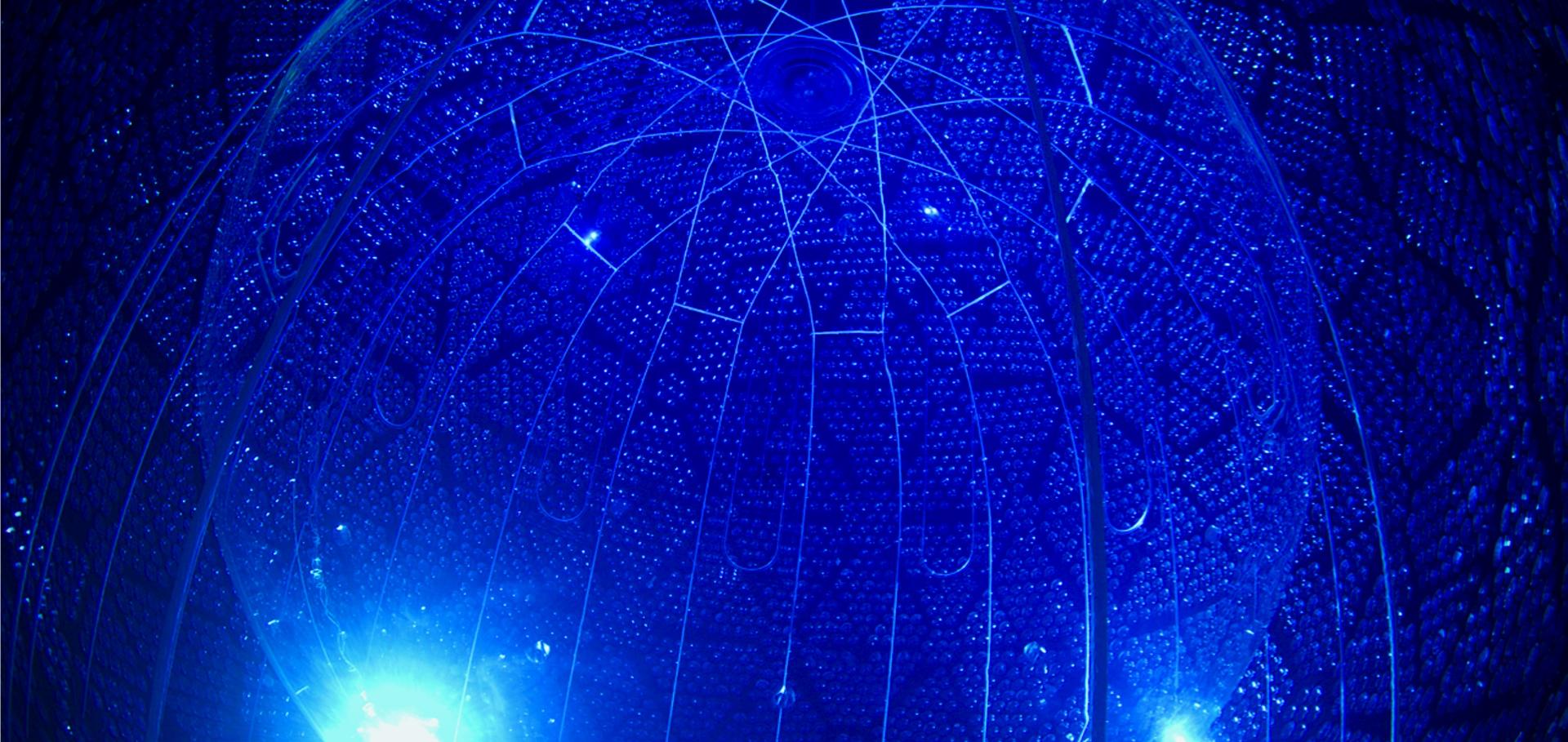

SNO+ is a large underground neutrino experiment located 2 km beneath Sudbury, Canada, in an active mine. At its heart is a 12-metre-wide acrylic sphere filled with an ultra-pure liquid and surrounded by thousands of light-sensing photomultiplier tubes. Being deep underground shields the detector from cosmic radiation, allowing scientists to observe extremely rare signals from neutrinos—tiny, almost massless particles produced in the Sun, nuclear reactors, within the Earth, and in explosive astrophysical events such as supernovae. SNO+ continues the legacy of the Nobel Prize-winning SNO experiment by exploring new kinds of neutrino interactions.
A major focus of my research is studying solar neutrinos, especially their interactions with carbon inside the SNO+ detector. Solar neutrinos are created in the Sun’s core and can pass through the Earth-and through you-without leaving a trace. But the intense solar neutrino flux occasionally interacts with a rare isotope of carbon, ¹³C, inside the detector.
In this rare process a neutrino converts a carbon nucleus into a nitrogen nucleus which then decays about ten minutes later. Detecting this distinctive two-step sequence allows us to clearly identify the reaction. This is the first time carbon-based solar-neutrino interaction has ever been observed, marking a new way to study neutrinos and providing an important test of the nuclear models that describe how they interact with matter. It is also the first measurement to use the Sun’s natural neutrino flux as a “test beam” for probing neutrino–nucleus interactions.
Alongside this work, I also investigate lower-energy solar neutrinos probing how neutrinos evolve as they travel from the Sun to the Earth, including the matter effects that change their flavour. Measuring these low-energy signals requires a detailed understanding of backgrounds and the development of techniques to reduce or remove them.
Together, this research expands our ability to test fundamental physics, and deepens our understanding of how neutrinos interact with the world around us.