Home
Department Of Physics text logo
  • Research
    • Our research
    • Our research groups
    • Our research in action
    • Research funding support
    • Summer internships for undergraduates
  • Study
    • Undergraduates
    • Postgraduates
  • Engage
    • For alumni
    • For business
    • For schools
    • For the public
  • Support
Menu
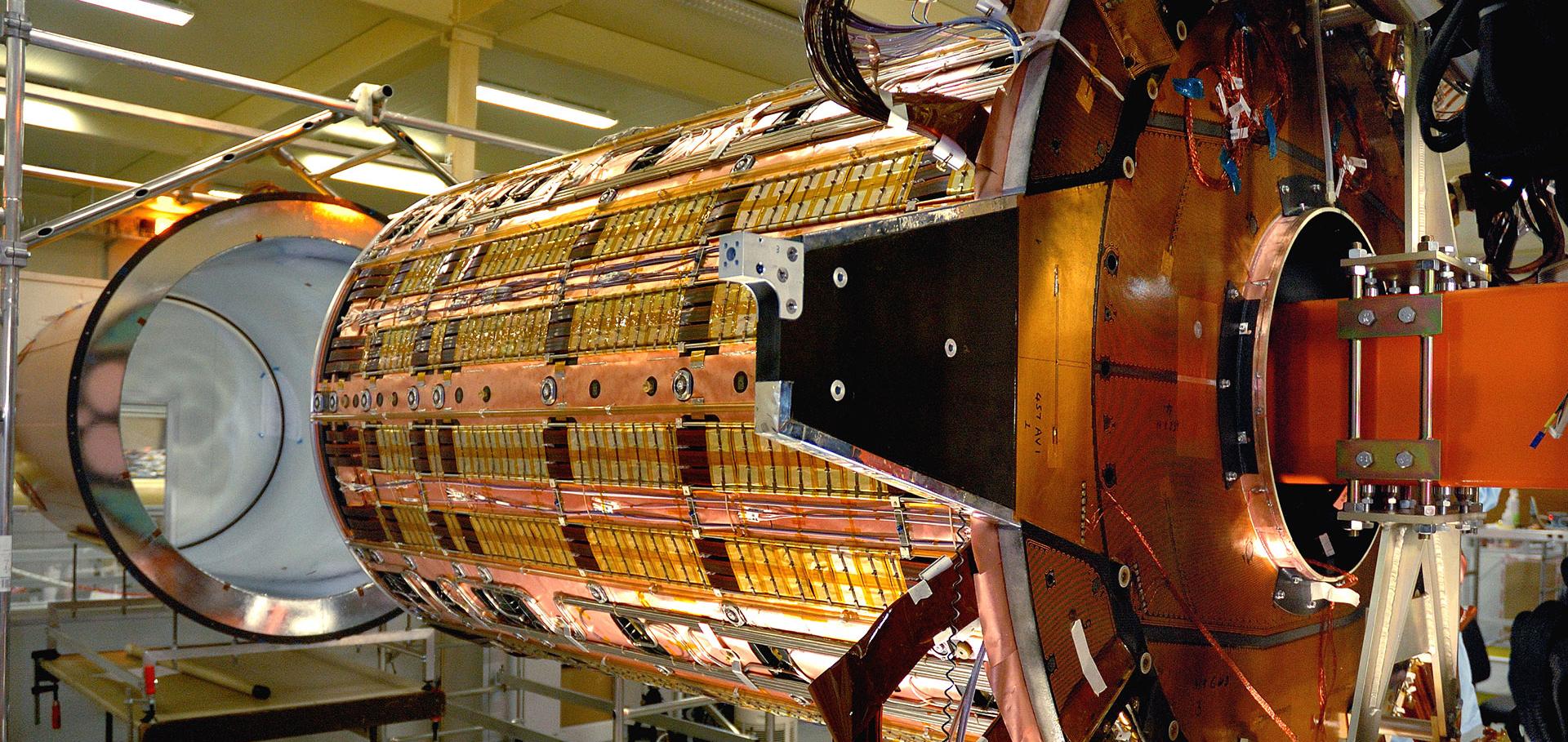
Insertion of STC into TRT at the Department of Physics, Oxford
Credit: CERN

Malcolm John

Associate Professor of Experimental Particle Physics

Research theme

  • Fundamental particles and interactions

Sub department

  • Particle Physics

Research groups

  • LHCb
malcolm.john@physics.ox.ac.uk
Telephone: 01865 (2)73401
Denys Wilkinson Building, room 670
  • About
  • Publications

Observation of J/ψ-pair production in pp collisions at √s=7 TeV

Physics Letters, Section B: Nuclear, Elementary Particle and High-Energy Physics 707:1 (2012) 52-59

Authors:

R Aaij, B Adeva, M Adinolfi, C Adrover, A Affolder, Z Ajaltouni, J Albrecht, F Alessio, M Alexander, G Alkhazov, P Alvarez Cartelle, AA Alves, S Amato, Y Amhis, J Anderson, RB Appleby, O Aquines Gutierrez, F Archilli, L Arrabito, A Artamonov, M Artuso, E Aslanides, G Auriemma, S Bachmann, JJ Back, DS Bailey, V Balagura, W Baldini, RJ Barlow, C Barschel, S Barsuk, W Barter, A Bates, C Bauer, T Bauer, A Bay, I Bediaga, K Belous, I Belyaev, E Ben-Haim, M Benayoun, G Bencivenni, S Benson, J Benton, R Bernet, MO Bettler, M van Beuzekom, A Bien, S Bifani, A Bizzeti, PM Bjørnstad, T Blake, F Blanc, C Blanks, J Blouw, S Blusk, A Bobrov, V Bocci, A Bondar, N Bondar, W Bonivento, S Borghi, A Borgia, TJV Bowcock, C Bozzi, T Brambach, J van den Brand, J Bressieux, D Brett, S Brisbane, M Britsch, T Britton, NH Brook, H Brown, A Büchler-Germann, I Burducea, A Bursche, J Buytaert, S Cadeddu, JM Caicedo Carvajal, O Callot, M Calvi, M Calvo Gomez, A Camboni, P Campana, A Carbone, G Carboni, R Cardinale, A Cardini, L Carson, K Carvalho Akiba, G Casse, M Cattaneo, M Charles, P Charpentier, N Chiapolini, K Ciba, X Cid Vidal, G Ciezarek, PEL Clarke

Abstract:

The production of J/ψ pairs in proton-proton collisions at a centre-of-mass energy of 7 TeV has been observed using an integrated luminosity of 37.5 pb -1 collected with the LHCb detector. The production cross-section for pairs with both J/ψ in the rapidity range 2
More details from the publisher

A multi-cohort study of polymorphisms in the GH/IGF axis and physical capability: The HALCyon programme

PLoS ONE 7:1 (2012)

Authors:

T Alfred, Y Ben-Shlomo, R Cooper, R Hardy, C Cooper, IJ Deary, TR Gaunt, D Gunnell, SE Harris, M Kumari, RM Martin, AA Sayer, JM Starr, D Kuh, INM Day

Abstract:

Background: Low muscle mass and function have been associated with poorer indicators of physical capability in older people, which are in-turn associated with increased mortality rates. The growth hormone/insulin-like growth factor (GH/IGF) axis is involved in muscle function and genetic variants in genes in the axis may influence measures of physical capability. Methods: As part of the Healthy Ageing across the Life Course (HALCyon) programme, men and women from seven UK cohorts aged between 52 and 90 years old were genotyped for six polymorphisms: rs35767 (IGF1), rs7127900 (IGF2), rs2854744 (IGFBP3), rs2943641 (IRS1), rs2665802 (GH1) and the exon-3 deletion of GHR. The polymorphisms have previously been robustly associated with age-related traits or are potentially functional. Meta-analysis was used to pool within-study genotypic effects of the associations between the polymorphisms and four measures of physical capability: grip strength, timed walk or get up and go, chair rises and standing balance. Results: Few important associations were observed among the several tests. We found evidence that rs2665802 in GH1 was associated with inability to balance for 5 s (pooled odds ratio per minor allele = 0.90, 95% CI: 0.82-0.98, p-value = 0.01, n = 10,748), after adjusting for age and sex. We found no evidence for other associations between the polymorphisms and physical capability traits. Conclusion: Our findings do not provide evidence for a substantial influence of these common polymorphisms in the GH/IGF axis on objectively measured physical capability levels in older adults. © 2012 Alfred et al.
More details from the publisher
Details from ORA
More details
More details

Inclusive W and Z production in the forward region at √ s = 7 TeV

Journal of High Energy Physics 2012:6 (2012)

Authors:

R Aaij, C Abellan Beteta, A Adametz, B Adeva, M Adinolfi, C Adrover, A Affolder, Z Ajaltouni, J Albrecht, F Alessio, M Alexander, S Ali, G Alkhazov, P Alvarez Cartelle, AA Alves, S Amato, Y Amhis, J Anderson, RB Appleby, O Aquines Gutierrez, F Archilli, A Artamonov, M Artuso, E Aslanides, G Auriemma, S Bachmann, JJ Back, V Balagura, W Baldini, RJ Barlow, C Barschel, S Barsuk, W Barter, A Bates, C Bauer, T Bauer, A Bay, J Beddow, I Bediaga, S Belogurov, K Belous, I Belyaev, E Ben-Haim, M Benayoun, G Bencivenni, S Benson, J Benton, R Bernet, MO Bettler, M Van Beuzekom, A Bien, S Bifani, T Bird, A Bizzeti, PM Bjørnstad, T Blake, F Blanc, C Blanks, J Blouw, S Blusk, A Bobrov, V Bocci, A Bondar, N Bondar, W Bonivento, S Borghi, A Borgia, TJV Bowcock, C Bozzi, T Brambach, J Van Den Brand, J Bressieux, D Brett, M Britsch, T Britton, NH Brook, H Brown, A Büchler-Germann, I Burducea, A Bursche, J Buytaert, S Cadeddu, O Callot, M Calvi, M Calvo Gomez, A Camboni, P Campana, A Carbone, G Carboni, R Cardinale, A Cardini, L Carson, K Carvalho Akiba, G Casse, M Cattaneo, C Cauet, M Charles, P Charpentier, N Chiapolini, M Chrzaszcz

Abstract:

Measurements of inclusive W and Z boson production cross-sections in pp collisions at √ s = 7TeV using final states containing muons are presented. The data sample corresponds to an integrated luminosity of 37 pb -1 collected with the LHCb detector. The W and Z bosons are reconstructed from muons with a transverse momentum above 20 GeV/c and pseudorapidity between 2:0 and 4:5, and, in the case of the Z cross-section, a dimuon invariant mass between 60 and 120 GeV/c2. The cross-sections are measured to be 831±9±27±29 pb for W+, 656±8±19±23 for W- and 76:7±1:7±3: 3±2:7 pb for Z, where the first uncertainty is statistical, the second is systematic and the third is due to the luminosity. Differential cross-sections, W and Z cross-section ratios and the lepton charge asymmetry are also measured in the same kinematic region. The ratios are determined to be σW+→μ+ν/σW- →μ-ν = 1:27±0:02±0:01 and ( σW+→μ+ν+σW- →μ-ν)/σZ→μμ = 19:4±0:5± 0:9. The results are in general agreement with theoretical predictions, performed at nextto- next-to-leading order in QCD using recently calculated parton distribution functions. Copyright CERN.
More details from the publisher
More details

Measurement of b-hadron branching fractions for two-body decays into charmless charged hadrons

Journal of High Energy Physics 2012:10 (2012)

Authors:

R Aaij, CA Beteta, B Adeva, M Adinolfi, C Adrover, A Affolder, Z Ajaltouni, J Albrecht, F Alessio, M Alexander, S Ali, G Alkhazov, PA Cartelle, AA Alves, S Amato, Y Amhis, J Anderson, RB Appleby, OA Gutierrez, F Archilli, A Artamonov, M Artuso, E Aslanides, G Auriemma, S Bachmann, JJ Back, V Balagura, W Baldini, RJ Barlow, C Barschel, S Barsuk, W Barter, A Bates, C Bauer, T Bauer, A Bay, I Bediaga, S Belogurov, K Belous, I Belyaev, E Ben-Haim, M Benayoun, G Bencivenni, S Benson, J Benton, R Bernet, MO Bettler, M Van Beuzekom, A Bien, S Bifani, T Bird, A Bizzeti, PM Bjørnstad, T Blake, F Blanc, C Blanks, J Blouw, S Blusk, A Bobrov, V Bocci, A Bondar, N Bondar, W Bonivento, S Borghi, A Borgia, TJV Bowcock, C Bozzi, T Brambach, J Van Den Brand, J Bressieux, D Brett, M Britsch, T Britton, NH Brook, H Brown, K De Bruyn, A Büchler-Germann, I Burducea, A Bursche, J Buytaert, S Cadeddu, O Callot, M Calvi, M Calvo Gomez, A Camboni, P Campana, A Carbone, G Carboni, R Cardinale, A Cardini, L Carson, K Carvalho Akiba, G Casse, M Cattaneo, C Cauet, M Charles, P Charpentier, N Chiapolini, K Ciba, X Cid Vidal

Abstract:

Based on data corresponding to an integrated luminosity of 0.37 fb -1 collected by the LHCb experiment in 2011, the following ratios of branching fractions are measured: B(B0 → π+π -) / B(B0 → K+π-) = 0.262 ± 0.009 ± 0.017; (fs/fd) B(Bs0 → K +K-) / B(B0 → K+π -) = 0.316 ± 0.009 ± 0.019; (fs/fd) B(B s0 → π+K-) / B(B0 → K+π-) = 0.074 ± 0.006 ± 0.006; (fd/fs) ± B(B0 → K+K-) / B(B s0 → K+K-) = 0.018 -0.007 +-0.007 ± 0.009; (fs/fd) B(Bs0 → π+π-) / B(B0 → π+π-) = 0.050 -0.009+0.011 ± 0.004; BΛb0 → pπ-) / BΛb0 → pK-) = 0.86 ± 0.08 ± 0.05; where the πrst uncertainties are statistical and the second systematic. Using the current world average of B(B0 → K +π-π and the ratio of the strange to light neutral B meson production fs/fd measured by LHCb, we obtain: B(B0 → π+π-) = (5.08 ± 0.17 ± 0.37) × 10-6; B(Bs0 → K+K-) = (23.0 ± 0.7 ± 2.3) × 10-6; B(Bs0 → π+K-) = (5.4 ± 0.4 ± 0.6) × 10-6; B(B0 → K+K-) = (0.11 -0.04+0.05 ± 0.06) × 10 -6; B(Bs0 → π+π -) = (0.95 -0.17+0.21 ± 0.13) × 10-6. The measurements of B(Bs0 → K +K-), B(Bs0 → π+K-) and B(B0 → K+K -) are the most precise to date. The decay mode Bs0 → π+π- is observed for the first time with a significance of more than 5σ. Copyright CERN.
More details from the publisher
More details

Measurement of charged particle multiplicities in pp collisions at √s = 7 TeV in the forward region

European Physical Journal C 72:4 (2012)

Authors:

R Aaij, CA Beteta, B Adeva, M Adinolfi, C Adrover, A Affolder, Z Ajaltouni, J Albrecht, F Alessio, M Alexander, G Alkhazov, PA Cartelle, AA Alves, S Amato, Y Amhis, J Anderson, RB Appleby, OA Gutierrez, F Archilli, L Arrabito, A Artamonov, M Artuso, E Aslanides, G Auriemma, S Bachmann, JJ Back, DS Bailey, V Balagura, W Baldini, RJ Barlow, C Barschel, S Barsuk, W Barter, A Bates, C Bauer, T Bauer, A Bay, I Bediaga, S Belogurov, K Belous, I Belyaev, E Ben-Haim, M Benayoun, G Bencivenni, S Benson, J Benton, R Bernet, MO Bettler, M Van Beuzekom, A Bien, S Bifani, T Bird, A Bizzeti, PM Bjørnstad, T Blake, F Blanc, C Blanks, J Blouw, S Blusk, A Bobrov, V Bocci, A Bondar, N Bondar, W Bonivento, S Borghi, A Borgia, TJV Bowcock, C Bozzi, T Brambach, J Van Den Brand, J Bressieux, D Brett, M Britsch, T Britton, NH Brook, H Brown, A Büchler-Germann, I Burducea, A Bursche, J Buytaert, S Cadeddu, O Callot, M Calvi, MC Gomez, A Camboni, P Campana, A Carbone, G Carboni, R Cardinale, A Cardini, L Carson, KC Akiba, G Casse, M Cattaneo, C Cauet, M Charles, P Charpentier, N Chiapolini, K Ciba, XC Vidal

Abstract:

Charged particle production in proton-proton collisions is studied with the LHCb detector at a centre-of-mass energy of √s = 7 TeV in different intervals of pseudorapidity η. Charged particles are reconstructed close to the interaction region in the vertex detector, which provides high reconstruction efficiency in the η ranges −2.5 < η <−2.0 and 2.0 < η < 4.5. The data were taken with a minimum bias trigger, only requiring one or more reconstructed tracks in the vertex detector. By selecting an event sample with at least one track with a transverse momentum greater than 1 GeV/c a hard QCD subsample is investigated. Several event generators are compared with the data; none are able to describe fully the multiplicity distributions or the charged particle density distribution as a function of η. In general, the models underestimate charged particle production.
More details from the publisher

Pagination

  • First page First
  • Previous page Prev
  • …
  • Page 237
  • Page 238
  • Page 239
  • Page 240
  • Current page 241
  • Page 242
  • Page 243
  • Page 244
  • Page 245
  • …
  • Next page Next
  • Last page Last

Footer Menu

  • Contact us
  • Giving to the Dept of Physics
  • Work with us
  • Media

User account menu

  • Log in

Follow us

FIND US

Clarendon Laboratory,

Parks Road,

Oxford,

OX1 3PU

CONTACT US

Tel: +44(0)1865272200

University of Oxfrod logo Department Of Physics text logo
IOP Juno Champion logo Athena Swan Silver Award logo

© University of Oxford - Department of Physics

Cookies | Privacy policy | Accessibility statement

Built by: Versantus

  • Home
  • Research
  • Study
  • Engage
  • Our people
  • News & Comment
  • Events
  • Our facilities & services
  • About us
  • Giving to Physics
  • Current students
  • Staff intranet