Home
Department Of Physics text logo
  • Research
    • Our research
    • Our research groups
    • Our research in action
    • Research funding support
    • Summer internships for undergraduates
  • Study
    • Undergraduates
    • Postgraduates
  • Engage
    • For young people
    • For teachers
    • For the public
    • For alumni
    • For business
  • Support
Menu
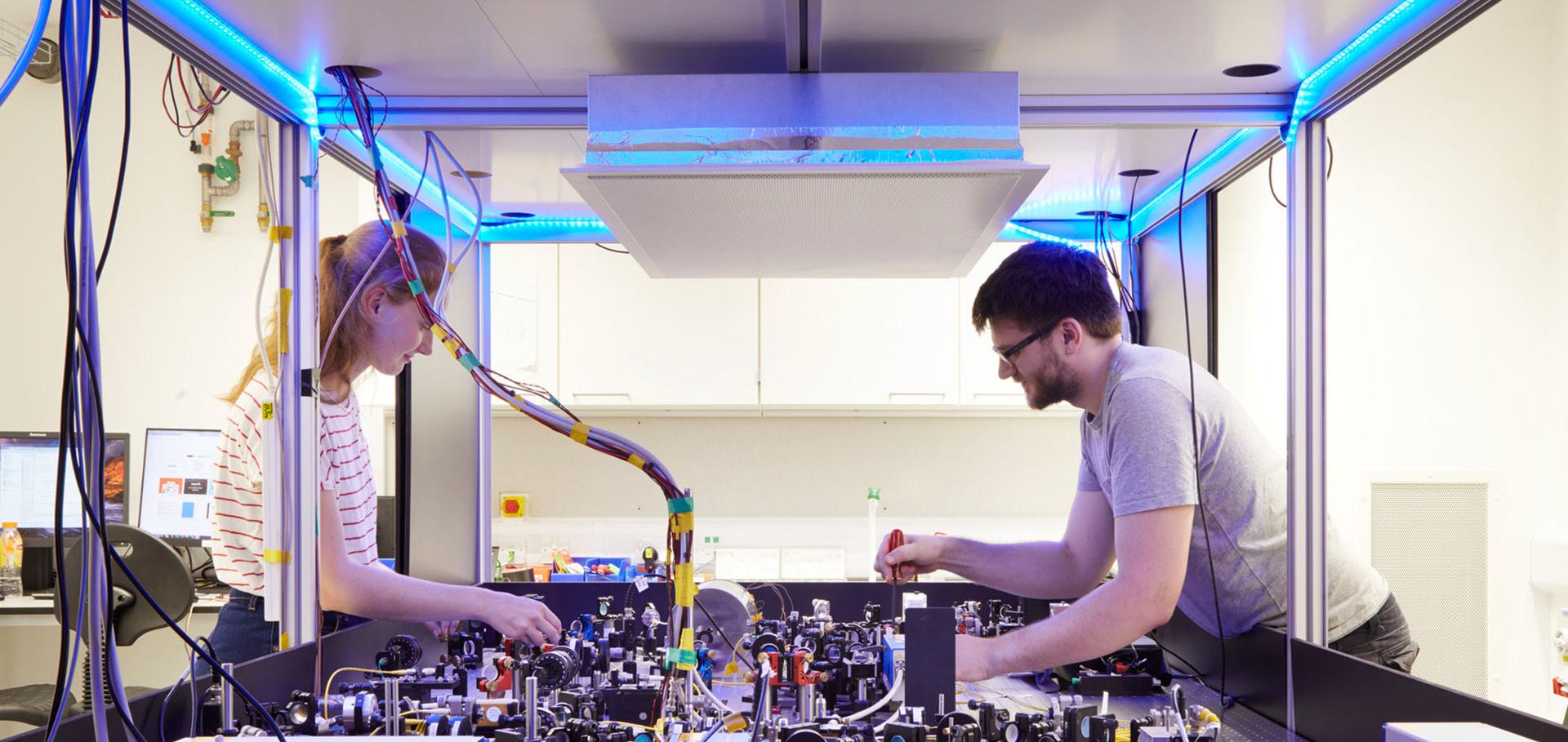
Atomic and Laser Physics
Credit: Jack Hobhouse

Mariana Moreira

Postdoctoral Research Assistant

Research theme

  • Accelerator physics
  • Lasers and high energy density science
  • Plasma physics

Sub department

  • Atomic and Laser Physics

Research groups

  • Laser-plasma accelerator group
mariana.moreira@physics.ox.ac.uk
Clarendon Laboratory, room Simon Room
  • About
  • Publications

Proton bunch self-modulation in plasma with density gradient

Physical Review Letters American Physical Society 125 (2020) 264801

Authors:

F Braunmüller, T Nechaeva, E Adli, Philip Burrows, Rebecca Ramjiawan, Eugenio Senes

Abstract:

We study experimentally the effect of linear plasma density gradients on the self-modulation of a 400 GeV proton bunch. Results show that a positive or negative gradient increases or decreases the number of microbunches and the relative charge per microbunch observed after 10 m of plasma. The measured modulation frequency also increases or decreases. With the largest positive gradient we observe two frequencies in the modulation power spectrum. Results are consistent with changes in wakefields’ phase velocity due to plasma density gradients adding to the slow wakefields’ phase velocity during self-modulation growth predicted by linear theory.
More details from the publisher
Details from ORA
More details
More details

Proton beam defocusing in AWAKE: comparison of simulations and measurements

Plasma Physics and Controlled Fusion IOP Publishing 62 (2020) 125023

Authors:

Alexander Gorn, Marlene Turner, Philip Burrows, Konstantin V Lotov, Rebecca Ramjiawan, Eugenio Senes

Abstract:

Plasma Physics and Controlled Fusion PAPER Proton beam defocusing in AWAKE: comparison of simulations and measurements A A Gorn1,2, M Turner3, E Adli4, R Agnello5, M Aladi6, Y Andrebe5, O Apsimon7,8, R Apsimon7,8, A-M Bachmann3,9,10, M A Baistrukov1,2Show full author list Published 6 November 2020 • © 2020 IOP Publishing Ltd Plasma Physics and Controlled Fusion, Volume 62, Number 12 Citation A A Gorn et al 2020 Plasma Phys. Control. Fusion 62 125023 80 Total downloads Turn on MathJax Get permission to re-use this article Share this article Share this content via email Share on Facebook Share on Twitter Share on Google+ Share on Mendeley Article information Abstract In 2017, AWAKE demonstrated the seeded self-modulation (SSM) of a 400 GeV proton beam from the Super Proton Synchrotron at CERN. The angular distribution of the protons deflected due to SSM is a quantitative measure of the process, which agrees with simulations by the two-dimensional (axisymmetric) particle-in-cell code LCODE to about 5%. The agreement is achieved in beam population scans at two selected plasma densities and in the scan of longitudinal plasma density gradient. The agreement is reached only in the case of a wide enough simulation box (several plasma wavelengths) that is closer to experimental conditions, but requires more computational power. Therefore, particle-in-cell codes can be used to interpret the SSM physics underlying the experimental data.
More details from the publisher
Details from ORA

Experimental study of wakefields driven by a self-modulating proton bunch in plasma

Physical Review Accelerators and Beams American Physical Society 23:8 (2020) 81302

Authors:

M Turner, P Muggli, E Adli, R Agnello, M Aladi, Y Andrebe, O Apsimon, R Apsimon, A-M Bachmann, Ma Baistrukov, F Batsch, M Bergamaschi, P Blanchard, Pn Burrows, B Buttenschoen, A Caldwell, J Chappell, E Chevallay, M Chung, Da Cooke, H Damerau, C Davut, G Demeter, Lh Deubner, A Dexter, Gp Djotyan, S Doebert, J Farmer, A Fasoli, Vn Fedosseev, R Fiorito, Ra Fonseca, F Friebel, I Furno, L Garolfi, S Gessner, B Goddard, I Gorgisyan, Aa Gorn, E Granados, M Granetzny, O Grulke, E Gschwendtner, V Hafych, A Hartin, A Helm, Jr Henderson, A Howling, M Huether, R Jacquier

Abstract:

We study experimentally the longitudinal and transverse wakefields driven by a highly relativistic proton bunch during self-modulation in plasma. We show that the wakefields’ growth and amplitude increase with increasing seed amplitude as well as with the proton bunch charge in the plasma. We study transverse wakefields using the maximum radius of the proton bunch distribution measured on a screen downstream from the plasma. We study longitudinal wakefields by externally injecting electrons and measuring their final energy. Measurements agree with trends predicted by theory and numerical simulations and validate our understanding of the development of self-modulation. Experiments were performed in the context of the Advanced Wakefield Experiment (AWAKE).
More details from the publisher
Details from ORA
More details

TeV acceleration in a Matryoshka plasma channel

Journal of Physics: Conference Series IOP Publishing 1596:1 (2020) 012065-012065

Authors:

JP Farmer, A Pukhov

Abstract:

Abstract Plasma-based accelerators offer accelerating fields orders of magnitude higher than conventional radio-frequency cavities. However, these accelerating fields are typically coupled with strong focusing fields, which can result in significant radiative energy loss at high energies. In this work, we present a new accelerator configuration, the Matryoshka channel, a hollow plasma channel stabilized by a hollow plasma filament. We demonstrate that the absence of on-axis focusing plasma fields greatly reduces radiation losses, allowing acceleration to the TeV frontier.
More details from the publisher

Correction to 'Proton-driven plasma wakefield acceleration in AWAKE'.

Philosophical Transactions of the Royal Society A Mathematical Physical and Engineering Sciences The Royal Society 378:2164 (2020) 20190539

Authors:

E Gschwendtner, M Turner, E Adli, A Ahuja, O Apsimon, R Apsimon, A-M Bachmann, F Batsch, C Bracco, F Braunmüller, S Burger, G Burt, B Buttenschön, A Caldwell, J Chappell, E Chevallay, M Chung, D Cooke, H Damerau, LH Deubner, A Dexter, S Doebert, J Farmer, VN Fedosseev, R Fiorito, RA Fonseca, F Friebel, L Garolfi, S Gessner, B Goddard, I Gorgisyan, AA Gorn, E Granados, O Grulke, A Hartin, A Helm, JR Henderson, M Hüther, M Ibison, S Jolly, F Keeble, MD Kelisani, S-Y Kim, F Kraus, M Krupa, T Lefevre, Y Li, S Liu, N Lopes, KV Lotov, M Martyanov, S Mazzoni, VA Minakov, JC Molendijk, JT Moody, M Moreira, P Muggli, H Panuganti, A Pardons, F Peña Asmus, A Perera, A Petrenko, A Pukhov, S Rey, P Sherwood, LO Silva, AP Sosedkin, PV Tuev, F Velotti, L Verra, VA Verzilov, J Vieira, CP Welsch, M Wendt, B Williamson, M Wing, B Woolley, G Xia
More details from the publisher
More details
More details

Pagination

  • First page First
  • Previous page Prev
  • Page 1
  • Page 2
  • Page 3
  • Current page 4
  • Page 5
  • Page 6
  • Next page Next
  • Last page Last

Footer Menu

  • Contact us
  • Giving to the Dept of Physics
  • Work with us
  • Media

User account menu

  • Log in

Follow us

FIND US

Clarendon Laboratory,

Parks Road,

Oxford,

OX1 3PU

CONTACT US

Tel: +44(0)1865272200

University of Oxfrod logo Department Of Physics text logo
IOP Juno Champion logo Athena Swan Silver Award logo

© University of Oxford - Department of Physics

Cookies | Privacy policy | Accessibility statement

Built by: Versantus

  • Home
  • Research
  • Study
  • Engage
  • Our people
  • News & Comment
  • Events
  • Our facilities & services
  • About us
  • Giving to Physics
  • Current students
  • Staff intranet