Home
Department Of Physics text logo
  • Research
    • Our research
    • Our research groups
    • Our research in action
    • Research funding support
    • Summer internships for undergraduates
  • Study
    • Undergraduates
    • Postgraduates
  • Engage
    • For alumni
    • For business
    • For schools
    • For the public
  • Support
Menu
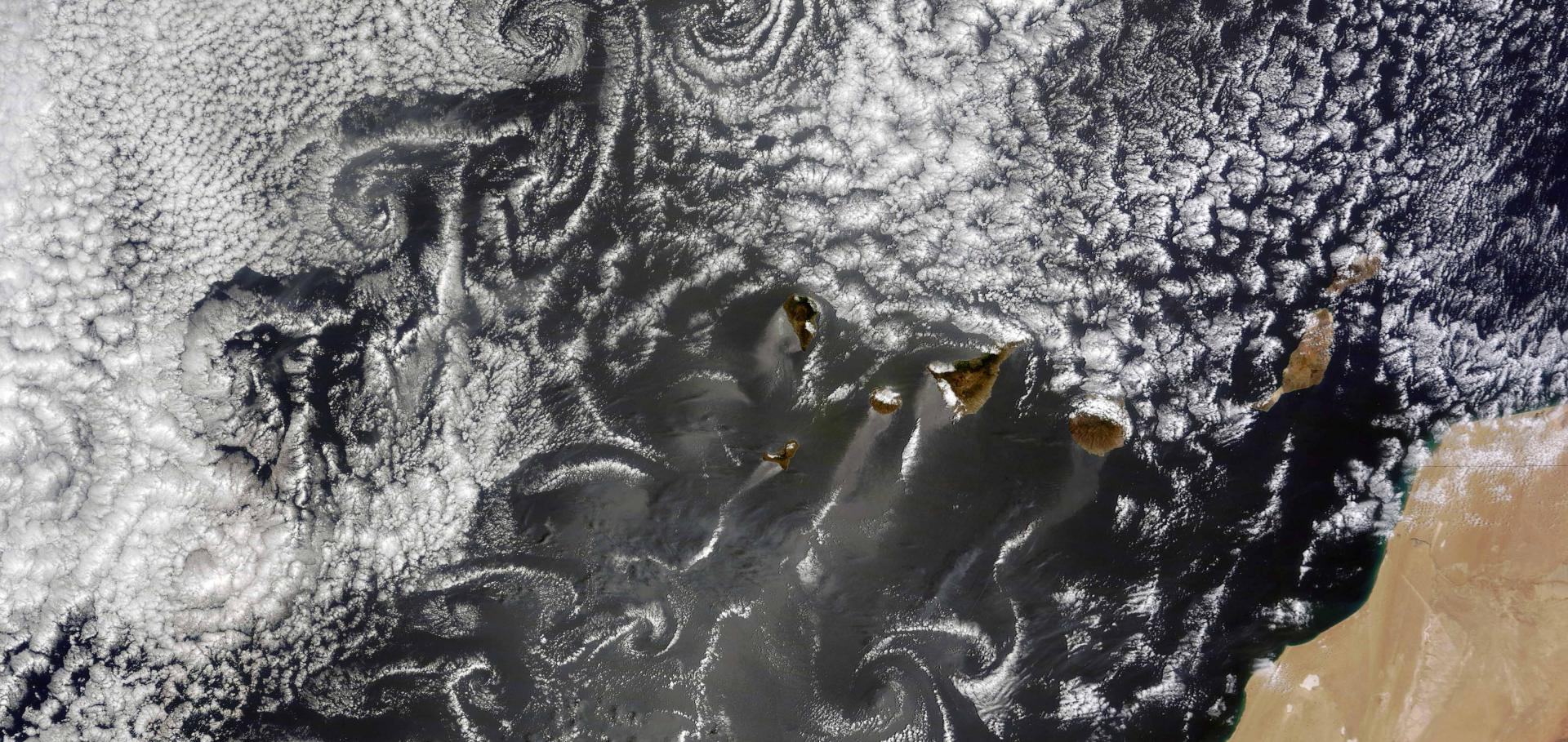
von Kármán vortex street over Canary Islands
Credit: NASA

Philip Stier

Professor of Atmospheric Physics

Research theme

  • Climate physics

Sub department

  • Atmospheric, Oceanic and Planetary Physics

Research groups

  • Climate processes
philip.stier@physics.ox.ac.uk
Telephone: 01865 (2)72887
Atmospheric Physics Clarendon Laboratory, room 103
  • About
  • Research
  • Teaching
  • CV
  • Publications

Atmospheric energy budget response to idealized aerosol perturbation in tropical cloud systems

Copernicus GmbH

Authors:

Guy Dagan, Philip Stier, Matthew Christensen, Guido Cioni, Daniel Klocke, Axel Seifert

Abstract:

<jats:p>Abstract. The atmospheric energy budget is analysed in numerical simulations of tropical cloud systems. This is done in order to better understand the physical processes behind aerosol effects on the atmospheric energy budget. The simulations include both shallow convective clouds and deep convective tropical clouds over the Atlantic Ocean. Two different sets of simulations, at different dates (10–12/8/2016 and 16–18/8/2016), are being simulated with different dominant cloud modes (shallow or deep). For each case, the cloud droplet number concentrations (CDNC) is varied as a proxy for changes in aerosol concentrations. It is shown that the total column atmospheric radiative cooling is substantially reduced with CDNC in the deep-cloud dominated case (by ~ 10.0 W/m2), while a much smaller reduction (~ 1.6 W/m2) is shown in the shallow-cloud dominated case. This trend is caused by an increase in the ice and water vapor content at the upper troposphere that leads to a reduced outgoing longwave radiation. A decrease in sensible heat flux (driven by increase in the near surface air temperature) reduces the warming by ~ 1.4 W/m2 in both cases. It is also shown that the cloud fraction response behaves in opposite ways to an increase in CDNC, showing an increase in the deep-cloud dominated case and a decrease in the shallow-cloud dominated case. This demonstrates that under different environmental conditions the response to aerosol perturbation could be different. </jats:p>
More details from the publisher

Biomass Burning Emissions Analysis Based on MODIS AOD and AeroCom Multi-Model Simulations

Authors:

Mariya Petrenko, Ralph Kahn, Mian Chin, Susanne E Bauer, Tommi Bergman, Huisheng Bian, Gabriele Curci, Ben Johnson, Johannes Kaiser, Zak Kipling, Harri Kokkola, Xiaohong Liu, Keren Mezuman, Tero Mielonen, Gunnar Myhre, Xiaohua Pan, Anna Protonotariou, Samuel Remy, Ragnhild Bieltvedt Skeie, Philip Stier, Toshihiko Takemura, Kostas Tsigaridis, Hailong Wang, Duncan Watson-Parris, Kai Zhang
More details from the publisher

Black carbon vertical profiles strongly affect its radiative forcing uncertainty

Authors:

BH Samset, G Myhre, M Schulz, Y Balkanski, S Bauer, TK Berntsen, H Bian, N Bellouin, T Diehl, RC Easter, SJ Ghan, T Iversen, S Kinne, A Kirkevåg, J-F Lamarque, G Lin, X Liu, J Penner, Ø Seland, RB Skeie, P Stier, T Takemura, K Tsigaridis, K Zhang
More details from the publisher

Brightening of the global cloud field by nitric acid and the associated radiative forcing

Authors:

R Makkonen, S Romakkaniemi, H Kokkola, P Stier, P Räisänen, S Rast, J Feichter, M Kulmala, A Laaksonen
More details from the publisher

ClimateBench: A benchmark dataset for data-driven climate projections

Authors:

Duncan Watson-Parris, Yuhan Rao, Dirk Olivié, Øyvind Seland, Peer J Nowack, Gustau Camps-Valls, Philip Stier, Shahine Bouabid, Maura Dewey, Emilie Fons, Jessenia Gonzalez, Paula Harder, Kai Jeggle, Julien Lenhardt, Peter Manshausen, Maria Novitasari, Lucile Ricard, Carla Roesch
More details from the publisher

Pagination

  • First page First
  • Previous page Prev
  • …
  • Page 64
  • Page 65
  • Page 66
  • Page 67
  • Current page 68
  • Page 69
  • Page 70
  • Page 71
  • Page 72
  • …
  • Next page Next
  • Last page Last

Footer Menu

  • Contact us
  • Giving to the Dept of Physics
  • Work with us
  • Media

User account menu

  • Log in

Follow us

FIND US

Clarendon Laboratory,

Parks Road,

Oxford,

OX1 3PU

CONTACT US

Tel: +44(0)1865272200

University of Oxfrod logo Department Of Physics text logo
IOP Juno Champion logo Athena Swan Silver Award logo

© University of Oxford - Department of Physics

Cookies | Privacy policy | Accessibility statement

Built by: Versantus

  • Home
  • Research
  • Study
  • Engage
  • Our people
  • News & Comment
  • Events
  • Our facilities & services
  • About us
  • Giving to Physics
  • Current students
  • Staff intranet