Home
Department Of Physics text logo
  • Research
    • Our research
    • Our research groups
    • Our research in action
    • Research funding support
    • Summer internships for undergraduates
  • Study
    • Undergraduates
    • Postgraduates
  • Engage
    • For young people
    • For teachers
    • For the public
    • For alumni
    • For business
  • Support
Menu
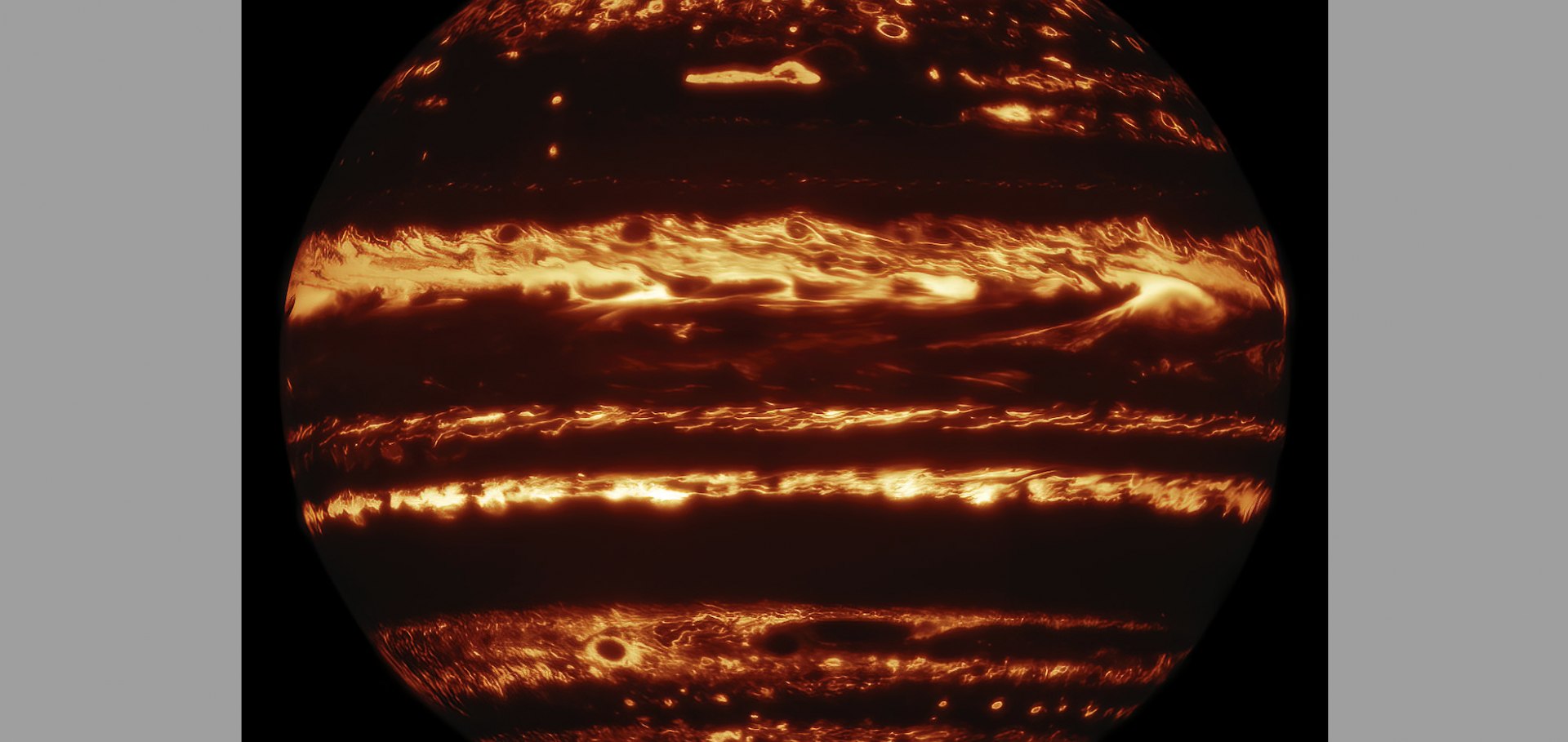
Jupiter's infrared image

What stir up Jupiter's unearthly jet streams and storms?

Credit: Gemini Observatory

Dr Xianyu Tan

Visitor

Research theme

  • Astronomy and astrophysics
  • Exoplanets and planetary physics

Sub department

  • Atmospheric, Oceanic and Planetary Physics

Research groups

  • Planetary Climate Dynamics
xianyu.tan@physics.ox.ac.uk
Atmospheric Physics Clarendon Laboratory, room 209 G
My Personal Website
  • About
  • Research
  • Publications

Characterizing the orbital and dynamical state of the HD 82943 planetary system with keck radial velocity data

Astrophysical Journal American Astronomical Society 777:2 (2013) 101-101

Authors:

Xianyu Tan, MJ Payne, MH Lee, EB Ford, AW Howard, JA Johnson, GW Marcy, JT Wright

Abstract:

We present an updated analysis of radial velocity data of the HD 82943 planetary system based on 10 yr of measurements obtained with the Keck telescope. Previous studies have shown that the HD 82943 system has two planets that are likely in 2:1 mean-motion resonance (MMR), with orbital periods about 220 and 440 days. However, alternative fits that are qualitatively different have also been suggested, with two planets in a 1:1 resonance or three planets in a Laplace 4:2:1 resonance. Here we use χ2 minimization combined with a parameter grid search to investigate the orbital parameters and dynamical states of the qualitatively different types of fits, and we compare the results to those obtained with the differential evolution Markov chain Monte Carlo method. Our results support the coplanar 2:1 MMR configuration for the HD 82943 system, and show no evidence for either the 1:1 or three-planet Laplace resonance fits. The inclination of the system with respect to the sky plane is well constrained at $20^{+4.9}_{-5.5}$ degrees, and the system contains two planets with masses of about 4.78 M J and 4.80 M J (where M J is the mass of Jupiter) and orbital periods of about 219 and 442 days for the inner and outer planet, respectively. The best fit is dynamically stable with both eccentricity-type resonant angles θ1 and θ2 librating around 0°.
More details from the publisher
Details from ORA
More details
Details from ArXiV

Two Giant Planets Orbiting the K Giant Star η Cet

Proceedings of the International Astronomical Union Cambridge University Press (CUP) 8:S299 (2013) 309-310

Authors:

T Trifonov, S Reffert, X Tan, MH Lee, A Quirrenbach
More details from the publisher

Pagination

  • First page First
  • Previous page Prev
  • …
  • Page 10
  • Page 11
  • Page 12
  • Page 13
  • Page 14
  • Page 15
  • Page 16
  • Page 17
  • Current page 18

Footer Menu

  • Contact us
  • Giving to the Dept of Physics
  • Work with us
  • Media

User account menu

  • Log in

Follow us

FIND US

Clarendon Laboratory,

Parks Road,

Oxford,

OX1 3PU

CONTACT US

Tel: +44(0)1865272200

University of Oxfrod logo Department Of Physics text logo
IOP Juno Champion logo Athena Swan Silver Award logo

© University of Oxford - Department of Physics

Cookies | Privacy policy | Accessibility statement

Built by: Versantus

  • Home
  • Research
  • Study
  • Engage
  • Our people
  • News & Comment
  • Events
  • Our facilities & services
  • About us
  • Giving to Physics
  • Current students
  • Staff intranet