Home
Department Of Physics text logo
  • Research
    • Our research
    • Our research groups
    • Our research in action
    • Research funding support
    • Summer internships for undergraduates
  • Study
    • Undergraduates
    • Postgraduates
  • Engage
    • For alumni
    • For business
    • For schools
    • For the public
  • Support
Menu
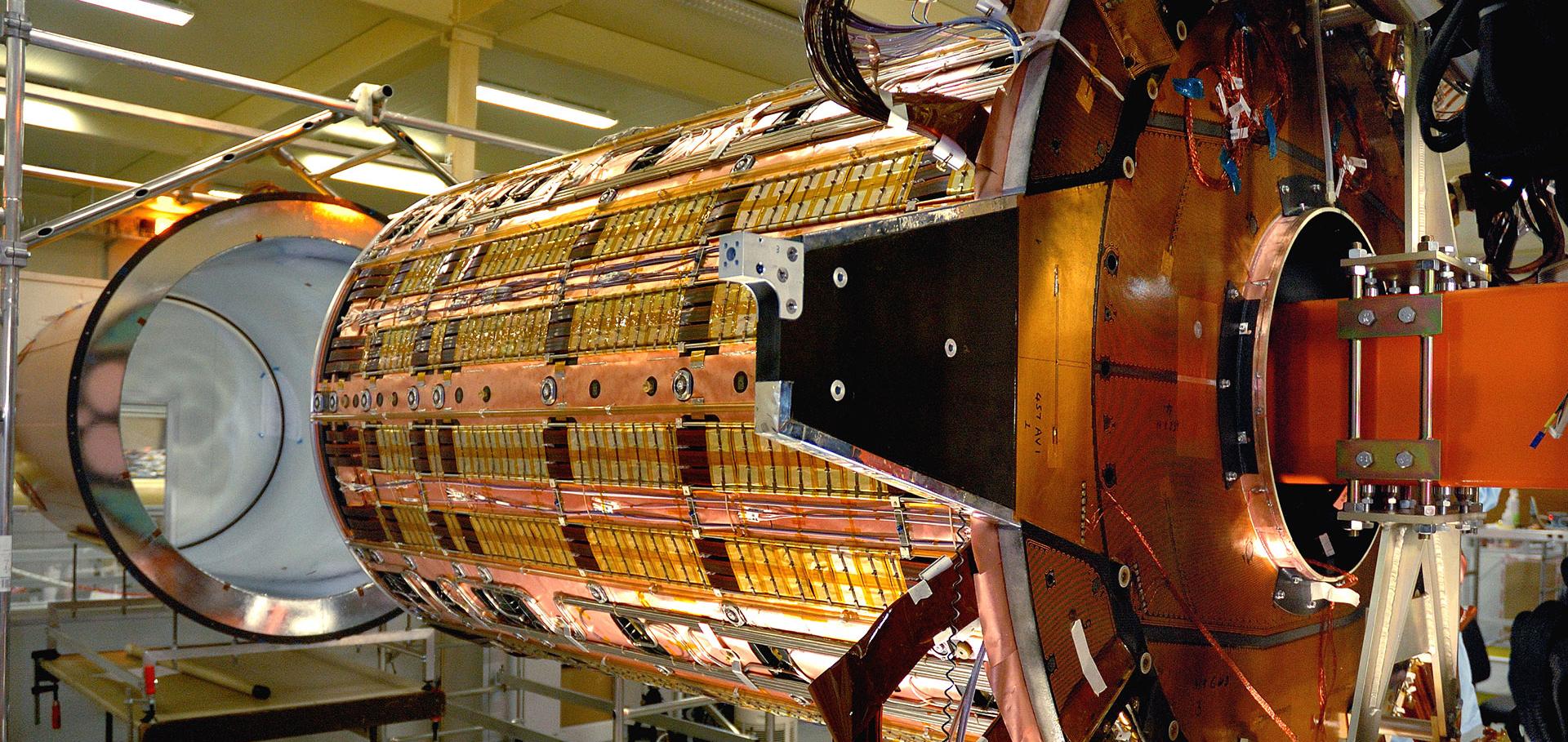
Insertion of STC into TRT at the Department of Physics, Oxford
Credit: CERN

Dr Max Topp-Mugglestone

Postdoctoral Research Assistant in High Energy Beam Dynamics

Research theme

  • Accelerator physics

Sub department

  • Particle Physics
max.topp-mugglestone@physics.ox.ac.uk
Telephone: 01865 273424
Denys Wilkinson Building, room 604a
  • About
  • Publications

Beam stacking experiment at a fixed field alternating gradient accelerator

Physical Review Accelerators and Beams American Physical Society (APS) 28:1 (2025) 12803

Authors:

T Uesugi, Y Ishi, Y Kuriyama, Y Mori, C Jolly, Dj Kelliher, J-B Lagrange, Ap Letchford, S Machida, DW Posthuma de Boer, Ct Rogers, E Yamakawa, M Topp-Mugglestone

Abstract:

A key challenge in particle accelerators is to achieve high peak intensity. Space charge is particularly strong at lower energy such as during injection and typically limits achievable peak intensity. The beam stacking technique can overcome this limitation by accumulating a beam at high energy where space charge is weaker. In beam stacking, a bunch of particles is injected and accelerated to high energy. This bunch continues to circulate, while a second and subsequent bunches are accelerated to merge into the first. It also allows the user cycle and acceleration cycles to be separated which is often valuable. Beam stacking is not possible in a time varying magnetic field, but a fixed field machine such as an fixed field alternating gradient accelerator (FFA) does not sweep the magnetic field. In this paper, we describe experimental demonstration of beam stacking of two beams at KURNS FFA in Kyoto University. The momentum spread and intensity of the beam was analyzed by study of the Schottky signal, demonstrating stacking with only a slight increase of momentum spread of the combined beams. The intensity of the first beam was, however, significantly reduced. rf knockout is the suspected source of the beam loss.
More details from the publisher
More details

Studies of high order modes in asymmetric dual-axis cavity

Applied Physics Letters AIP Publishing 113:24 (2018)

Authors:

Jacob Topp-Mugglestone, Ivan Konoplev, Huibo Zhang, A Seryi

Abstract:

Electron-beam current in superconducting radiofrequency energy recovery linear accelerators (SCRF ERLs) is limited by beam break-up (BBU) instabilities disrupting beam transport and energy recuperation. The instabilities originate from the accumulation of high order modes (HOMs) in the cavity and positive feedback between the beam and HOMs which is especially evident in multi-pass ERLs. Overcoming the beam current limitations due to BBU instabilities is one of the challenges in accelerator science. A dual-axis asymmetric SCRF ERL has been proposed as a possible way to drive a high average current electron beam for next-generation light sources and beam cooling in electron-ion colliders (EICs). In this work, detailed studies on HOMs in the asymmetric dual axis cavity were carried out. The asymmetric field distribution of HOMs (i.e., confinement to one or another axis) has been demonstrated and their excitation from different axes has been studied. The results confirm the numerical predictions and theory developed to describe the asymmetric dual axis cavity.
More details from the publisher
Details from ORA
More details

Footer Menu

  • Contact us
  • Giving to the Dept of Physics
  • Work with us
  • Media

User account menu

  • Log in

Follow us

FIND US

Clarendon Laboratory,

Parks Road,

Oxford,

OX1 3PU

CONTACT US

Tel: +44(0)1865272200

University of Oxfrod logo Department Of Physics text logo
IOP Juno Champion logo Athena Swan Silver Award logo

© University of Oxford - Department of Physics

Cookies | Privacy policy | Accessibility statement

Built by: Versantus

  • Home
  • Research
  • Study
  • Engage
  • Our people
  • News & Comment
  • Events
  • Our facilities & services
  • About us
  • Giving to Physics
  • Current students
  • Staff intranet