Home
Department Of Physics text logo
  • Research
    • Our research
    • Our research groups
    • Our research in action
    • Research funding support
    • Summer internships for undergraduates
  • Study
    • Undergraduates
    • Postgraduates
  • Engage
    • For alumni
    • For business
    • For schools
    • For the public
  • Support
Menu
SNO+

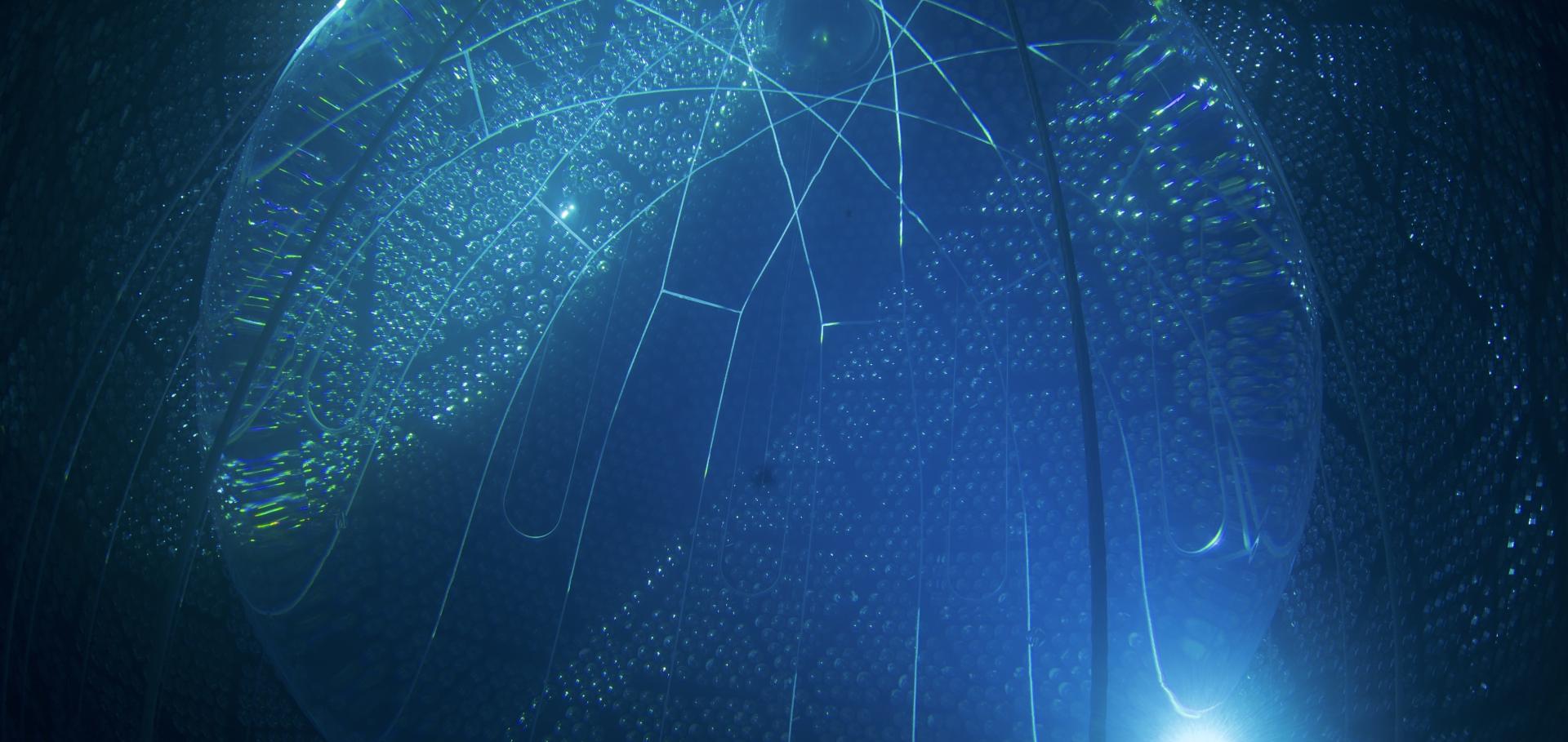
SNO+ detector. The inner vessel is filled with 780T of liquid scintillator and surrounded by a geodesic sphere of photomultiplier tubes immersed in ultra-pure water. The detector is located 2.1km underground at Canada's SNOLAB, outside of Sudbury, Western Ontario.

Credit: SNOLAB

Jeff Tseng

Professor of Physics

Research theme

  • Particle astrophysics & cosmology
  • Fundamental particles and interactions

Sub department

  • Particle Physics

Research groups

  • Rubin-LSST
  • SNO+
Jeff.Tseng@physics.ox.ac.uk
Telephone: 01865 (2)73398
Denys Wilkinson Building, room 674
Home page
  • About
  • Publications

Expected tracking performance of the ATLAS Inner Tracker at the High-Luminosity LHC

Journal of Instrumentation IOP Publishing 20:02 (2025) P02018

Authors:

G Aad, E Aakvaag, B Abbott, S Abdelhameed, K Abeling, NJ Abicht, SH Abidi, M Aboelela, A Aboulhorma, H Abramowicz, Y Abulaiti, BS Acharya, A Ackermann, C Adam Bourdarios, L Adamczyk, SV Addepalli, MJ Addison, J Adelman, A Adiguzel, T Adye, AA Affolder, Y Afik, MN Agaras, A Aggarwal

Abstract:

The high-luminosity phase of LHC operations (HL-LHC), will feature a large increase in simultaneous proton-proton interactions per bunch crossing up to 200, compared with a typical leveling target of 64 in Run 3. Such an increase will create a very challenging environment in which to perform charged particle trajectory reconstruction, a task crucial for the success of the ATLAS physics program, and will exceed the capabilities of the current ATLAS Inner Detector (ID). A new all-silicon Inner Tracker (ITk) will replace the current ID in time for the start of the HL-LHC. To ensure successful use of the ITk capabilities in Run 4 and beyond, the ATLAS tracking software has been successfully adapted to achieve state-of-the-art track reconstruction in challenging high-luminosity conditions with the ITk detector. This paper presents the expected tracking performance of the ATLAS ITk based on the latest available developments since the ITk technical design reports.
More details from the publisher
Details from ORA
More details

Initial measurement of reactor antineutrino oscillation at SNO+

European Physical Journal C Springer Nature 85:1 (2025) 17

Authors:

A Allega, MR Anderson, S Andringa, M Askins, DJ Auty, A Bacon, J Baker, F Barão, N Barros, R Bayes, EW Beier, TS Bezerra, A Bialek, SD Biller, E Blucher, E Caden, EJ Callaghan, M Chen, S Cheng, B Cleveland, D Cookman, J Corning, MA Cox, R Dehghani, J Deloye, MM Depatie, F Di Lodovico, C Dima, J Dittmer, KH Dixon, MS Esmaeilian, E Falk, N Fatemighomi, R Ford, A Gaur, OI González-Reina, D Gooding, C Grant, J Grove, S Hall, AL Hallin, D Hallman, WJ Heintzelman, RL Helmer, C Hewitt, V Howard, B Hreljac, J Hu, P Huang, R Hunt-Stokes, SMA Hussain, AS Inácio, CJ Jillings, S Kaluzienski, T Kaptanoglu, H Khan, J Kladnik, JR Klein, LL Kormos, B Krar, C Kraus, CB Krauss, T Kroupová, C Lake, L Lebanowski, C Lefebvre, V Lozza, M Luo, A Maio, S Manecki, J Maneira, RD Martin, N McCauley, AB McDonald, C Mills, G Milton, A Molina Colina, D Morris, I Morton-Blake, M Mubasher, S Naugle, LJ Nolan, HM O’Keeffe, GD Orebi Gann, J Page, K Paleshi, W Parker, J Paton, SJM Peeters, L Pickard, B Quenallata, P Ravi, A Reichold, S Riccetto, J Rose, R Rosero, I Semenec, J Simms, P Skensved, M Smiley, J Smith, R Svoboda, B Tam, J Tseng, E Vázquez-Jáuregui, JGC Veinot, CJ Virtue, M Ward, JJ Weigand, JR Wilson, JD Wilson, A Wright, S Yang, M Yeh, Z Ye, S Yu, Y Zhang, K Zuber, A Zummo
More details from the publisher
More details

Measurement of the B8 solar neutrino flux using the full SNO+ water phase dataset

Physical Review D American Physical Society (APS) 110:12 (2024) 122003

Authors:

A Allega, MR Anderson, S Andringa, M Askins, DM Asner, DJ Auty, A Bacon, F Barão, N Barros, R Bayes, EW Beier, A Bialek, SD Biller, E Blucher, E Caden, EJ Callaghan, M Chen, S Cheng, B Cleveland, D Cookman, J Corning, MA Cox, R Dehghani, J Deloye, MM Depatie, F Di Lodovico, C Dima, J Dittmer, KH Dixon, MS Esmaeilian, E Falk, N Fatemighomi, R Ford, A Gaur, OI González-Reina, D Gooding, C Grant, J Grove, S Hall, AL Hallin, D Hallman, WJ Heintzelman, RL Helmer, C Hewitt, B Hreljac, J Hu, P Huang, R Hunt-Stokes, SMA Hussain, AS Inácio, CJ Jillings, S Kaluzienski, T Kaptanoglu, J Kladnik, JR Klein, LL Kormos, B Krar, C Kraus, CB Krauss, T Kroupová, C Lake, L Lebanowski, C Lefebvre, V Lozza, M Luo, A Maio, S Manecki, J Maneira, RD Martin, N McCauley, AB McDonald, G Milton, D Morris, M Mubasher, S Naugle, LJ Nolan, HM O’Keeffe, GD Orebi Gann, J Page, K Paleshi, W Parker, J Paton, SJM Peeters, L Pickard, B Quenallata, P Ravi, A Reichold, S Riccetto, J Rose, R Rosero, I Semenec, J Simms, P Skensved, M Smiley, R Svoboda, B Tam, J Tseng, E Vázquez-Jáuregui, CJ Virtue, M Ward, JR Wilson, JD Wilson, A Wright, S Yang, M Yeh, Z Ye, S Yu, Y Zhang, K Zuber, A Zummo
More details from the publisher
More details

Data-driven core collapse supernova multilateration with first neutrino events

ArXiv 2410.11984 (2024)

Authors:

Farrukh Azfar, Jeff Tseng, Marta Colomer Molla, Kate Scholberg, Alec Habig, Segev BenZvi, Melih Kara, James Kneller, Jost Migenda, Dan Milisavljevic, Evan O'Connor
Details from ArXiV

The SNEWS 2.0 alert software for the coincident detection of neutrinos from core-collapse supernovae

Journal of Instrumentation IOP Publishing 19:10 (2024) P10017

Authors:

M Kara, S Torres-Lara, AL Baxter, S BenZvi, M Colomer Molla, A Habig, JP Kneller, M Lai, RF Lang, M Linvill, D Milisavljevic, J Migenda, C Orr, K Scholberg, J Smolsky, J Tseng, CD Tunnell, J Vasel, A Sheshukov

Abstract:

The neutrino signal from the next galactic core-collapse supernova will provide an invaluable early warning of the explosion. By combining the burst trigger from several neutrino detectors, the location of the explosion can be triangulated minutes to hours before the optical emission becomes visible, while also reducing the rate of false-positive triggers. To enable multi-messenger follow-up of nearby supernovae, the SuperNova Early Warning System 2.0 (SNEWS 2.0) will produce a combined alert using a global network of neutrino detectors. This paper describes the trigger publishing and alert formation framework of the SNEWS 2.0 network. The framework is built on the HOPSKOTCH publish-subscribe system to easily incorporate new detectors into the network, and it implements a coincidence system to form alerts and estimate a false-positive rate for the combined triggers. The paper outlines the structure of the SNEWS 2.0 software and the initial testing of coincident signals.
More details from the publisher
Details from ORA

Pagination

  • First page First
  • Previous page Prev
  • Page 1
  • Current page 2
  • Page 3
  • Page 4
  • Page 5
  • Page 6
  • Page 7
  • Page 8
  • Page 9
  • …
  • Next page Next
  • Last page Last

Footer Menu

  • Contact us
  • Giving to the Dept of Physics
  • Work with us
  • Media

User account menu

  • Log in

Follow us

FIND US

Clarendon Laboratory,

Parks Road,

Oxford,

OX1 3PU

CONTACT US

Tel: +44(0)1865272200

University of Oxfrod logo Department Of Physics text logo
IOP Juno Champion logo Athena Swan Silver Award logo

© University of Oxford - Department of Physics

Cookies | Privacy policy | Accessibility statement

Built by: Versantus

  • Home
  • Research
  • Study
  • Engage
  • Our people
  • News & Comment
  • Events
  • Our facilities & services
  • About us
  • Giving to Physics
  • Current students
  • Staff intranet