Home
Department Of Physics text logo
  • Research
    • Our research
    • Our research groups
    • Our research in action
    • Research funding support
    • Summer internships for undergraduates
  • Study
    • Undergraduates
    • Postgraduates
  • Engage
    • For young people
    • For teachers
    • For the public
    • For alumni
    • For business
  • Support
Menu
SNO+

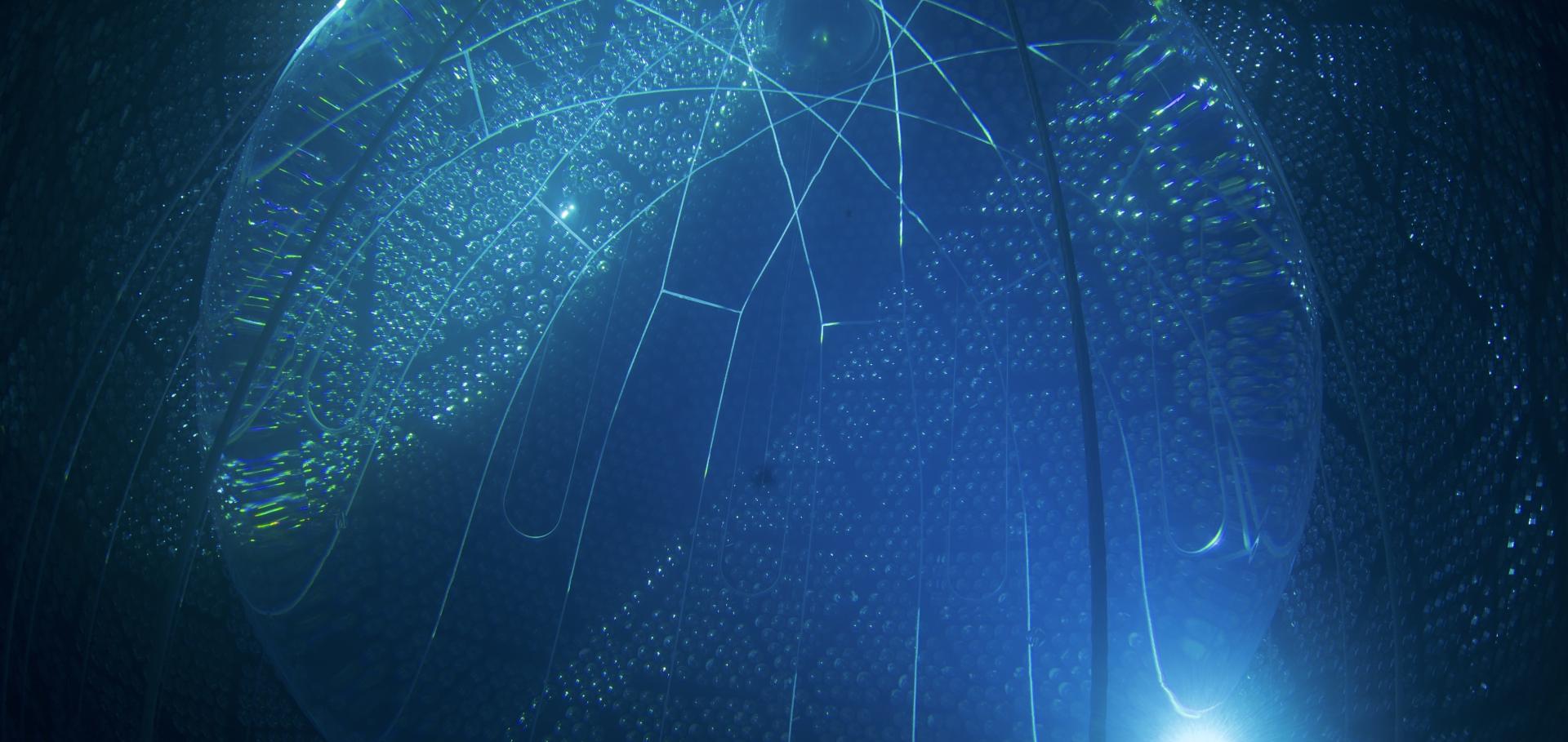
SNO+ detector. The inner vessel is filled with 780T of liquid scintillator and surrounded by a geodesic sphere of photomultiplier tubes immersed in ultra-pure water. The detector is located 2.1km underground at Canada's SNOLAB, outside of Sudbury, Western Ontario.

Credit: SNOLAB

Jeff Tseng

Professor of Physics

Research theme

  • Particle astrophysics & cosmology
  • Fundamental particles and interactions

Sub department

  • Particle Physics

Research groups

  • Rubin-LSST
  • SNO+
Jeff.Tseng@physics.ox.ac.uk
Telephone: 01865 (2)73398
Denys Wilkinson Building, room 674
Home page
  • About
  • Publications

Search for a heavy particle decaying into an electron and a muon with the ATLAS detector in √s=7TeV pp collisions at the LHC

Physical Review Letters 106:25 (2011)

Authors:

G Aad, B Abbott, J Abdallah, AA Abdelalim, A Abdesselam, O Abdinov, B Abi, M Abolins, H Abramowicz, H Abreu, E Acerbi, BS Acharya, DL Adams, TN Addy, J Adelman, M Aderholz, S Adomeit, P Adragna, T Adye, S Aefsky, JA Aguilar-Saavedra, M Aharrouche, SP Ahlen, F Ahles, A Ahmad, M Ahsan, G Aielli, T Akdogan, TPA Kesson, G Akimoto, AV Akimov, A Akiyama, MS Alam, MA Alam, S Albrand, M Aleksa, IN Aleksandrov, F Alessandria, C Alexa, G Alexander, G Alexandre, T Alexopoulos, M Alhroob, M Aliev, G Alimonti, J Alison, M Aliyev, PP Allport, SE Allwood-Spiers, J Almond, A Aloisio, R Alon, A Alonso, MG Alviggi, K Amako, P Amaral, C Amelung, VV Ammosov, A Amorim, G Amorós, N Amram, C Anastopoulos, T Andeen, CF Anders, KJ Anderson, A Andreazza, V Andrei, ML Andrieux, XS Anduaga, A Angerami, F Anghinolfi, N Anjos, A Annovi, A Antonaki, M Antonelli, S Antonelli, A Antonov, J Antos, F Anulli, S Aoun, L Aperio Bella, R Apolle, G Arabidze, I Aracena, Y Arai, ATH Arce, JP Archambault, S Arfaoui, JF Arguin, E Arik, M Arik, AJ Armbruster, O Arnaez, C Arnault, A Artamonov, G Artoni, D Arutinov, S Asai, R Asfandiyarov, S Ask

Abstract:

This Letter presents the first search for a heavy particle decaying into an e±μss final state in √s=7TeV pp collisions at the LHC. The data were recorded by the ATLAS detector during 2010 and correspond to a total integrated luminosity of 35pb-1. No excess above the standard model background expectation is observed. Exclusions at 95% confidence level are placed on two representative models. In an R-parity violating supersymmetric model, tau sneutrinos with a mass below 0.75 TeV are excluded, assuming all R-parity violating couplings are zero except λ311′=0.11 and λ312=0.07. In a lepton flavor violating model, a Z′-like vector boson with masses of 0.70-1.00 TeV and corresponding cross sections times branching ratios of 0.175-0.183 pb is excluded. These results extend to higher mass R-parity violating sneutrinos and lepton flavor violating Z's than previous constraints from the Tevatron. © 2011 American Physical Society.
More details from the publisher
More details
More details

Search for pair production of first or second generation leptoquarks in proton-proton collisions at √s=7TeV using the ATLAS detector at the LHC

Physical Review D - Particles, Fields, Gravitation and Cosmology 83:11 (2011)

Authors:

G Aad, B Abbott, J Abdallah, AA Abdelalim, A Abdesselam, O Abdinov, B Abi, M Abolins, H Abramowicz, H Abreu, E Acerbi, BS Acharya, DL Adams, TN Addy, J Adelman, M Aderholz, S Adomeit, P Adragna, T Adye, S Aefsky, JA Aguilar-Saavedra, M Aharrouche, SP Ahlen, F Ahles, A Ahmad, M Ahsan, G Aielli, T Akdogan, TPA Ákesson, G Akimoto, AV Akimov, A Akiyama, MS Alam, MA Alam, S Albrand, M Aleksa, IN Aleksandrov, F Alessandria, C Alexa, G Alexander, G Alexandre, T Alexopoulos, M Alhroob, M Aliev, G Alimonti, J Alison, M Aliyev, PP Allport, SE Allwood-Spiers, J Almond, A Aloisio, R Alon, A Alonso, MG Alviggi, K Amako, P Amaral, C Amelung, VV Ammosov, A Amorim, G Amorós, N Amram, C Anastopoulos, T Andeen, CF Anders, KJ Anderson, A Andreazza, V Andrei, ML Andrieux, XS Anduaga, A Angerami, F Anghinolfi, N Anjos, A Annovi, A Antonaki, M Antonelli, S Antonelli, A Antonov, J Antos, F Anulli, S Aoun, L Aperio Bella, R Apolle, G Arabidze, I Aracena, Y Arai, ATH Arce, JP Archambault, S Arfaoui, JF Arguin, E Arik, M Arik, AJ Armbruster, O Arnaez, C Arnault, A Artamonov, G Artoni, D Arutinov, S Asai, R Asfandiyarov, S Ask

Abstract:

This paper describes searches for the pair production of first or second generation scalar leptoquarks using 35pb-1 of proton-proton collision data recorded by the ATLAS detector at √s=7TeV. Leptoquarks are searched in events with two oppositely-charged muons or electrons and at least two jets, and in events with one muon or electron, missing transverse momentum and at least two jets. After event selection, the observed yields are consistent with the predicted backgrounds. Leptoquark production is excluded at the 95 CL for masses MLQ<376 (319) GeV and MLQ<422 (362) GeV for first and second generation scalar leptoquarks, respectively, when assuming the branching fraction of a leptoquark to a charged lepton is equal to 1.0 (0.5). © 2011 American Physical Society.
More details from the publisher
More details

Search for high mass dilepton resonances in pp collisions at √s=7 TeV with the ATLAS experiment

Physics Letters, Section B: Nuclear, Elementary Particle and High-Energy Physics 700:3-4 (2011) 163-180

Authors:

G Aad, B Abbott, J Abdallah, AA Abdelalim, A Abdesselam, O Abdinov, B Abi, M Abolins, H Abramowicz, H Abreu, E Acerbi, BS Acharya, DL Adams, TN Addy, J Adelman, M Aderholz, S Adomeit, P Adragna, T Adye, S Aefsky, JA Aguilar-Saavedra, M Aharrouche, SP Ahlen, F Ahles, A Ahmad, M Ahsan, G Aielli, T Akdogan, TPA Åkesson, G Akimoto, AV Akimov, A Akiyama, MS Alam, MA Alam, S Albrand, M Aleksa, IN Aleksandrov, F Alessandria, C Alexa, G Alexander, G Alexandre, T Alexopoulos, M Alhroob, M Aliev, G Alimonti, J Alison, M Aliyev, PP Allport, SE Allwood-Spiers, J Almond, A Aloisio, R Alon, A Alonso, MG Alviggi, K Amako, P Amaral, C Amelung, VV Ammosov, A Amorim, G Amorós, N Amram, C Anastopoulos, T Andeen, CF Anders, KJ Anderson, A Andreazza, V Andrei, ML Andrieux, XS Anduaga, A Angerami, F Anghinolfi, N Anjos, A Annovi, A Antonaki, M Antonelli, S Antonelli, A Antonov, J Antos, F Anulli, S Aoun, L Aperio Bella, R Apolle, G Arabidze, I Aracena, Y Arai, ATH Arce, JP Archambault, S Arfaoui, JF Arguin, E Arik, M Arik, AJ Armbruster, O Arnaez, C Arnault, A Artamonov, G Artoni, D Arutinov, S Asai, R Asfandiyarov, S Ask

Abstract:

This Letter presents a search for high mass e+e- or μ+μ- resonances in pp collisions at √s=7 TeV at the LHC. The data were recorded by the ATLAS experiment during 2010 and correspond to a total integrated luminosity of ~40 pb-1. No statistically significant excess above the Standard Model expectation is observed in the search region of dilepton invariant mass above 110 GeV. Upper limits at the 95% confidence level are set on the cross section times branching ratio of Z' resonances decaying to dielectrons and dimuons as a function of the resonance mass. A lower mass limit of 1.048 TeV on the Sequential Standard Model Z' boson is derived, as well as mass limits on Z* and E6-motivated Z' models. © 2011 CERN.
More details from the publisher
More details

Boosted objects: A probe of beyond the standard model physics

European Physical Journal C Springer-Verlag 71:1661 (2011)

Authors:

A Abdesselam, A Belyaev, A Belyaev, E Bergeaas Kuutmann, U Bitenc, G Brooijmans, J Butterworth, P Bruckman de Renstrom, D Buarque Franzosi, R Buckingham, B Chapleau, M Dasgupta, A Davison, J Dolen, S Ellis, F Fassi, J Ferrando, MT Frandsen, J Frost, T Gadfort, N Glover, A Haas, E Halkiadakis, K Hamilton, C Hays

Abstract:

We present the report of the hadronic working group of the BOOST2010 workshop held at the University of Oxford in June 2010. The first part contains a review of the potential of hadronic decays of highly boosted particles as an aid for discovery at the LHC and a discussion of the status of tools developed to meet the challenge of reconstructing and isolating these topologies. In the second part, we present new results comparing the performance of jet grooming techniques and top tagging algorithms on a common set of benchmark channels. We also study the sensitivity of jet substructure observables to the uncertainties in Monte Carlo predictions.
More details from the publisher
Details from ORA

Measurement of underlying event characteristics using charged particles in pp collisions at √s=900GeV and 7 TeV with the ATLAS detector

Physical Review D - Particles, Fields, Gravitation and Cosmology 83:11 (2011)

Authors:

G Aad, B Abbott, J Abdallah, AA Abdelalim, A Abdesselam, O Abdinov, B Abi, M Abolins, H Abramowicz, H Abreu, E Acerbi, BS Acharya, M Ackers, DL Adams, TN Addy, J Adelman, M Aderholz, S Adomeit, P Adragna, T Adye, S Aefsky, JA Aguilar-Saavedra, M Aharrouche, SP Ahlen, F Ahles, A Ahmad, H Ahmed, M Ahsan, G Aielli, T Akdogan, TPA Ákesson, G Akimoto, AV Akimov, MS Alam, MA Alam, S Albrand, M Aleksa, IN Aleksandrov, M Aleppo, F Alessandria, C Alexa, G Alexander, G Alexandre, T Alexopoulos, M Alhroob, M Aliev, G Alimonti, J Alison, M Aliyev, PP Allport, SE Allwood-Spiers, J Almond, A Aloisio, R Alon, A Alonso, J Alonso, MG Alviggi, K Amako, P Amaral, C Amelung, VV Ammosov, A Amorim, G Amorós, N Amram, C Anastopoulos, T Andeen, CF Anders, KJ Anderson, A Andreazza, V Andrei, ML Andrieux, XS Anduaga, A Angerami, F Anghinolfi, N Anjos, A Annovi, A Antonaki, M Antonelli, S Antonelli, J Antos, B Antunovic, F Anulli, S Aoun, R Apolle, G Arabidze, I Aracena, Y Arai, ATH Arce, JP Archambault, S Arfaoui, JF Arguin, T Argyropoulos, E Arik, M Arik, AJ Armbruster, KE Arms, SR Armstrong, O Arnaez, C Arnault, A Artamonov

Abstract:

Measurements of charged particle distributions, sensitive to the underlying event, have been performed with the ATLAS detector at the LHC. The measurements are based on data collected using a minimum-bias trigger to select proton-proton collisions at center-of-mass energies of 900 GeV and 7 TeV. The "underlying event" is defined as those aspects of a hadronic interaction attributed not to the hard scattering process, but rather to the accompanying interactions of the rest of the proton. Three regions are defined in azimuthal angle with respect to the highest transverse momentum charged particle in the event, such that the region transverse to the dominant momentum-flow is most sensitive to the underlying event. In each of these regions, distributions of the charged particle multiplicity, transverse momentum density, and average pT are measured. The data show generally higher underlying event activity than that predicted by Monte Carlo models tuned to pre-LHC data. © 2011 American Physical Society.
More details from the publisher
More details

Pagination

  • First page First
  • Previous page Prev
  • …
  • Page 207
  • Page 208
  • Page 209
  • Page 210
  • Current page 211
  • Page 212
  • Page 213
  • Page 214
  • Page 215
  • …
  • Next page Next
  • Last page Last

Footer Menu

  • Contact us
  • Giving to the Dept of Physics
  • Work with us
  • Media

User account menu

  • Log in

Follow us

FIND US

Clarendon Laboratory,

Parks Road,

Oxford,

OX1 3PU

CONTACT US

Tel: +44(0)1865272200

University of Oxfrod logo Department Of Physics text logo
IOP Juno Champion logo Athena Swan Silver Award logo

© University of Oxford - Department of Physics

Cookies | Privacy policy | Accessibility statement

Built by: Versantus

  • Home
  • Research
  • Study
  • Engage
  • Our people
  • News & Comment
  • Events
  • Our facilities & services
  • About us
  • Giving to Physics
  • Current students
  • Staff intranet