Home
Department Of Physics text logo
  • Research
    • Our research
    • Our research groups
    • Our research in action
    • Research funding support
    • Summer internships for undergraduates
  • Study
    • Undergraduates
    • Postgraduates
  • Engage
    • For young people
    • For teachers
    • For the public
    • For alumni
    • For business
  • Support
Menu
SNO+

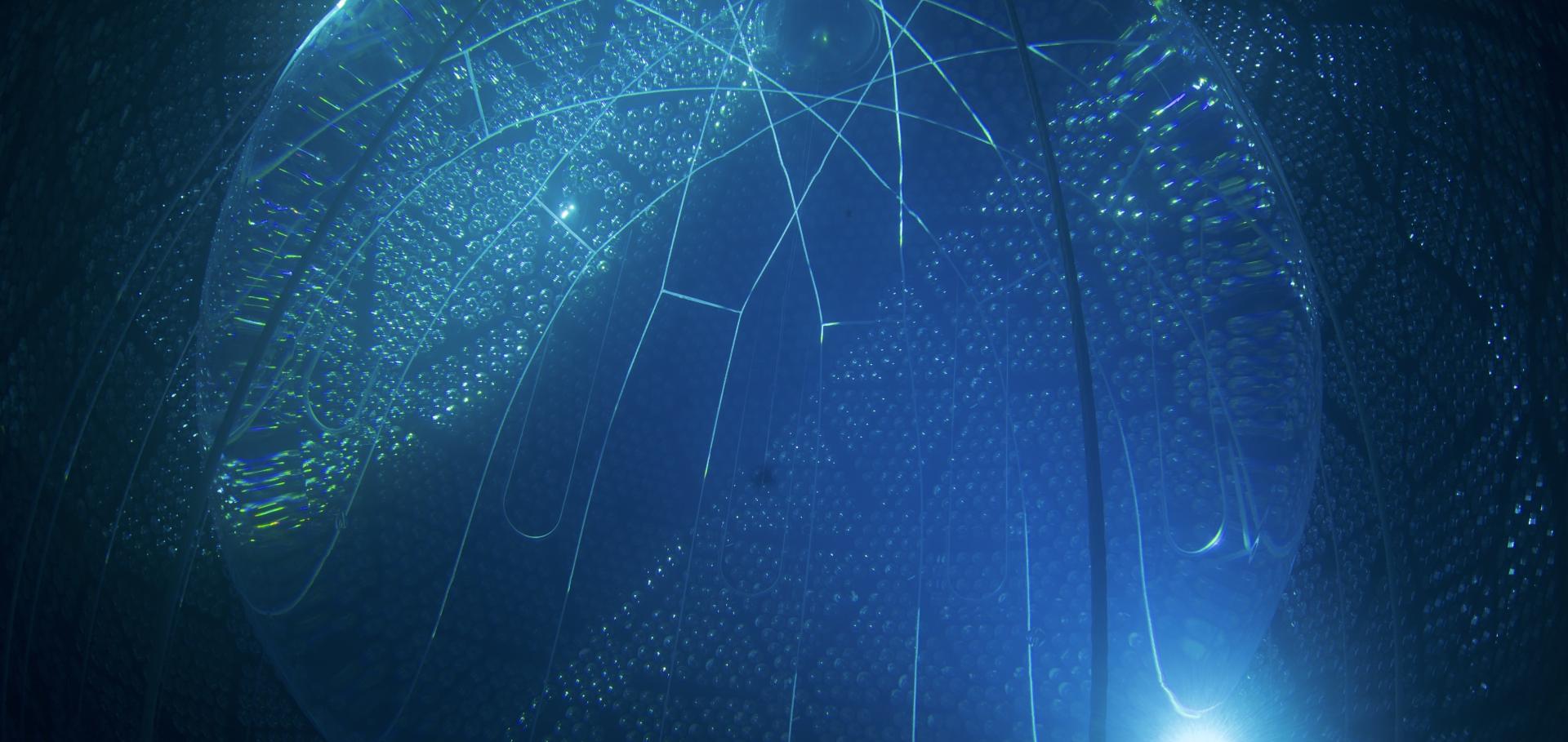
SNO+ detector. The inner vessel is filled with 780T of liquid scintillator and surrounded by a geodesic sphere of photomultiplier tubes immersed in ultra-pure water. The detector is located 2.1km underground at Canada's SNOLAB, outside of Sudbury, Western Ontario.

Credit: SNOLAB

Jeff Tseng

Professor of Physics

Research theme

  • Particle astrophysics & cosmology
  • Fundamental particles and interactions

Sub department

  • Particle Physics

Research groups

  • Rubin-LSST
  • SNO+
Jeff.Tseng@physics.ox.ac.uk
Telephone: 01865 (2)73398
Denys Wilkinson Building, room 674
Home page
  • About
  • Publications

Search for quark contact interactions in dijet angular distributions in pp collisions at s=7 TeV measured with the ATLAS detector

Physics Letters Section B Nuclear Elementary Particle and High Energy Physics 694:4-5 (2011) 327-345

Authors:

G Aad, B Abbott, J Abdallah, AA Abdelalim, A Abdesselam, O Abdinov, B Abi, M Abolins, H Abramowicz, H Abreu, E Acerbi, BS Acharya, M Ackers, DL Adams, TN Addy, J Adelman, M Aderholz, S Adomeit, C Adorisio, P Adragna, T Adye, S Aefsky, JA Aguilar-Saavedra, M Aharrouche, SP Ahlen, F Ahles, A Ahmad, H Ahmed, M Ahsan, G Aielli, T Akdogan, TPA Åkesson, G Akimoto, AV Akimov, A Aktas, MS Alam, MA Alam, S Albrand, M Aleksa, IN Aleksandrov, M Aleppo, F Alessandria, C Alexa, G Alexander, G Alexandre, T Alexopoulos, M Alhroob, M Aliev, G Alimonti, J Alison, M Aliyev, PP Allport, SE Allwood-Spiers, J Almond, A Aloisio, R Alon, A Alonso, J Alonso, MG Alviggi, K Amako, P Amaral, G Ambrosio, C Amelung, VV Ammosov, A Amorim, G Amorós, N Amram, C Anastopoulos, T Andeen, CF Anders, KJ Anderson, A Andreazza, V Andrei, ML Andrieux, XS Anduaga, A Angerami, F Anghinolfi, N Anjos, A Annovi, A Antonaki, M Antonelli, S Antonelli, J Antos, B Antunovic, F Anulli, S Aoun, R Apolle, G Arabidze, I Aracena, Y Arai, ATH Arce, JP Archambault, S Arfaoui, JF Arguin, T Argyropoulos, E Arik, M Arik, AJ Armbruster, KE Arms, SR Armstrong

Abstract:

Dijet angular distributions from the first LHC pp collisions at center-of-mass energy s=7 TeV have been measured with the ATLAS detector. The dataset used for this analysis represents an integrated luminosity of 3.1 pb-1. Dijet Χ distributions and centrality ratios have been measured up to dijet masses of 2.8 TeV, and found to be in good agreement with Standard Model predictions. Analysis of the λ distributions excludes quark contact interactions with a compositeness scale Χ below 3.4 TeV, at 95% confidence level, significantly exceeding previous limits. © 2010 CERN.
More details from the publisher
More details

A search for new physics in dijet mass and angular distributions in ppcollisions at √s=7 TeV measured with the ATLAS detector

New Journal of Physics 13 (2011)

Authors:

G Aad, B Abbott, J Abdallah, AA Abdelalim, A Abdesselam, O Abdinov, B Abi, M Abolins, H Abramowicz, H Abreu, E Acerbi, BS Acharya, DL Adams, TN Addy, J Adelman, M Aderholz, S Adomeit, P Adragna, T Adye, S Aefsky, JA Aguilar-Saavedra, M Aharrouche, SP Ahlen, F Ahles, A Ahmad, M Ahsan, G Aielli, T Akdogan, TPA Åkesson, G Akimoto, AV Akimov, A Akiyama, MS Alam, MA Alam, S Albrand, M Aleksa, IN Aleksandrov, M Aleppo, F Alessandria, C Alexa, G Alexander, G Alexandre, T Alexopoulos, M Alhroob, M Aliev, G Alimonti, J Alison, M Aliyev, PP Allport, SE Allwood-Spiers, J Almond, A Aloisio, R Alon, A Alonso, MG Alviggi, K Amako, P Amaral, C Amelung, VV Ammosov, A Amorim, G Amorós, N Amram, C Anastopoulos, T Andeen, CF Anders, KJ Anderson, A Andreazza, V Andrei, ML Andrieux, XS Anduaga, A Angerami, F Anghinolfi, N Anjos, A Annovi, A Antonaki, M Antonelli, S Antonelli, A Antonov, J Antos, F Anulli, S Aoun, LA Bella, R Apolle, G Arabidze, I Aracena, Y Arai, ATH Arce, JP Archambault, S Arfaoui, JF Arguin, E Arik, M Arik, AJ Armbruster, O Arnaez, C Arnault, A Artamonov, G Artoni, D Arutinov, S Asai, R Asfandiyarov

Abstract:

A search for new interactions and resonances produced in LHC proton-proton (pp) collisions at a centre-of-mass energy √s = 7 TeV was performed with the ATLAS detector. Using a dataset with an integrated luminosity of 36 pb -1, dijet mass and angular distributions were measured up to dijet masses of ∼3.5TeV and were found to be in good agreement with Standard Model predictions. This analysis sets limits at 95% CL on various models for new physics: an excited quark is excluded for mass between 0.60 and 2.64 TeV, an axigluon hypothesis is excluded for axigluon masses between 0.60 and 2.10 TeV and quantum black holes are excluded in models with six extra space-time dimensions for quantum gravity scales between 0.75 and 3.67 TeV. Production cross section limits as a function of dijet mass are set using a simplified Gaussian signal model to facilitate comparisons with other hypotheses. Analysis of the dijet angular distribution using a novel technique simultaneously employing the dijet mass excludes quark contact interactions with a compositeness scale A below 9.5 TeV. © 2011 CERN for the benefit of the ATLAS Collaboration.
More details from the publisher
Details from ORA
More details

Measurement of the centrality dependence of J/Ψ yields and observation of Z production in lead-lead collisions with the ATLAS detector at the LHC

Physics Letters, Section B: Nuclear, Elementary Particle and High-Energy Physics 697:4 (2011) 294-312

Authors:

G Aad, B Abbott, J Abdallah, AA Abdelalim, A Abdesselam, O Abdinov, B Abi, M Abolins, H Abramowicz, H Abreu, E Acerbi, BS Acharya, M Ackers, DL Adams, TN Addy, J Adelman, M Aderholz, S Adomeit, P Adragna, T Adye, S Aefsky, JA Aguilar-Saavedra, M Aharrouche, SP Ahlen, F Ahles, A Ahmad, M Ahsan, G Aielli, T Akdogan, TPA Åkesson, G Akimoto, AV Akimov, MS Alam, MA Alam, S Albrand, M Aleksa, IN Aleksandrov, M Aleppo, F Alessandria, C Alexa, G Alexander, G Alexandre, T Alexopoulos, M Alhroob, M Aliev, G Alimonti, J Alison, M Aliyev, PP Allport, SE Allwood-Spiers, J Almond, A Aloisio, R Alon, A Alonso, J Alonso, MG Alviggi, K Amako, P Amaral, C Amelung, VV Ammosov, A Amorim, G Amorós, N Amram, C Anastopoulos, T Andeen, CF Anders, KJ Anderson, A Andreazza, V Andrei, ML Andrieux, XS Anduaga, A Angerami, F Anghinolfi, N Anjos, A Annovi, A Antonaki, M Antonelli, S Antonelli, J Antos, F Anulli, S Aoun, L Aperio Bella, R Apolle, G Arabidze, I Aracena, Y Arai, ATH Arce, JP Archambault, S Arfaoui, JF Arguin, E Arik, M Arik, AJ Armbruster, KE Arms, SR Armstrong, O Arnaez, C Arnault, A Artamonov, G Artoni, D Arutinov

Abstract:

Using the ATLAS detector, a centrality-dependent suppression has been observed in the yield of J/Ψ mesons produced in the collisions of lead ions at the Large Hadron Collider. In a sample of minimum-bias lead-lead collisions at a nucleon-nucleon centre of mass energy sNN=2.76 TeV, corresponding to an integrated luminosity of about 6.7 μb-1, J/Ψ mesons are reconstructed via their decays to μ+μ- pairs. The measured J/Ψ yield, normalized to the number of binary nucleon-nucleon collisions, is found to significantly decrease from peripheral to central collisions. The centrality dependence is found to be qualitatively similar to the trends observed at previous, lower energy experiments. The same sample is used to reconstruct Z bosons in the μ+μ- final state, and a total of 38 candidates are selected in the mass window of 66 to 116 GeV. The relative Z yields as a function of centrality are also presented, although no conclusion can be inferred about their scaling with the number of binary collisions, because of limited statistics. This analysis provides the first results on J/Ψ and Z production in lead-lead collisions at the LHC. © 2011 CERN.
More details from the publisher
More details

Measurement of the jet fragmentation function and transverse profile in proton-proton collisions at a center-of-mass energy of 7 TeV with the ATLAS detector

European Physical Journal C 71:12 (2011) 1-27

Authors:

MS Alam, J Ernst, V Rojo, DM Gingrich, MS Kim, S Liu, RW Moore, JL Pinfold, N Soni, HS Subramania, F Vives Vaque, T Hryn’ova, A Jeremie, S Jézéquel, M Kataoka, J Labbe, R Lafaye, J Levêque, VP Lombardo, N Massol, P Perrodo, H Przysiezniak, E Richter-Was, G Sauvage, E Sauvan, T Todorov, D Tsionou, I Wingerter-Seez, R Zitoun, Y Zolnierowski, J Siegrist, LA Skinnari, G Stavropoulos, M Tatarkhanov, L Tompkins, V Tsulaia, S Vahsen, D Varouchas, J Virzi, Y Yao, S Zenz, S Psoroulas, B Radics, O Runolfsson, S Schaepe, K Schmieden, M Schmitz, JW Schumacher, T Schwindt, JA Stillings, T Stockmanns, J Therhaag, JW Tsung, K Uchida, M Uhlenbrock, N Vlasov, A Vogel, E von Toerne, N Wermes, P Wienemann, C Zendler, R Zimmermann, S Zimmermann, E Fullana Torregrosa, C Gabaldon, N Garelli, V Garonne, JC Gayde, F Gianotti, SM Gibson, J Godlewski, A Gonidec, L Goossens, B Gorini, P Grafstrm, HM Gray, S Haas, F Hahn, S Haider, M Hatch, M Hauschild, RJ Hawkings, AM Henriques Correia, L Hervas, A Hoecker, M Huhtinen, J Inigo-Golfin, MR Jaekel, P Jenni, O Jonsson, C Joram, M Kaneda, J Kaplon, N Kerschen, T Klioutchnikova, J Knobloch, D Kollar, MJ Kotamki, J Kvita, K Köneke

Abstract:

© (publication year), (publisher). All rights reserved. The jet fragmentation function and transverse profile for jets with 25 GeV < pTjet < 500 GeV and |ηjet| < 1.2 produced in proton-proton collisions with a center-of-mass energy of 7 TeV are presented. The measurement is performed using data with an integrated luminosity of 36 pb−1. Jets are reconstructed and their momentum measured using calorimetric information. The momenta of the charged particle constituents are measured using the tracking system. The distributions corrected for detector effects are compared with various Monte Carlo event generators and generator tunes. Several of these choices show good agreement with the measured fragmentation function. None of these choices reproduce both the transverse profile and fragmentation function over the full kinematic range of the measurement.

Measurement of the Υ(1S) production cross-section in pp collisions at s=7 TeV in ATLAS

Physics Letters, Section B: Nuclear, Elementary Particle and High-Energy Physics 705:1-2 (2011) 9-27

Authors:

G Aad, B Abbott, J Abdallah, AA Abdelalim, A Abdesselam, O Abdinov, B Abi, M Abolins, H Abramowicz, H Abreu, E Acerbi, BS Acharya, DL Adams, TN Addy, J Adelman, M Aderholz, S Adomeit, P Adragna, T Adye, S Aefsky, JA Aguilar-Saavedra, M Aharrouche, SP Ahlen, F Ahles, A Ahmad, M Ahsan, G Aielli, T Akdogan, TPA Åkesson, G Akimoto, AV Akimov, A Akiyama, MS Alam, MA Alam, S Albrand, M Aleksa, IN Aleksandrov, F Alessandria, C Alexa, G Alexander, G Alexandre, T Alexopoulos, M Alhroob, M Aliev, G Alimonti, J Alison, M Aliyev, PP Allport, SE Allwood-Spiers, J Almond, A Aloisio, R Alon, A Alonso, MG Alviggi, K Amako, P Amaral, C Amelung, VV Ammosov, A Amorim, G Amorós, N Amram, C Anastopoulos, N Andari, T Andeen, CF Anders, KJ Anderson, A Andreazza, V Andrei, ML Andrieux, XS Anduaga, A Angerami, F Anghinolfi, N Anjos, A Annovi, A Antonaki, M Antonelli, A Antonov, J Antos, F Anulli, S Aoun, L Aperio Bella, R Apolle, G Arabidze, I Aracena, Y Arai, ATH Arce, JP Archambault, S Arfaoui, JF Arguin, E Arik, M Arik, AJ Armbruster, O Arnaez, C Arnault, A Artamonov, G Artoni, D Arutinov, S Asai, R Asfandiyarov, S Ask

Abstract:

A measurement of the cross-section for Υ(1S)→μ+μ- production in proton-proton collisions at centre of mass energy of 7 TeV is presented. The cross-section is measured as a function of the Υ(1S) transverse momentum in two bins of rapidity, |yΥ(1S)|<1.2 and 1.2<|yΥ(1S)|<2.4. The measurement requires that both muons have transverse momentum pTμ>4 GeV and pseudorapidity |ημ|<2.5 in order to reduce theoretical uncertainties on the acceptance, which depend on the poorly known polarisation. The results are based on an integrated luminosity of 1.13 pb-1, collected with the ATLAS detector at the Large Hadron Collider. The cross-section measurement is compared to theoretical predictions: it agrees to within a factor of two with a prediction based on the NRQCD model including colour-singlet and colour-octet matrix elements as implemented in Pythia while it disagrees by up to a factor of ten with the next-to-leading order prediction based on the colour-singlet model. © 2011 CERN.
More details from the publisher

Pagination

  • First page First
  • Previous page Prev
  • …
  • Page 209
  • Page 210
  • Page 211
  • Page 212
  • Current page 213
  • Page 214
  • Page 215
  • Page 216
  • Page 217
  • …
  • Next page Next
  • Last page Last

Footer Menu

  • Contact us
  • Giving to the Dept of Physics
  • Work with us
  • Media

User account menu

  • Log in

Follow us

FIND US

Clarendon Laboratory,

Parks Road,

Oxford,

OX1 3PU

CONTACT US

Tel: +44(0)1865272200

University of Oxfrod logo Department Of Physics text logo
IOP Juno Champion logo Athena Swan Silver Award logo

© University of Oxford - Department of Physics

Cookies | Privacy policy | Accessibility statement

Built by: Versantus

  • Home
  • Research
  • Study
  • Engage
  • Our people
  • News & Comment
  • Events
  • Our facilities & services
  • About us
  • Giving to Physics
  • Current students
  • Staff intranet