Home
Department Of Physics text logo
  • Research
    • Our research
    • Our research groups
    • Our research in action
    • Research funding support
    • Summer internships for undergraduates
  • Study
    • Undergraduates
    • Postgraduates
  • Engage
    • For alumni
    • For business
    • For schools
    • For the public
  • Support
Menu
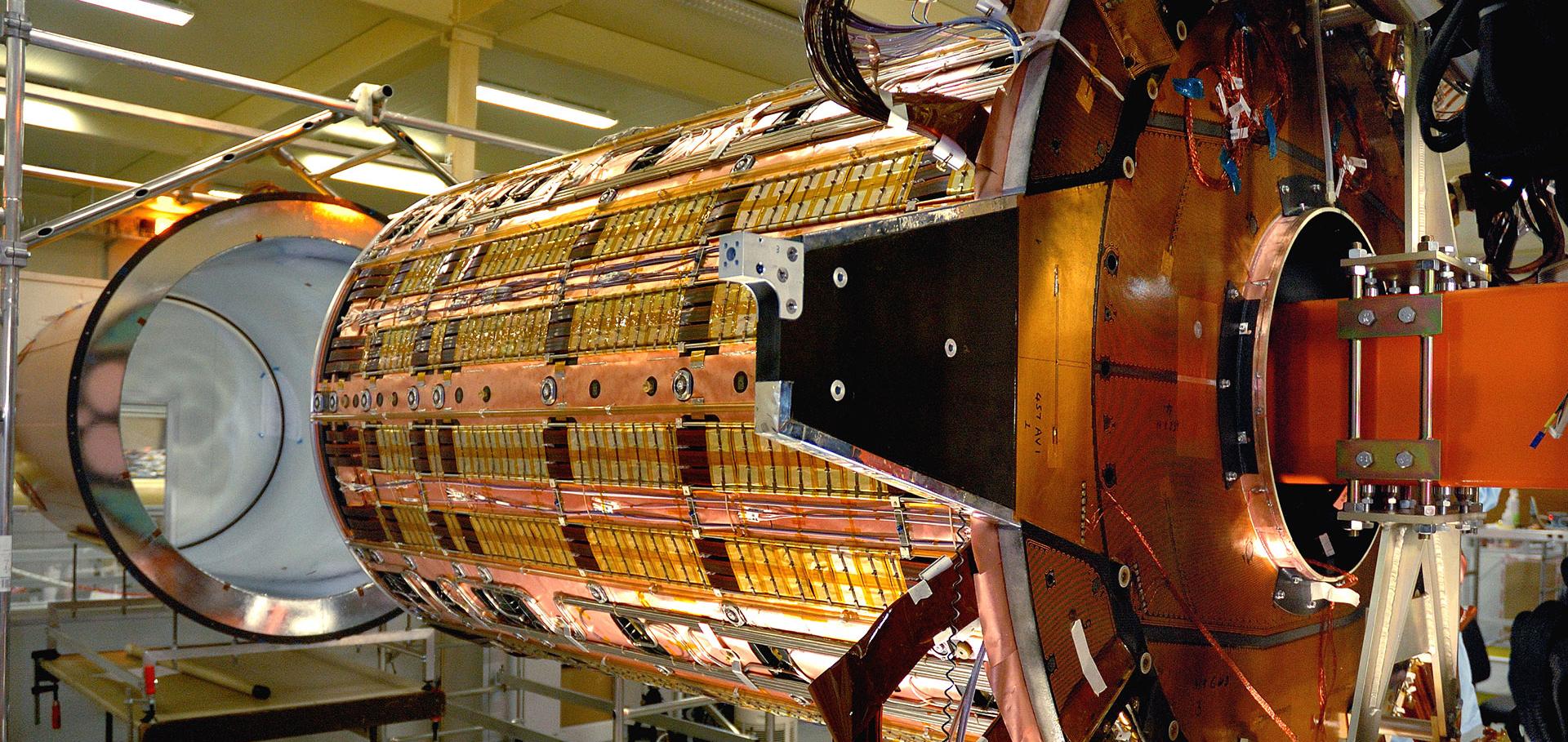
Insertion of STC into TRT at the Department of Physics, Oxford
Credit: CERN

Georg Viehhauser

University Research Lecturer

Sub department

  • Particle Physics

Research groups

  • ePIC
Georg.Viehhauser@physics.ox.ac.uk
Telephone: 01865 (2)73410
Denys Wilkinson Building, room 602
  • About
  • Publications

Hadronic structure in the decay τ-→ντπ-π 0π0 and the sign of the tau neutrino helicity

Physical Review D Particles Fields Gravitation and Cosmology 61:1 (2000) 1-22

Authors:

DM Asner, A Eppich, J Gronberg, TS Hill, DJ Lange, RJ Morrison, HN Nelson, TK Nelson, D Roberts, BH Behrens, WT Ford, A Gritsan, H Krieg, J Roy, JG Smith, JP Alexander, R Baker, C Bebek, BE Berger, K Berkelman, V Boisvert, DG Cassel, DS Crowcroft, M Dickson, S Von Dombrowski, PS Drell, KM Ecklund, R Ehrlich, AD Foland, P Gaidarev, RS Galik, L Gibbons, B Gittelman, SW Gray, DL Hartill, BK Heltsley, PI Hopman, DL Kreinick, T Lee, Y Liu, TO Meyer, NB Mistry, CR Ng, E Nordberg, M Ogg, JR Patterson, D Peterson, D Riley, A Soffer, JG Thayer, PG Thies, B Valant-Spaight, A Warburton, C Ward, M Athanas, P Avery, CD Jones, M Lohner, C Prescot, AI Rubiera, J Yelton, J Zheng, G Brandenburg, RA Briere, A Ershov, YS Gao, DYJ Kim, R Wilson, TE Browder, Y Li, JL Rodriguez, H Yamamoto, T Bergfeld, BI Eisenstein, J Ernst, GE Gladding, GD Gollin, RM Hans, E Johnson, I Karliner, MA Marsh, M Palmer, C Plager, C Sedlack, M Selen, JI Thaler, J Williams, KW Edwards, A Bellerive, R Janicek, PM Patel, AJ Sadoff, R Ammar, P Baringer, A Bean, D Besson, D Coppage, R Davis, S Kotov, I Kravchenko

Abstract:

Based on a sample corresponding to 4.3×10⁶ produced τ-pair events, we have studied hadronic dynamics in the decay τ-→ντπ-π 0π0 in data recorded by the CLEO II detector operating at the CESR e+e- collider. The decay is dominated by the process τ-→ντa1-(1260), with the a1- meson decaying to three pions predominantly via the lowest dimensional (mainly S-wave) ρ-π0 Born amplitude. From model-dependent fits to the Dalitz plot and angular observables in bins of 3 π mass, we find significant additional contributions from amplitudes for a1 decay to σπ, f0(1370)π, and f2(1270)π, as well as higher dimensional a1→ρπ and ρ′ π amplitudes. Notably, the squared σπ amplitude accounts for approximately 15% of the total τ- →ντπ-π0π0 rate in the models considered. The data are well described using couplings to these amplitudes that are independent of the 3π mass. These amplitudes also provide a good description for the τ- →ντπ-π0π0 Dalitz plot distributions. We have searched for additional contributions from τ-→ντπ′ -(1300). We place 90% confidence level upper limits on the branching fraction for this channel of between 1.0×10⁻⁴ and 1.9×10⁻⁴, depending on the π′ decay mode considered. The π-π0π0 mass spectrum is parametrized by a Breit-Wigner form with a mass-dependent width which is specified according to the results of the Dalitz plot fits plus an unknown coupling to an a1→K*K amplitude. From a χ2 fit using this parametrization, we extract the pole mass and width of the a1, as well as the magnitude of the K*K coupling. We have also investigated the impact of a possible contribution from the a1′(1700) meson on this spectrum. Finally, exploiting the parity-violating angular asymmetry in a1→3π decay, we determine the signed value of the τ neutrino helicity to be hντ=-1.02±0.13 (stat)±0.03 (syst+model), confirming the left-handedness of the τ neutrino. ©1999 The American Physical Society.
More details from the publisher

Limit on the tau neutrino mass from τ→π-π+π-π 0ντ

Physical Review D 61:5 (2000) DUMMY5

Authors:

M Athanas, P Avery, CD Jones, M Lohner, C Prescott, AI Rubiera, J Yelton, J Zheng, G Brandenburg, RA Briere, A Ershov, YS Gao, DYJ Kim, R Wilson, TE Browder, Y Li, JL Rodriguez, H Yamamoto, T Bergfeld, BI Eisenstein, J Ernst, GE Gladding, GD Gollin, RM Hans, E Johnson, I Karliner, MA Marsh, M Palmer, C Plager, C Sedlack, M Selen, JJ Thaler, J Williams, KW Edwards, R Janicek, PM Patel, AJ Sadoff, R Ammar, P Baringer, A Bean, D Besson, D Coppage, R Davis, S Kotov, I Kravchenko, N Kwak, X Zhao, L Zhou, S Anderson, VV Frolov, Y Kubota, SJ Lee, R Mahapatra, JJ O'Neill, R Poling, T Riehle, A Smith, MS Alam, SB Athar, AH Mahmood, S Timm, F Wappler, A Anastassov, JE Duboscq, KK Gan, C Gwon, T Hart, K Honscheid, H Kagan, R Kass, J Lorenc, H Schwarthoff, E von Toerne, MM Zoeller, SJ Richichi, H Severini, P Skubic, A Undrus, M Bishai, S Chen, J Fast, JW Hinson, J Lee, N Menon, DH Miller, EI Shibata, IPJ Shipsey, S Glenn, Y Kwon, AL Lyon, EH Thorndike, CP Jessop, K Lingel, H Marsiske, ML Perl, V Savinov, D Ugolini, X Zhou, TE Coan, V Fadeyev

Abstract:

From a data sample of 29058 τ+→π±π+π -π0ντdecays observed in the CLEO detector we derive a 95% confidence upper limit on the tau neutrino mass of 28 MeV. ©2000 The American Physical Society.
More details from the publisher

Measurement of B→plv decay and Vub

Physical Review D 61:5 (2000) DUMMY4

Authors:

BH Behrens, WT Ford, A Gritsan, H Krieg, J Roy, JG Smith, JP Alexander, R Baker, C Bebek, BE Berger, K Berkelman, V Boisvert, DG Cassel, DS Crowcroft, M Dickson, S von Dombrowski, PS Drell, KM Ecklund, R Ehrlich, AD Foland, P Gaidarev, L Gibbons, B Gittelman, SW Gray, DL Hartill, BK Heltsley, PI Hopman, DL Kreinick, T Lee, Y Liu, TO Meyer, NB Mistry, CR Ng, E Nordberg, M Ogg, JR Patterson, D Peterson, D Riley, JG Thayer, PG Thies, B Valant-Spaight, A Warburton, C Ward, M Athanas, P Avery, CD Jones, M Lohner, C Prescott, AI Rubiera, J Yelton, J Zheng, G Brandenburg, RA Briere, A Ershov, YS Gao, DYJ Kim, R Wilson, TE Browder, Y Li, JL Rodriguez, H Yamamoto, T Bergfeld, BI Eisenstein, J Ernst, GE Gladding, GD Gollin, RM Hans, E Johnson, I Karliner, MA Marsh, M Palmer, C Plager, C Sedlack, M Selen, JJ Thaler, J Williams, KW Edwards, A Bellerive, R Janicek, PM Patel, AJ Sadoff, R Ammar, P Baringer, A Bean, D Besson, D Coppage, R Davis, S Kotov, I Kravchenko, N Kwak, X Zhao, L Zhou, S Anderson, VV Frolov, Y Kubota, SJ Lee, R Mahapatra, JJ O'Neill, R Poling, T Riehle
More details from the publisher

Observation of B → K±π0 and B → K0π0, and evidence for B → π+π−

Physical Review Letters 85:3 (2000) 515-519

Authors:

D Cronin-Hennessy, Y Kwon, AL Lyon, EH Thorndike, CP Jessop, H Marsiske, ML Perl, V Savinov, D Ugolini, X Zhou, TE Coan, V Fadeyev, Y Maravin, I Narsky, R Stroynowski, J Ye, T Wlodek, M Artuso, R Ayad, C Boulahouache, K Bukin, E Dambasuren, S Karamnov, S Kopp, G Majumder, GC Moneti, R Mountain, S Schuh, T Skwarnicki, S Stone, G Viehhauser, JC Wang, A Wolf, J Wu, SE Csorna, I Danko, KW McLean, SZ Márka, Z Xu, R Godang, K Kinoshita, IC Lai, S Schrenk, G Bonvicini, D Cinabro, LP Perera, GJ Zhou, G Eigen, E Lipeles, M Schmidtler, A Shapiro, WM Sun, AJ Weinstein, F Würthwein, DE Jaffe, G Masek, HP Paar, EM Potter, S Prell, V Sharma, DM Asner, A Eppich, J Gronberg, TS Hill, DJ Lange, RJ Morrison, HN Nelson, RA Briere, BH Behrens, WT Ford, A Gritsan, J Roy, JG Smith, JP Alexander, R Baker, C Bebek, BE Berger, K Berkelman, F Blanc, V Boisvert, DG Cassel, M Dickson, PS Drell, KM Ecklund, R Ehrlich, AD Foland, P Gaidarev, L Gibbons, B Gittelman, SW Gray, DL Hartill, BK Heltsley, PI Hopman, CD Jones, DL Kreinick, M Lohner, A Magerkurth, TO Meyer, NB Mistry, CR Ng

Abstract:

We have studied charmless hadronic decays of B mesons into two-body final states with kaons and pions and observe three new processes with the following branching fractions: B(B → π+π−) = (4.3+1.6−1.4±0.5)×10−6, B(B→K0π0)=(14.6+5.9+2.4−5.1−3.3) × 10−6, and B(B → K±π0) = (11.6+3.0+1.4−2.7−1.3) × 10−6. We also update our previous measurements for the decays B → K±π∓ and B± → K0π±. © 2000 American Physical Society.
More details from the publisher

Search for rare and forbidden η′ decays

Physical Review Letters 84:1 (2000) 26-30

Authors:

RA Briere, BH Behrens, WT Ford, A Gritsan, H Krieg, J Roy, JG Smith, JP Alexander, R Baker, C Bebek, BE Berger, K Berkelman, F Blanc, V Boisvert, DG Cassel, M Dickson, S von Dombrowski, PS Drell, KM Ecklund, R Ehrlich, AD Foland, P Gaidarev, RS Galik, L Gibbons, B Gittelman, SW Gray, DL Hartill, BK Heltsley, PI Hopman, CD Jones, DL Kreinick, T Lee, Y Liu, TO Meyer, NB Mistry, CR Ng, E Nordberg, JR Patterson, D Peterson, D Riley, JG Thayer, PG Thies, B Valant-Spaight, A Warburton, P Avery, M Lohner, C Prescott, AI Rubiera, J Yelton, J Zheng, G Brandenburg, A Ershov, YS Gao, DYJ Kim, R Wilson, TE Browder, Y Li, JL Rodriguez, H Yamamoto, T Bergfeld, BI Eisenstein, J Ernst, GE Gladding, GD Gollin, RM Hans, E Johnson, I Karliner, MA Marsh, M Palmer, C Plager, C Sedlack, M Selen, JJ Thaler, J Williams, KW Edwards, R Janicek, PM Patel, AJ Sadoff, R Ammar, P Baringer, A Bean, D Besson, D Coppage, R Davis, S Kotov, I Kravchenko, N Kwak, X Zhao, S Anderson, VV Frolov, Y Kubota, SJ Lee, R Mahapatra, JJ O’neill, R Poling, T Riehle, A Smith, S Ahmed, MS Alam, SB Athar

Abstract:

We have searched for rare and forbidden decays of the η′ meson in hadronic events at the CLEO II detector. The search is conducted on 4.80 fb−1 of e+e− collisions at 10.6 GeV center-of-mass energy at the Cornell Electron Storage Ring. We find no signals and set 90% confidence level upper limits of their branching fractions: B(η′→e+e−η)<2.4×10⁻³, B(η′→e+e−π0)<1.4×10⁻³, B(η′→e+e−γ)<0.9×10⁻³, and B(η′→eμ)<4.7×10⁻⁴. We also fit the matrix element of the η′→π+π−η Dalitz plot with the parametrization |M|2=A|1+αy|2, where y is a linear function of the kinetic energy of the ηand find Re (α)=−0.021±0.025. © 2000 The American Physical Society.
More details from the publisher
More details
More details

Pagination

  • First page First
  • Previous page Prev
  • …
  • Page 290
  • Page 291
  • Page 292
  • Page 293
  • Current page 294
  • Page 295
  • Page 296
  • Page 297
  • Page 298
  • …
  • Next page Next
  • Last page Last

Footer Menu

  • Contact us
  • Giving to the Dept of Physics
  • Work with us
  • Media

User account menu

  • Log in

Follow us

FIND US

Clarendon Laboratory,

Parks Road,

Oxford,

OX1 3PU

CONTACT US

Tel: +44(0)1865272200

University of Oxfrod logo Department Of Physics text logo
IOP Juno Champion logo Athena Swan Silver Award logo

© University of Oxford - Department of Physics

Cookies | Privacy policy | Accessibility statement

Built by: Versantus

  • Home
  • Research
  • Study
  • Engage
  • Our people
  • News & Comment
  • Events
  • Our facilities & services
  • About us
  • Giving to Physics
  • Current students
  • Staff intranet