Home
Department Of Physics text logo
  • Research
    • Our research
    • Our research groups
    • Our research in action
    • Research funding support
    • Summer internships for undergraduates
  • Study
    • Undergraduates
    • Postgraduates
  • Engage
    • For alumni
    • For business
    • For schools
    • For the public
Menu
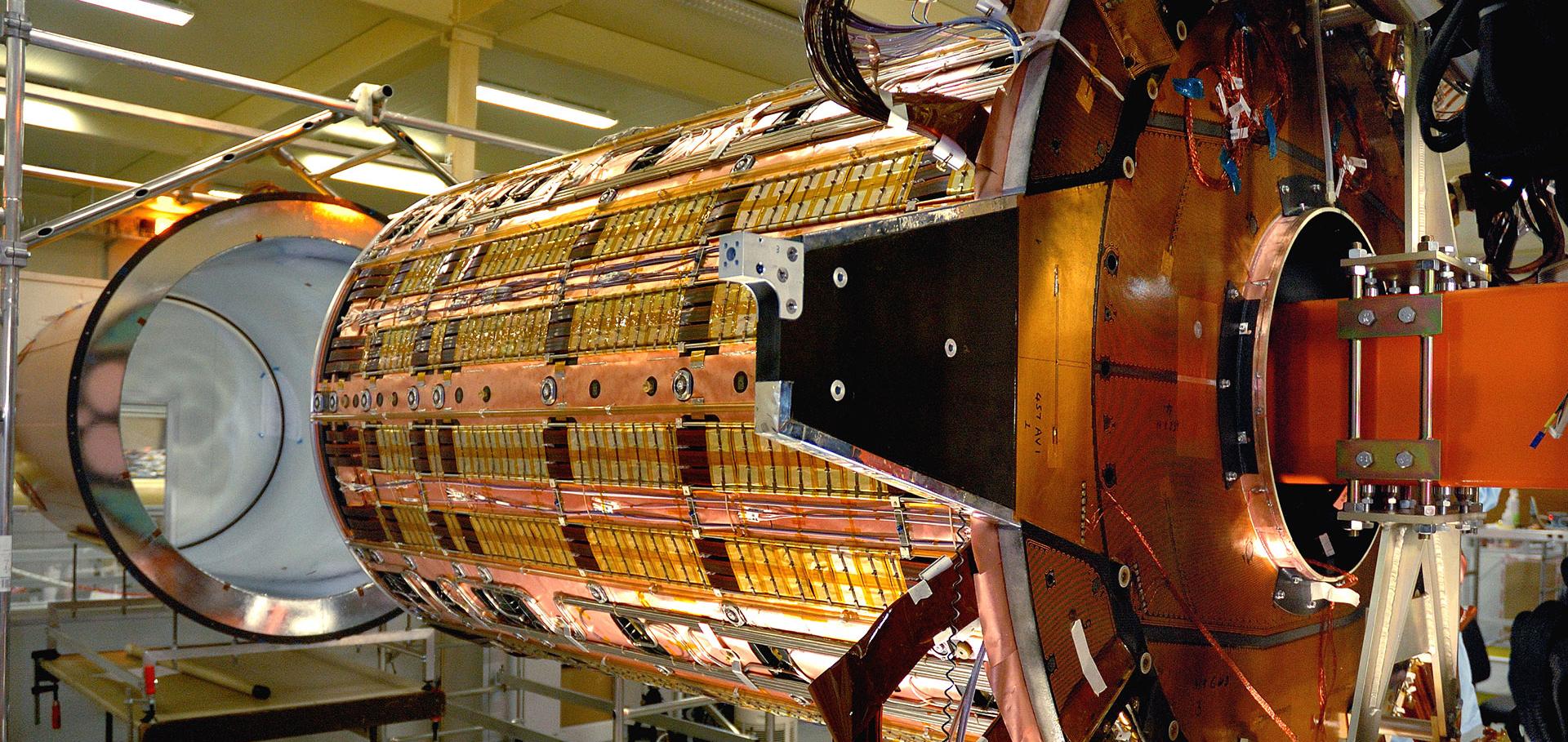
Insertion of STC into TRT at the Department of Physics, Oxford
Credit: CERN

Prof Roman Walczak

Emeritus Professor

Research theme

  • Accelerator physics
  • Lasers and high energy density science
  • Plasma physics

Sub department

  • Particle Physics

Research groups

  • Laser-plasma accelerator group
Roman.Walczak@physics.ox.ac.uk
Denys Wilkinson Building, room 659
  • About
  • Publications

Measurement of the Q2 and energy dependence of diffractive interactions at HERA: The ZEUS collaboration

European Physical Journal C 25:2 (2002) 169-187

Authors:

S Chekanov, D Krakauer, S Magill, B Musgrave, A Pellegrino, J Repond, R Yoshida, MCK Mattingly, P Antonioli, G Anzivino, G Bari, M Basile, L Bellagamba, D Boscherini, A Bruni, G Bruni, G Cara Romeo, M Chiarini, L Cifarelli, F Cindolo, A Contin, M Corradi, S De Pasquale, P Giusti, G Iacobucci, G Levi, A Margotti, T Massam, R Nania, C Nemoz, F Palmonari, A Pesci, G Sartorelli, Y Zamora Garcia, A Zichichi, G Aghuzumtsyan, D Bartsch, I Brock, J Crittenden, S Goers, H Hartmann, E Hilger, P Irrgang, HP Jakob, A Kappes, UF Katz, R Kerger, O Kind, E Paul, J Rautenberg, R Renner, H Schnurbusch, A Stifutkin, J Tandler, KC Voss, A Weber, DS Bailey, NH Brook, JE Cole, B Foster, GP Heath, HF Heath, S Robins, E Rodrigues, J Scott, RJ Tapper, M Wing, R Ayad, M Capua, L Iannotti, A Mastroberardino, M Schioppa, G Susinno, JY Kim, YK Kim, JH Lee, IT Lim, MY Pac, A Caldwell, M Helbich, X Liu, B Mellado, S Paganis, WB Schmidke, F Sciulli, J Chwastowski, A Eskreys, J Figiel, K Olkiewicz, MB Przybycień, P Stopa, L Zawiejski, B Bednarek, I Grabowska-Bold, K Jeleń, D Kisielewska, AM Kowal, M Kowal, T Kowalski, B Mindur

Abstract:

Diffractive dissociation of virtual photons, γ*p → Xp, has been studied in ep interactions with the ZEUS detector at HERA. The data cover photon virtualities 0.17 < Q2 < 0.70 GeV2 and 3 < Q2 < 80 GeV2 with 3 < MX < 38 GeV, where MX is the mass of the hadronic final state. Diffractive events were selected by two methods: the first required the detection of the scattered proton in the ZEUS leading proton spectrometer (LPS); the second was based on the distribution of MX. The integrated luminosities of the low- and high-Q2 samples used in the LPS-based analysis are ≃ 0.9 pb-1 and ≃ 3.3 pb-1, respectively. The sample used for the MX-based analysis corresponds to an integrated luminosity of ≃ 6.2 pb-1. The dependence of the diffractive cross section on W, the virtual photon-proton centre-of-mass energy, and on Q2 is studied. In the low-Q2 range, the energy dependence is compatible with Regge theory and is used to determine the intercept of the Pomeron trajectory. The W dependence of the diffractive cross section exhibits no significant change from the low-Q2 to the high-Q2 region. In the low-Q2 range, little Q2 dependence is found, a significantly different behaviour from the rapidly falling cross section measured for Q2 > 3 GeV2. The ratio of the diffractive to the virtual photon-proton total cross section is studied as a function of W and Q2. Comparisons are made with a model based on perturbative QCD.
More details from the publisher

Leading neutron production in e+p collisions at HERA

Nuclear Physics B 637 (2002) 3-56

Authors:

B Foster, G. Levman, W. Schmidke, R. Yoshida
More details from the publisher
More details

Measurement of high-Q2 charged current cross sections in e- p deep inelastic scattering at HERA

Physics Letters, Section B: Nuclear, Elementary Particle and High-Energy Physics 539:3-4 (2002) 197-217

Authors:

S Chekanov, D Krakauer, S Magill, B Musgrave, J Repond, R Yoshida, MCK Mattingly, P Antonioli, G Bari, M Basile, L Bellagamba, D Boscherini, A Bruni, G Bruni, G Cara Romeo, L Cifarelli, F Cindolo, A Contin, M Corradi, S De Pasquale, P Giusti, G Iacobucci, G Levi, A Margotti, R Nania, F Palmonari, A Pesci, G Sartorelli, A Zichichi, G Aghuzumtsyan, D Bartsch, I Brock, J Crittenden, S Goers, H Hartmann, E Hilger, P Irrgang, HP Jakob, A Kappes, UF Katz, R Kerger, O Kind, E Paul, J Rautenberg, R Renner, H Schnurbusch, A Stifutkin, J Tandler, KC Voss, A Weber, DS Bailey, NH Brook, JE Cole, B Foster, GP Heath, HF Heath, S Robins, E Rodrigues, J Scott, RJ Tapper, M Wing, M Capua, A Mastroberardino, M Schioppa, G Susinno, JY Kim, YK Kim, JH Lee, IT Lim, MY Pac, A Caldwell, M Helbich, X Liu, B Mellado, S Paganis, WB Schmidke, F Sciulli, J Chwastowski, A Eskreys, J Figiel, K Olkiewicz, MB Przybycień, P Stopa, L Zawiejski, L Adamczyk, B Bednarek, I Grabowska-Bold, K Jeleń, D Kisielewska, AM Kowal, M Kowal, T Kowalski, B Mindur, E Rulikowska-Zarebska, L Suszycki, D Szuba, J Szuba

Abstract:

Cross sections for e- p charged current deep inelastic scattering have been measured at a centre-of-mass energy of 318 GeV with an integrated luminosity of 16.4 pb-1 using the ZEUS detector at HERA. Differential cross sections dσ/dQ2, dσ/dx and dσ/dy are presented for Q2 > 200 GeV2. In addition, d2σ/(dxdQ2) was measured in the kinematic range 280 GeV2 < Q2 < 30 000 GeV2 and 0.015 < × < 0.42. The predictions of the Standard Model agree well with the measured cross sections. The mass of the W boson, determined from a fit to dσ/dQ2, is MW = 80.3±2.1(stat.) ± 1.2(syst.) ± 1.0(PDF) GeV. © 2002 Published by Elsevier Science B.V.
More details from the publisher
More details

Exclusive photoproduction of J/ψ mesons at HERA

European Physical Journal C 24:3 (2002) 345-360

Authors:

S Chekanov, D Krakauer, S Magill, B Musgrave, A Pellegrino, J Repond, R Yoshida, MCK Mattingly, P Antonioli, G Bari, M Basile, L Bellagamba, D Boscherini, A Bruni, G Bruni, G Cara Romeo, L Cifarelli, F Cindolo, A Contin, M Corradi, S De Pasquale, P Giusti, G Iacobucci, G Levi, A Margotti, T Massam, R Nania, F Palmonari, A Pesci, G Sartorelli, A Zichichi, G Aghuzumtsyan, D Bartsch, I Brock, J Crittenden, S Goers, H Hartmann, E Hilger, P Irrgang, HP Jakob, A Kappes, UF Katz, R Kerger, O Kind, E Paul, J Rautenberg, R Renner, H Schnurbusch, A Stifutkin, J Tandler, KC Voss, A Weber, H Wessoleck, DS Bailey, NH Brook, JE Cole, B Foster, GP Heath, HF Heath, S Robins, E Rodrigues, J Scott, RJ Tapper, M Wing, M Capua, A Mastroberardino, M Schioppa, G Susinno, JY Kim, YK Kim, JH Lee, IT Lim, MY Pac, A Caldwell, M Helbich, X Liu, B Mellado, S Paganis, WB Schmidke, F Sciulli, J Chwastowski, A Eskreys, J Figiel, K Olkiewicz, MB Przybycień, P Stopa, L Zawiejski, B Bednarek, I Grabowska-Bold, K Jeleń, D Kisielewska, AM Kowal, M Kowal, T Kowalski, B Mindur, E Rulikowska-Zarebska, L Suszycki, D Szuba, J Szuba, A Kotański

Abstract:

The exclusive photoproduction of J/ψ mesons, γp → J/ψp, has been studied in ep collisions with the ZEUS detector at HERA, in the kinematic range 20 < W < 290 GeV, where W is the photon-proton centre-of-mass energy. The J/ψ mesons were reconstructed in the ninon and the electron decay channels using integrated luminosities of 38 pb-1 and 55 pb-1, respectively. The helicity structure of J/ψ production shows that the hypothesis of s-channel helicity conservation is satisfied within two standard deviations. The total cross section and the differential cross-section dσ/dt, where t is the squared four-momentum transfer at the proton vertex, are presented as a function of W, for |t| < 18 Ge2. The t distribution exhibits an exponential shape with a slope parameter increasing logarithmically with W with a value b = 4.15 ± 0.05(stat.)-0.18+0.30(syst.) GeV-2 at W = 90 GeV. The effective parameters of the Pomeron trajectory are αℙ(0) = 1.200 ± 0.009(stat.) -0.010+0.004(Syst.) and α′ℙ = 0.115 ± 0.018(stat.)-0.015+0.008(syst.) GeV-2.
More details from the publisher

Search for lepton-flavor violation in e+p collisions at DESY HERA

Physical Review D - Particles, Fields, Gravitation and Cosmology 65:9 (2002) 920041-9200416

Authors:

S Chekanov, M Derrick, D Krakauer, S Magill, B Musgrave, A Pellegrino, J Repond, R Yoshida, MCK Mattingly, P Antonioli, G Bari, M Basile, L Bellagamba, D Boscherini, A Bruni, G Bruni, G Cara Romeo, L Cifarelli, F Cindolo, A Contin, M Corradi, S de Pasquale, P Giusti, G Iacobucci, G Levi, A Margotti, T Massam, R Nania, F Palmonari, A Pesci, G Sartorelli, A Zichichi, G Aghuzumtsyan, D Bartsch, I Brock, J Crittenden, S Goers, H Hartmann, E Hilger, P Irrgang, HP Jakob, A Kappes, UF Katz, R Kerger, O Kind, E Paul, J Rautenberg, R Renner, H Schnurbusch, A Stifutkin, J Tandler, KC Voss, A Weber, H Wessoleck, DS Bailey, NH Brook, JE Cole, B Foster, GP Heath, HF Heath, S Robins, E Rodrigues, J Scott, RJ Tapper, M Wing, M Capua, A Mastroberardino, M Schioppa, G Susinno, HY Jeoung, JY Kim, JH Lee, IT Lim, KJ Ma, MY Pac, A Caldwell, M Helbich, X Liu, B Mellado, S Paganis, WB Schmidke, F Sciulli, J Chwastowski, A Eskreys, J Figiel, K Olkiewicz, MB Przybycień, P Stopa, L Zawiejski, B Bednarek, I Grabowska-Bold, K Jeleń, D Kisielewska, AM Kowal, M Kowal, T Kowalski, B Mindur, E Rulikowska-Zarebska, L Suszycki, D Szuba

Abstract:

A search has been made for lepton-flavor-violating interactions of the type e+p→lX, where l denotes a μ or τ with high transverse momentum, at a center-of-mass energy √s of 300 GeV with an integrated luminosity of 47.7 pb-1 using the ZEUS detector at HERA. No evidence was found for lepton-flavor violation and constraints were derived on leptoquarks (LQs) that could mediate such interactions. For LQ masses below √s, limits are set on λeq1βlq, where λeq1 is the coupling of the LQ to an electron and a first-generation quark q1 and βlq is the branching ration of the LQ to l and a quark. For LQ masses exceeding √s, limits are set on the four-fermion contact-interaction term λeqα λlqβ/M2LQ for leptoquarks that couple to an electron and a quark qα and also to l and a quark qβ. Some of the limits are also applicable to lepton-flavor-violating processes mediated by squarks in R-parity-violating supersymmetric models. In some cases involving heavy quarks and especially for l=τ, the ZEUS limits are the most stringent published to date.
More details from the publisher

Pagination

  • First page First
  • Previous page Prev
  • …
  • Page 60
  • Page 61
  • Page 62
  • Page 63
  • Current page 64
  • Page 65
  • Page 66
  • Page 67
  • Page 68
  • …
  • Next page Next
  • Last page Last

Footer Menu

  • Contact us
  • Giving to the Dept of Physics
  • Work with us
  • Media

User account menu

  • Log in

Follow us

FIND US

Clarendon Laboratory,

Parks Road,

Oxford,

OX1 3PU

CONTACT US

Tel: +44(0)1865272200

University of Oxfrod logo Department Of Physics text logo
IOP Juno Champion logo Athena Swan Silver Award logo

© University of Oxford - Department of Physics

Cookies | Privacy policy | Accessibility statement

Built by: Versantus

  • Home
  • Research
  • Study
  • Engage
  • Our people
  • News & Comment
  • Events
  • Our facilities & services
  • About us
  • Giving to Physics
  • Current students
  • Staff intranet