Home
Department Of Physics text logo
  • Research
    • Our research
    • Our research groups
    • Our research in action
    • Research funding support
    • Summer internships for undergraduates
  • Study
    • Undergraduates
    • Postgraduates
  • Engage
    • For young people
    • For teachers
    • For the public
    • For alumni
    • For business
  • Support
Menu
CMP
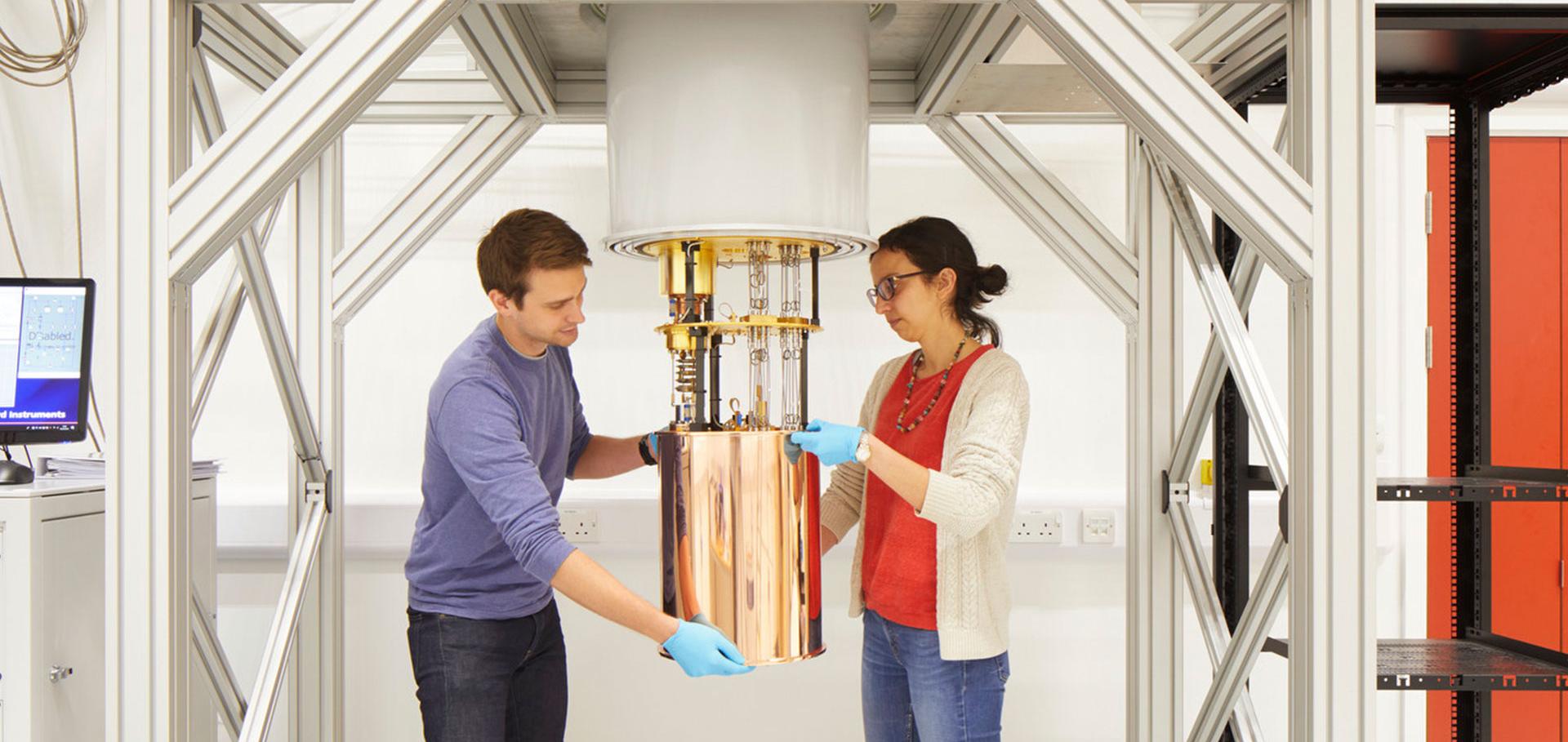
Credit: Jack Hobhouse

Roger Ward

Retired

Sub department

  • Condensed Matter Physics
Roger.Ward@physics.ox.ac.uk
Clarendon Laboratory, room 164
  • About
  • Publications

Neutron reflectometry studies of exchange springs in DyFe 2/YFe2 superlattices

Journal of Magnetism and Magnetic Materials 272-276 (2004) 1258-1259

Authors:

JD O'Neill, S Langridge, RM Dalgliesh, AA Zhukov, JML Beaujour, GJ Bowden, PAJ De Groot, BD Rainford, RCC Ward, MR Wells

Abstract:

Spin-polarised neutron reflectometry has been used to investigate a magnetic exchange spring, formed in a (75Å DyFe2/150Å YFe2) × 18 multilayer thin film. The existence of an exchange spring is found to enhance the level of neutron spin flipping during reflection, a strong indicator of the formation of transverse magnetic moments within the YFe2 layers. © 2003 Published by Elsevier B.V.
More details from the publisher
More details

Magnetism of U/Fe multilayers

Journal of Alloys and Compounds 369:1-2 (2004) 14-17

Authors:

MF Thomas, AM Beesley, L Bouchenoire, SD Brown, P Thompson, ADF Herring, GH Lander, S Langridge, WG Stirling, RCC Ward, SW Zochowski

Abstract:

Magnetic multilayers are known to have behaviour shaped by the intrinsic magnetic properties of their constituents and of their interactions. Multilayers composed of Uranium (5f electrons) and transition metal (3d electrons) provide the unique combination of a potentially large orbital moment with strong electronic hybridisation effects between the extended 5f states and the strongly magnetic 3d states. In this study U/Fe multilayers with layer thicknesses 20ÅIV edge using different geometries of circular polarisation helicity and applied magnetic field. Some evidence of U moments has been observed. © 2003 Elsevier B.V. All rights reserved.
More details from the publisher

Vector magnetometer studies of the easy magnetisation direction in epitaxially grown DyFe2 film

Journal of Magnetism and Magnetic Materials 270:3 (2004) 312-320

Authors:

AA Zhukov, GJ Bowden, JML Beaujour, BD Rainford, PAJ De Groot, RCC Ward, MR Wells, H Küpfer

Abstract:

A vector vibrating sample magnetometer has been used to determine the direction of easy magnetisation in a thin film of DyFe2. The 4000 Å thick film, with a [110] growth direction, was prepared using molecular beam epitaxy. The results show that the direction of easy magnetisation is temperature dependent. At 4K this direction corresponds to the [001] type axes. But at 290K, the easy axis is close to a [1̄10] direction, but pointing out of the plane of the film at angle of ∼(14±3)°. On the basis of the vector magnetometer results at 290K we find two easy magnetisation axes close to [3̄50] or [5̄30] (and opposite directions). Finally, it is shown that DyFe2 films are unique in that the remanent magnetisation can be manipulated to point either in or out of the plane of the film. © 2003 Elsevier B.V. All rights reserved.
More details from the publisher
More details

Epitaxial strain and interface effects on the magnetoelastic behaviour of Dy/Ho and Dy/Lu superlattices

Journal of Magnetism and Magnetic Materials 272-276:III (2004) 2088-2089

Authors:

L Benito, K Roky, M Ciria, JI Arnaudas, C De La Fuente, A Del Moral, RCC Ward, MR Wells, A Matheny

Abstract:

The basal plane magnetoelastic stress, Bγ,2, of Dy 16/Ho22, Dy14/Lu30 and Dy 21/Lu11 (0001) superlattices is investigated. For Dy 16/Ho22 we obtain Bγ,2 (12 T, 0 K) = 0.4GPa, while for Dy21/Lu11 and Dy21/Lu 11 it amounts 0.33 and 0.9 GPa, respectively. In the first case, the value obtained is explained in terms of the known values of B γ,2 for bulk Dy and Ho, including small interface and strain contributions, whereas in the Dy/Lu samples, Bγ,2 have large non-bulk contributions. The differences in epitaxial compression and in electronic structure for both kind of superlattices can explain these results. © 2004 Elsevier B.V. All rights reserved.
More details from the publisher

Field-dependent easy magnetic axes in epitaxially grown (1 1 0) DyFe 2 film

Journal of Magnetism and Magnetic Materials 272-276:SUPPL. 1 (2004) e1591-e1592

Authors:

GJ Bowden, AA Zhukov, JML Beaujour, JD O'Neill, BD Rainford, PAJ De Groot, RCC Ward, MR Wells, H Küpfer

Abstract:

At room temperature, 57Fe Mössbauer studies suggest that the easy axis in MBE grown (1 1 0) DyFe2 films is [3̄ 5 1]. Whereas vector vibrating sample magnetometer investigations indicate [3̄ 5 0]. But both agree that the easy axis points at some 14° out of the plane of the film. In this paper, we give theoretical expressions for (i) the energy stability of the [ū v 0] axis, (ii) the field required to pull the magnetization back into the [1̄ 1 0] plane of the film, and (iii) energies of the [ū v 0] and [0 0 1] axes. These expressions are used to derive values for the fourth order crystal field and the magneto-elastic strain term. © 2004 Elsevier B.V. All rights reserved.
More details from the publisher
More details

Pagination

  • First page First
  • Previous page Prev
  • …
  • Page 10
  • Page 11
  • Page 12
  • Page 13
  • Current page 14
  • Page 15
  • Page 16
  • Page 17
  • Page 18
  • …
  • Next page Next
  • Last page Last

Footer Menu

  • Contact us
  • Giving to the Dept of Physics
  • Work with us
  • Media

User account menu

  • Log in

Follow us

FIND US

Clarendon Laboratory,

Parks Road,

Oxford,

OX1 3PU

CONTACT US

Tel: +44(0)1865272200

University of Oxfrod logo Department Of Physics text logo
IOP Juno Champion logo Athena Swan Silver Award logo

© University of Oxford - Department of Physics

Cookies | Privacy policy | Accessibility statement

Built by: Versantus

  • Home
  • Research
  • Study
  • Engage
  • Our people
  • News & Comment
  • Events
  • Our facilities & services
  • About us
  • Giving to Physics
  • Current students
  • Staff intranet