Home
Department Of Physics text logo
  • Research
    • Our research
    • Our research groups
    • Our research in action
    • Research funding support
    • Summer internships for undergraduates
  • Study
    • Undergraduates
    • Postgraduates
  • Engage
    • For alumni
    • For business
    • For schools
    • For the public
  • Support
Menu
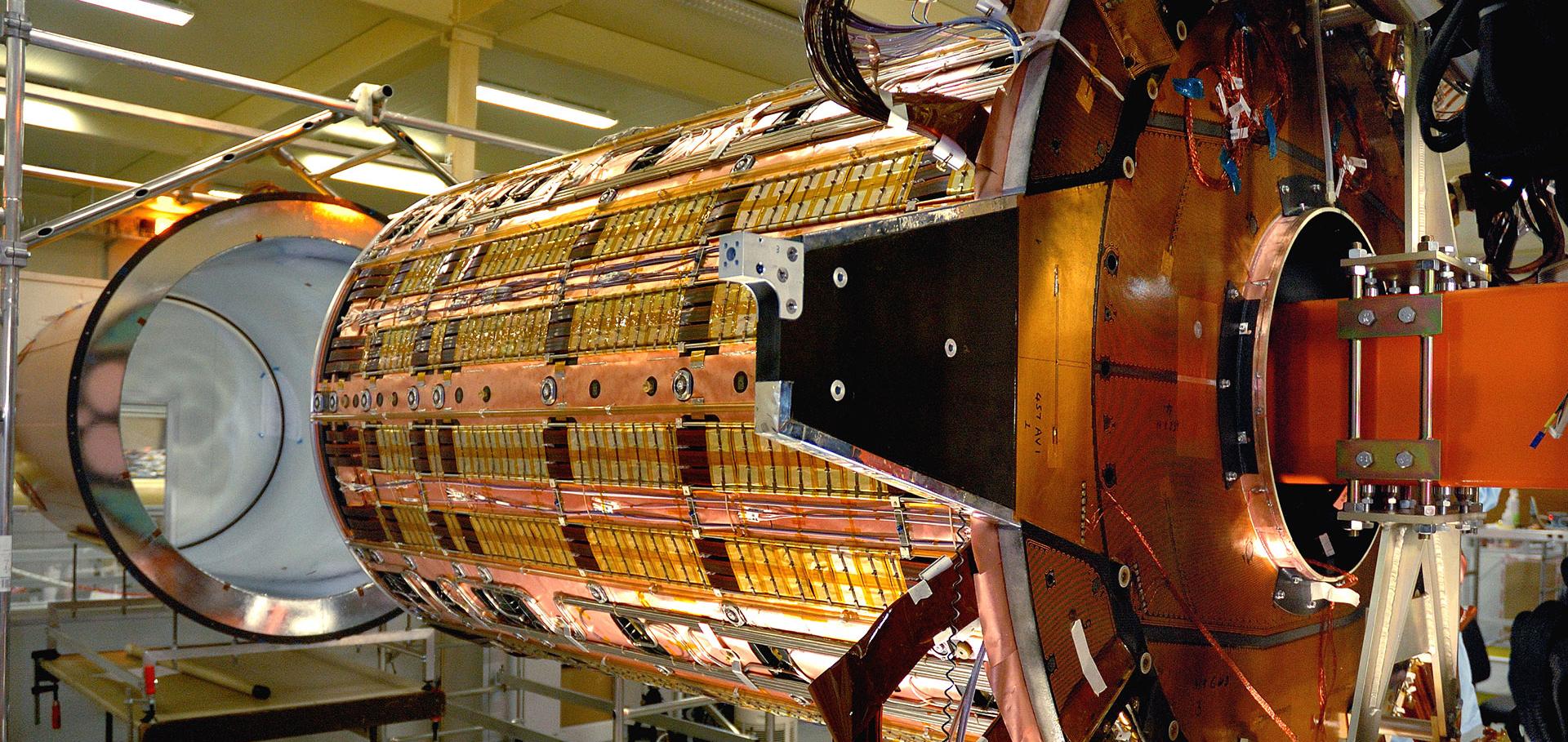
Insertion of STC into TRT at the Department of Physics, Oxford
Credit: CERN

David Wark

Professor of Particle Physics

Sub department

  • Particle Physics

Research groups

  • Accelerator Neutrinos
dave.wark@physics.ox.ac.uk
Telephone: 01865 (2)73400
Denys Wilkinson Building, room 626
  • About
  • Publications

Measuring the electric dipole moment of the neutron: The cryoEDM experiment

Proceedings of Science EPS-HEP 2009 376

Authors:

CA Baker, SN Balashov, V Francis, K Green, MGD van der Grinten, PS Iaydjiev, SN Ivanov, A Khazov, MAH Tucker, DL Wark, A Davidson, JR Grozier, M Hardiman, PG Harris, JR Karamath, K Katsika, JM Pendlebury, SJM Peeters, DB Shiers, PN Smith, CM Townsley, I Wardell, C Clarke, S Henry, H Kraus, M McCann, P Geltenbort, H Yoshiki

Abstract:

The cryoEDM experiment at the Institut Laue-Langevin in Grenoble will measure the electric dipole moment (EDM) of the neutron with unparalleled precision. A neutron EDM arises due to CP violation. The cryoEDM experiment is sensitive to levels of CP violation predicted by many “beyond the standard model” theories and the result will therefore constrain or support these theories. The current limit to the neutron EDM stands at d_n<2.9x 10^-26 e cm as measured with a room temperature experiment. By operating in superfluid helium below 0.9 K and collecting high densities of ultra cold neutrons, the cryoEDM experiment will improve on the existing limit or measure an EDM. High precision magnetometry is essential to reduce the systematic errors in the cryoEDM experiment originating from changes in the magnetic environment. We present the cryoEDM apparatus and technologies.

Placeholder for new paper

Search for CP violation in Neutrino and Antineutrino Oscillations by the T2K experiment with $2.2\times10^{21}$ protons on target

Authors:

K Abe, R Akutsu, A Ali, J Amey, C Andreopoulos, L Anthony, M Antonova, S Aoki, A Ariga, Y Ashida, Y Azuma, S Ban, M Barbi, GJ Barker, GILES Barr, C Barry, M Batkiewicz, F Bench, V Berardi, S Berkman, RM Berner, L Berns, S Bhadra, S Bienstock, A Blondel, S Bolognesi, B Bourguille, SB Boyd, D Brailsford, A Bravar, C Bronner, MB Avanzini, J Calcutt, T Campbell, S Cao, SL Cartwright, A Cervera, A Chappell, C Checchia, D Cherdack, N Chikuma, G Christodoulou, J Coleman, G Collazuol, D Coplowe, A Cudd, A Dabrowska, GD Rosa, T Dealtry

Abstract:

The T2K experiment measures muon neutrino disappearance and electron neutrino appearance in accelerator-produced neutrino and antineutrino beams. With an exposure of $14.7(7.6)\times 10^{20}$ protons on target in neutrino (antineutrino) mode, 89 $\nu_e$ candidates and 7 anti-$\nu_e$ candidates were observed while 67.5 and 9.0 are expected for $\delta_{CP}=0$ and normal mass ordering. The obtained $2\sigma$ confidence interval for the $CP$ violating phase, $\delta_{CP}$, does not include the $CP$-conserving cases ($\delta_{CP}=0,\pi$). The best-fit values of other parameters are $\sin^2\theta_{23} = 0.526^{+0.032}_{-0.036}$ and $\Delta m^2_{32}=2.463\pm0.065\times10^{-3} \mathrm{eV}^2/c^4$.
More details from the publisher
More details
More details
Details from ArXiV

Pagination

  • First page First
  • Previous page Prev
  • …
  • Page 43
  • Page 44
  • Page 45
  • Page 46
  • Page 47
  • Page 48
  • Page 49
  • Page 50
  • Current page 51

Footer Menu

  • Contact us
  • Giving to the Dept of Physics
  • Work with us
  • Media

User account menu

  • Log in

Follow us

FIND US

Clarendon Laboratory,

Parks Road,

Oxford,

OX1 3PU

CONTACT US

Tel: +44(0)1865272200

University of Oxfrod logo Department Of Physics text logo
IOP Juno Champion logo Athena Swan Silver Award logo

© University of Oxford - Department of Physics

Cookies | Privacy policy | Accessibility statement

Built by: Versantus

  • Home
  • Research
  • Study
  • Engage
  • Our people
  • News & Comment
  • Events
  • Our facilities & services
  • About us
  • Giving to Physics
  • Current students
  • Staff intranet